When calculators arrived, some parents worried that children would stop learning arithmetic. Then, when the internet arrived, the worry became that no one would remember anything. Now it is AI: will my child still learn to think?
The world is turning AI-first, and it is reasonable to ask whether our children are ready. But, parents have been here before.
What helped the last time
The calculator did not end arithmetic. The approach was to teach the maths first and the tool second. A child who understood numbers could use a calculator and tell when an answer looked wrong.
The internet taught a similar lesson. A result at the top of a search page was not necessarily correct, so children had to ask who had written the answers they got and whether it could be trusted.
Banning the tool did not help, and neither did trusting it blindly. What helped was teaching children what the tool does and when not to trust it.
What is different with AI
AI follows the same pattern, with two differences. First, AI produces fluent answers that can be wrong. An AI tool writes confident sentences, and it can sound as sure when wrong as when right. Second, AI comes built into everyday tools. Children meet AI in voice assistants, video feeds and homework chatbots, often without realising it.
{{/usCountry}}AI follows the same pattern, with two differences. First, AI produces fluent answers that can be wrong. An AI tool writes confident sentences, and it can sound as sure when wrong as when right. Second, AI comes built into everyday tools. Children meet AI in voice assistants, video feeds and homework chatbots, often without realising it.
{{/usCountry}}AI learns patterns from data. If that data is incomplete or one-sided, its answers can be too. A child who knows this is better placed to ask: can I trust this? That understanding is AI literacy.
Schools are finally catching up
From the 2026-27 session, the Central Board of Secondary Education (CBSE) has introduced a Computational Thinking and AI curriculum for Classes 3-8, with computational thinking woven into subjects from Class 3 and AI concepts arriving from Class 6.
Rollouts take time. Children are meeting AI on phones and games, where nobody is explaining what is happening. Parents do not need to be experts to help. The questions that worked for calculators work here too: “What is this tool doing, how would you check it, and when would you not use it?”
A structured way to learn AI
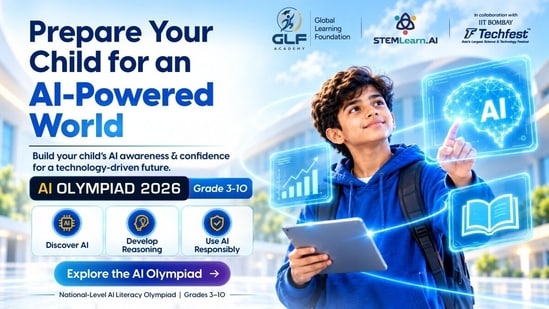
The Global Learning Foundation AI Olympiad 2026 is a structured way to learn how AI works. Organised by Global Learning Foundation in association with STEMLearn.AI and Techfest, IIT Bombay, it is a national exam on AI literacy for students in Grades 3-10.
Most Olympiads test what a child has already studied. This one is built around a subject most children have not met yet. The 60-minute exam, in English, is pitched at three levels. Grades 3 to 5 start with smart devices, data patterns, image and sound recognition and safe use of technology. Grades 6 to 8 move on to algorithms, data bias, neural networks and ethics. Grades 9 and 10 cover generative AI, Python programming, the machine-learning lifecycle and AI project building.
No coding background is needed. IIIT Allahabad has validated the syllabus and question banks, and COEP Technological University, Pune, has reviewed the curriculum and calibrated difficulty by grade. Every registered student gets grade-wise study material, access to the STEMLearn.AI platform and an official sample paper. A personalised report shows topic-wise strengths and gaps, along with a digitally verified participation certificate and a national ranking.
Exam dates and how to register
The registration fee is ₹299 for Grades 3-6 and ₹399 for Grades 7-10.
Students who register on their own take the exam online on 29 November 2026. Platform login follows within 24-48 hours of registration, and study material reaches the student’s home in five to seven business days. Schools can hold the exam on campus on 17, 20, 24 or 27 November 2026, with no institutional fee and a school-wise performance report.
AI tools will keep evolving, but a child who learns to understand them will always be ready to think for themselves, and shape what comes next. If you want to equip your child for the future, you register at https://glfacademy.org/olympiads/ai-olympiad-2026/.
Schools can get started at https://glfacademy.org/schools.
Note to the Reader: This article has been produced on behalf of the brand by HT Brand Studio and does not have journalistic/editorial involvement of Hindustan Times.