
 E-Paper



Country to lead in overweight young people by 2050: Report
By 2050, India will have 450 million adults who are overweight or obese, accounting for 11.8% of the global population that is overweight or obese

 Prefer HTon Google


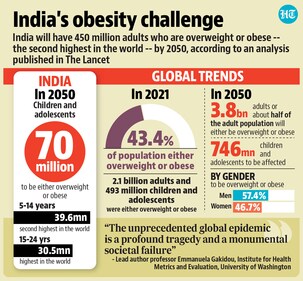
India will have the highest number of overweight or obese young people in the 15-24 years age group by 2050, and the second highest in the 5-14 years one, an analysis published in The Lancet on Monday said, highlighting the crisis the country faces. At 70 million, the number accounts for around 9.4% of the 746 million people in the two age groups who will be either overweight or obese, according to a new analysis from the Global Burden of Disease Study BMI Collaborators.
It isn’t just young people; by 2050, India will have 450 million adults who are overweight or obese, accounting for 11.8% of the global population that is overweight or obese.
In the 15-24 years age group, termed older adolescents by the authors, India will have the most people by 2050, at 39.6 million , up from 7.3 million in 1990. China will be a close second with 34.3 million.
In the 5-14 years age group, termed children and young adolescents, India will rank second with 30.5 million overweight or obese people, up from 9.1 million in 1990, after China , at 34.3 million.
Prime Minister Narendra Modi has launched an anti-obesity drive across the country to generate awareness about the need to stay fit and follow a healthy lifestyle. During his address at the opening ceremony of 38th National Games in Dehradun last month, Modi spoke about fighting obesity as it is increasing rapidly in the country.
He said that obesity was a matter of concern because it increases the risk of non-communicable diseases such as diabetes, and heart diseases. He discussed the importance of exercise and diet, with focus on balanced intake, and the need for reducing unhealthy fat and oil in food.
Globally, at least a half of adults (3.8 billion) and a third of children and adolescents (746 million) have been predicted to have overweight or obesity in next 25 years highlighting the need for urgent policy reform and action to curb the soaring numbers that pose an unparalleled threat of premature disease and death at local, national, and global levels.
According to the authors of the Lancet analysis, massive global failures in response to the growing obesity crisis over the past three decades contributed to a startling increase in the number of adults (aged 25 and older) and children and adolescents (aged 5-24 years) who are overweight and obese worldwide, rising from 731 million and 198 million respectively in 1990, to 2.11 billion and 493 million in 2021.
“The unprecedented global epidemic is a profound tragedy and a monumental societal failure,” said lead author professor Emmanuela Gakidou, Institute for Health Metrics and Evaluation, University of Washington, US, in a statement.
“Governments and the public health community can use our country-specific estimates on the stage, timing, and speed of current and forecasted transitions in weight to identify priority populations experiencing the greatest burdens of obesity who require immediate intervention and treatment, and those that remain predominantly overweight and should be primarily targeted with prevention strategies,” she added
Among high-income countries, the US had the highest rates of obesity, with around 42% of the male population and 46% of the female population affected by obesity in 2021. In India, 179.6 million adults were overweight or obese in 2021. By 2050, this number is expected to be 450 million, the second highest after China’s 627 million.
Currently, 43.4% of the global adult population is overweight or obese, the analysis said, and at the current rate of change, 57.4% of men and 46.7% of women will be overweight or obese by 2050.
The study used body mass index (BMI) for adults—widely used to track current global trends. For individuals older than 18 years, overweight was defined as having a BMI of 25 kg/m² to less than 30 kg/m² and obesity was defined as a BMI of 30 kg/m² or higher. For individuals younger than 18 years definitions were based on International Obesity Task Force criteria.
To be sure, the World Health Organisation (WHO) recently overhauled the criteria to define obesity and added waist-circumference measure along with BMI count to diagnose obesity.
Importantly, the authors note that recent generations are gaining weight faster than previous ones and obesity is occurring earlier, increasing the risk of complications such as type 2 diabetes, high blood pressure, cardiovascular diseases, and multiple cancers occurring at younger ages.
The authors stress that 5-year action plans (2025-2030) are urgently required to curb the rise in obesity and help inform new goals and targets for the post-2030 Sustainable Development Goal-era.
“But if we act now, preventing a complete transition to global obesity for children and adolescents is still possible,” said co-lead author Dr Jessica Kerr, Murdoch Children’s Research Institute, Australia.
Dr Ambrish Mithal, chairman, department of endocrinology and diabetes at Max Healthcare, said obesity numbers are increasing in India now due to easy access to ultra-processed food and people leading a largely sedentary lifestyle.
“The medical fraternity always well-understood how obesity is actually a disease that almost always is the root cause of all modern Non-Communicable Diseases. People suddenly are talking about it because now there’s a lot of research being done on it. Indians especially have always been predisposed to diabetes and other metabolic diseases because of the visceral fat that’s around the organs, which is most dangerous,” he said. “The focus should be on reducing obesity and you’ll see the difference.”


Catch your daily dose of Fashion, Health, Festivals, Travel, Relationship, Recipe and all the other Latest Lifestyle News on Hindustan Times Website and APPs.


