
COP31, the United Nations’ annual climate summit, ended without a deal in Antalya on Sunday, after the European Union, the UK and several climate-vulnerable countries rejected the final text, leaving the questions of fossil fuels and climate finance unresolved.
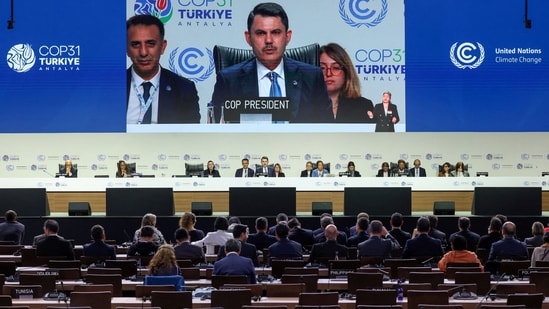
At the closing plenary on Sunday afternoon, COP31 president Murat Kurum, who is also Turkey’s environment minister, told countries the proposed Antalya pact did not have consensus. “We recognise that there is no consensus on this document. Therefore, these decisions have not been adopted,” he said.
India, speaking for the Like-Minded Developing Countries (LMDC), a negotiating bloc of developing countries, said the group had reservations about the text but remained prepared to move forward. It urged other countries to show flexibility and to uphold consensus and multilateralism.
The summit had two versions of its cover decision, the headline political document that sums up what countries agree to beyond the technical decisions. One was for all parties to the 1992 UN climate convention. The other, much longer, was for parties to the 2015 Paris Agreement and covered everything tied to Paris obligations. Both were left unadopted.
Also Read | COP31 becomes longest-ever UN climate summit, EU rejects 'greenwashing of fossil fuels'
{{/usCountry}}Also Read | COP31 becomes longest-ever UN climate summit, EU rejects 'greenwashing of fossil fuels'
{{/usCountry}}Decisions adopted separately still stand, including those on the Green Climate Fund, the main UN-linked fund for climate finance. The Paris Agreement and earlier COP decisions also remain in force, including the 2023 Dubai outcome known as the UAE Consensus. Everything that existed only in the Pact fell with it, including:
• A new two-year work programme on mountains and glaciers
• The Antalya–Addis Ababa road map on adaptation finance
• A high-level dialogue on overshooting the 1.5°C limit
• A report on how to measure the pledge to triple adaptation finance
The summit overran its scheduled Friday close by more than 44 hours, the longest in COP history, beating the record set at COP25 in Madrid in 2019. The closest precedent for a failed outcome is Copenhagen in 2009, where countries only “took note” of the Copenhagen Accord instead of adopting it.
A timeline of collapse
The fossil fuel language in the first draft was dropped on November 19 and did not come back, even after two days of overtime.
The disputed points
Money
Developing countries came to Antalya wanting a number for adaptation finance, the money that helps them cope with climate impacts already under way, such as floods and droughts. The first draft named $120 billion a year by 2035. The second draft dropped it, and it was not added back to the text thereafter.
Also Read | COP31 president says climate deal ‘not approved’; EU claims oil states ‘hijacked’ talks
“We didn't come here to beg,” Ghana's environment minister Zanetor Agyeman-Rawlings said, according to AFP.
The final draft recalled Article 9.1 of the Paris Agreement, under which developed countries “shall provide financial resources” to developing ones, but did not attach any new figures to it. It repeated last year’s call to at least triple adaptation finance by 2035 without saying from what level, and asked the UNFCCC’s Standing Committee on Finance for options on a baseline in time for next year’s summit. It cited the UN Environment Programme’s estimate that developing countries need about $305 billion a year for adaptation until 2035. The draft also restated the Paris goal of aligning global finance flows with low-emission development, but no longer cited Article 2.1(c), the provision behind it.
Fossil fuels
The words “fossil fuels” are nowhere in the final draft. Its opening line instead recalls the UAE Consensus “in its entirety”. That outcome of the 2023 Dubai summit was the first COP decision to call for transitioning away from fossil fuels in energy systems. Recalling it brought the Dubai pledge back by reference, without the presidency restating it.
The wording is important because the terms differ.
A phase-down means using less, as countries agreed for unabated coal power in Glasgow in 2021. A transition away means moving energy systems off fossil fuels with no end date, the Dubai formula. A phase-out, ending their use on a timetable, has never been agreed at a COP.
The first draft at Antalya had asked countries to speed up phasing out fossil fuels, but the demand in the final days was narrower: to restate the ‘transition away’.
Also Read | COP31 draft deal makes no mention of fossil fuels as talks go into double overtime
The countries pressing for more found that too weak. More than 130 countries backed restating the transition away but Saudi Arabia and Russia resisted stronger language on oil, gas and coal. “We will not endorse a cover decision or an Antalya Pact that does not even mention fossil fuels, which is the key driver of climate change,” Ireland’s climate and environment minister Darragh O'Brien said on behalf of the EU.
Equity
India’s main objection at the closing plenary was about equity. Speaking for the LMDC, it said the text did not adequately reflect the principle of “common but differentiated responsibilities and respective capabilities”, under which richer countries with larger historical emissions are expected to act first and pay more. It also objected to what it called the dilution of developed countries’ historical responsibility.
The draft acknowledged that historical carbon dioxide emissions account for at least four-fifths of the carbon budget for 1.5°C, the amount the world can still emit while holding warming to that limit. It did not say whose emissions those were.
“Whose emissions? – both past and continuing, have exhausted the global carbon budget?” India's representative asked.
India said the draft repeated paragraphs on responsibility from earlier decisions without connecting them to the imminent breach of 1.5°C.
New global targets
The draft’s two new quantified global goals were both on energy. One was to raise electricity’s share of final energy use to 35% by 2035. The other aimed to scale up carbon capture, utilisation and storage (CCUS) to gigatonne level by the same year, described as a collective aspiration.
The LMDC said equity was inadequately reflected, particularly in paragraphs introducing new global targets. Panama’s chief negotiator, Ana Aguilar, said the text put too much emphasis on carbon capture.
Science and process
The draft left open the timeline for the seventh assessment of the Intergovernmental Panel on Climate Change (IPCC), the UN science panel’s next full review, saying only that it “looks forward to an agreement” on one. Several countries also complained that the presidency’s handling of the drafts lacked transparency. On trade, the language weakened to a bare noting of “views” on measures with cross-border impacts.
Where the parties stood
The split did not run neatly between rich and poor countries. Climate-vulnerable developing countries objected alongside the EU, while the bloc India is part of said it was prepared to move forward.
Cooperation after this
Economists and political scientists have long studied why countries struggle to work together on problems such as climate change.
Five ideas may help explain what happened in Antalya. One objection can block a deal. Since the first COP in 1995, countries have applied the UN climate body’s rules of procedure without ever agreeing on the rule for voting. Decisions therefore need consensus, and any determined group can block one. That power has often been used to hold back ambition. In Antalya it worked the other way, with countries wanting stronger action blocking a text they judged too weak.
Everyone gains from others’ efforts. In The Logic of Collective Action (1965), the economist Mancur Olson explained why large groups struggle to provide goods that benefit all their members: each member gains from the others’ contributions while bearing its own costs. A stable climate works this way. Every country benefits from emission cuts made elsewhere, while the cost of its own cuts falls on its own economy. The Antalya draft framed its energy targets as a menu, introduced with the Latin “inter alia”, meaning “among other things”, which no single country was obliged to adopt.
Cooperation depends on agreeing who pays. The 1992 climate convention answered that question with “common but differentiated responsibilities”, the principle that countries with larger historical emissions and more money act first and pay more. India’s “whose emissions?” question in Antalya asked the draft to apply that principle to a carbon budget that is nearly used up.
Also Read | Carbon capture was a flashpoint at COP31. Why it is contested & how it differs from CO2 removal
Deals depend on trust. The political scientist Elinor Ostrom, who shared the 2009 economics Nobel for her work on how communities manage shared resources, found that cooperation lasts where people trust others to keep their side of a bargain. For developing countries, climate finance is the test of that trust. The draft also recorded “with concern” that developed countries had missed the emission cuts the IPCC said they needed by 2020, and India said developing countries had been told not to expect developed countries to engage on finance.
Smaller groups may move on their own. The economist William Nordhaus, a 2018 Nobel laureate, argued in a 2015 paper that “climate clubs” of countries, with trade penalties for those outside, could achieve more than global deals built on voluntary pledges. Countries have started grouping by ambition. More than 130 backed an explicit fossil fuel transition in Antalya, and Brazil’s presidency announced its fossil fuel roadmap outside the formal UN text at Belém last year. Whether such groups act without a consensus deal is an open question for 2027.
What remains
The unadopted text listed the gaps that now remain open:
• Emissions. Full implementation of current national climate plans would still put the world on course for about 2.6°C of warming, the draft said. It expected warming to pass 1.5°C “in the next few years”.
• Adaptation money. Needs of about $305 billion a year, with no agreed target or baseline for meeting them. “A commitment is only as strong as its definition,” said Suranjali Tandon, associate professor at the National Institute of Public Finance and Policy.
• Delivery. UN secretary-general Antonio Guterres called on major emitters to lead on emission cuts and on developed countries to deliver climate finance. He also urged all countries to speed up the transition away from fossil fuels. Harjeet Singh of the Fill the Fund campaign said “the money and the plan must now come”.
• Equity and trust. Aarti Khosla, director of Climate Trends, said that for India the outcome raised “serious concerns about equity and trust”.
• Science. A timeline for the IPCC’s next assessment, which countries want ready for the second global stocktake, the five-yearly review of progress under the Paris Agreement that concludes in 2028.
Countries next meet at the UN’s mid-year climate talks in Bonn in June 2027, ahead of COP32 in Addis Ababa, Ethiopia, in November 2027.
ABOUT THE AUTHOR
HT Explainers Desk delivers in-depth explainers and analysis on the stories shaping India and the world, from SimplyPut, Hindustan Times’ dedicated explainer section. The desk unpacks the science, policy, geopolitics and market forces behind major news events, breaking down complex developments into clear, accessible reporting for readers who want more than the headline. Explainers draw on the expertise of the journalists covering the story and insight from leading subject experts, translating specialist detail into plain language without losing precision or nuance. Coverage spans national and global news — from health and science breakthroughs to trade, technology, cybersecurity, aviation, energy and public policy — going beyond what happened to explain how it works, why it matters and what to watch next. Written for readers who want context, and not just the headlines, HT Explainers Desk brings together original reporting, data and expert analysis to make sense of the news as it develops. It is part of Hindustan Times, India's leading source for news, in-depth analysis and explanatory journalism since 1924.