As questions have been raised over the schedule for Parliament’s winter session, the Constitution of India leaves the decision on timing almost entirely to the government.
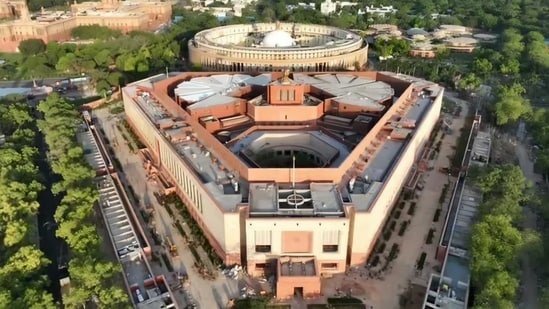
Parliament’s three sessions a year – budget, monsoon and winter sessions – grew out of practice. The Constitution requires only that six months not pass between two sessions.
The monsoon session, which last met on August 13, has not been formally closed, and the government can go one of two ways. It can prorogue, or formally end, that session and convene a fresh one. That needs a summons from the President, and lawmakers generally get at least a couple of weeks’ notice. Or it can extend the existing session at short notice, with no fresh summons.
People familiar with the discussions told HT that the winter session may begin in the first week of December even as Opposition parties said they had not received any communication from the government on the proposed schedule.
In the past five years, the government announced winter session dates after November 15 only once, in 2022. By Monday, the monsoon session had gone 95 days without being prorogued. According to PTI, the previous longest gap was 87 days, in 2008. The delimitation-linked Constitution amendment bill is among the Centre’s key legislative priorities for the coming session, HT reported.
What the Constitution says
Article 85 says the President summons each House of Parliament “at such time and place as he thinks fit”, provided six months do not pass between the last sitting of one session and the first sitting of the next. The President acts on the recommendation of the prime minister or the Cabinet. Under Article 87, the President addresses both Houses at the start of the first session of each year, and of the first session after a general election. The Constitution does not say how many sessions Parliament must hold or how many days it must meet.
{{/usCountry}}Article 85 says the President summons each House of Parliament “at such time and place as he thinks fit”, provided six months do not pass between the last sitting of one session and the first sitting of the next. The President acts on the recommendation of the prime minister or the Cabinet. Under Article 87, the President addresses both Houses at the start of the first session of each year, and of the first session after a general election. The Constitution does not say how many sessions Parliament must hold or how many days it must meet.
{{/usCountry}}In 2020, the gap came close to the limit. The budget session**, cut short by the Covid-19 pandemic,** was adjourned on March 23, and the monsoon session opened on September 14, nine days before the six months ran out.
How Article 85 came to be
As adopted in 1950, Article 85 said the Houses of Parliament “shall be summoned to meet twice at least in every year”, with no more than six months between sessions.
The Constituent Assembly, the body that drafted the Constitution, debated the clause on May 18, 1949.
KT Shah, a member from Bihar, wanted the gap between any two sessions capped at three months, and HV Kamath, a member from the Central Provinces and Berar, moved an amendment for more frequent sessions.
BR Ambedkar, chairman of the Drafting Committee, turned them down. He said the clause had been taken from the Government of India Act, 1935, and that “the atmosphere, which was then prevalent in 1935, was for the executive to shun the legislature”. He knew of one province, which he declined to name, where the legislature “never met for more than 18 days in the whole year”, and then only to approve proposals for collecting revenue.
Ambedkar said “the atmosphere has completely changed”, but the drafters retained the clause “as a measure of extra caution”.
“In fact, my fear is, if I may say so, that the sessions of Parliament would be so frequent and so lengthy that the members of the legislature would probably themselves get tired of the sessions,” he told the Assembly. He called the provision “sufficient by way of a minimum”.
The Assembly rejected the amendments and adopted the clause that day.
Two years later, the Constitution (First Amendment) Act, 1951 dropped the twice-a-year requirement and rewrote Article 85 in its present form. It also limited the President’s address, until then required at every session, to the first session of each year and the first after a general election.
Jawaharlal Nehru, then prime minister, explained the problem while introducing the bill, in a passage the Supreme Court quoted in 2002. Parliament had been meeting since November without being prorogued, and a strict reading of the law could hold that it had “not met all this year”.
The twice-a-year rule, he said, “was meant not to come in the way of our work but to come in the way of our leisure”.
Who decides the dates
The parliamentary affairs ministry aims to issue summons at least 21 clear days before a session, its handbook says, so that Lok Sabha members can give notice of questions. It adds that “this is, however, not always possible”.
In 1955, the Lok Sabha’s General Purposes Committee, a panel chaired by the Speaker that advises on the affairs of the House, tried to fix the calendar. It recommended that the winter session run from November 5, or the fourth day after Diwali if that was later, to December 22. It also proposed February 1 to May 7 for the budget session, and July 15 to September 15 for what it called the autumn session, now known as the monsoon session. The Cabinet agreed, but the ministry’s handbook records that the timetable “has not, however, been observed in practice”.
Five of the eight winter sessions held since 2017 opened in December (on December 15, 2017; December 11, 2018; December 7, 2022; December 4, 2023; and December 1, 2025. The other three began in November, and there was none in 2020.) The 2017 session began a day after the second and final phase of polling in the Gujarat assembly election, a move criticised by the Opposition as a delay.
Sessions left open before
The Lok Sabha can be recalled before a session is formally closed. Under its rules, the Speaker can bring back a House that has been adjourned sine die, or without a date to meet again, as long as the President has not prorogued it.
In 1987, the Lok Sabha’s budget session was adjourned sine die on May 12. On a proposal from the parliamentary affairs minister, the Speaker recalled it from July 27 to August 28. It was prorogued on September 3.
The Speaker recalled the House the same way after the winter session of 2003. The Lok Sabha was adjourned on December 23 and met again on January 29, 2004, without a fresh session and without the President’s address.
Ramdas Athawale, then a Lok Sabha member, challenged this in the Supreme Court, arguing that the January sitting began the first session of 2004 and needed the address. A five-judge bench disagreed and dismissed the petition in 2010. The resumption, it said, “by no stretch of imagination, could be characterised as commencement of a new session”.
In 2008, the monsoon session opened on July 21. The next day, the government of then prime minister Manmohan Singh won a confidence vote by 275 votes to 256, and the House was adjourned. It did not meet again until October 17, and was prorogued on December 24. The 87-day gap was the longest until this year, according to PTI.
The sittings
The Lok Sabha held 151 sittings in 1956, the most in any year between 1952 and 2021, and 33 in 2020, the fewest, according to the parliamentary affairs ministry’s figures. It averaged about 127 sittings a year from 1952 to 1959, against about 63 in the decade to 2021.
There was no winter session in 2020. Pralhad Joshi, then parliamentary affairs minister, wrote to Adhir Ranjan Chowdhury, Congress leader in the Lok Sabha, that floor leaders had favoured dropping it and that the budget session should be held in January. “Winter months are very crucial for managing the pandemic because of recent spurt in cases during this period, particularly in Delhi,” he wrote.
In 2002, a commission appointed by the government to review the working of the Constitution recommended that “the minimum number of days for sittings of Rajya Sabha and Lok Sabha should be fixed at 100 and 120 days respectively”.
How Britain and Canada do it
In Britain, a parliamentary session usually lasts about a year, beginning and ending in the spring. It opens with the State Opening, where the King's Speech outlines the government’s agenda, and ends with prorogation. Sessions have no fixed length. In 2019, all 11 justices of the UK Supreme Court ruled that then prime minister Boris Johnson’s advice to prorogue Parliament from early September until October 14 was “unlawful, void and of no effect”.
“Parliament has not been prorogued,” the court held.
Canada’s House of Commons works to a fixed calendar written into its Standing Orders, the rules that govern its proceedings. In a full year in session, the calendar provides for about 135 sitting days.