A data overload in the telecoms network used by air traffic control centres across the US forced the country to halt departures nationwide for more than four hours on Friday, with officials saying the issues may have been linked to new software added to the system.
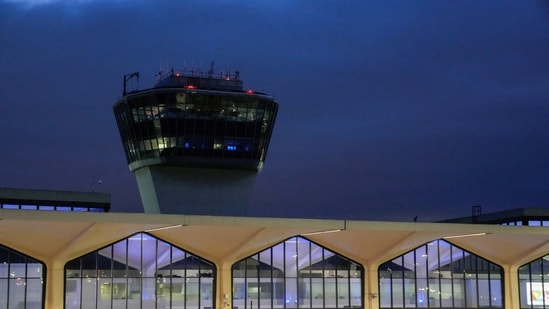
It was the third nationwide ground stop in the US this century, after the September 11, 2001, attacks and a computer failure in January 2023. More than 3,500 aircraft were in the air when the trouble began, transportation secretary Sean Duffy said. Homeland security secretary Markwayne Mullin said no one was in danger.
The problems started at 3.36pm Eastern Time, when radar and communications at the centres that handle high-altitude traffic became unstable. The Federal Aviation Administration (FAA), which runs US air traffic control, ordered the ground stop after “a communication issue” impacted “all Air Route Traffic Control Centers”, Duffy said. It lifted the order at 8.15pm.
About 11,000 flights carrying more than 1.5 million passengers had been due to leave US airports after 4pm, according to aviation analytics firm Cirium. By 11.30pm, nearly 10,000 flights had been cancelled, flight-tracking website Flightradar24 said. At least 827 flights were diverted by 7.05pm, Cirium said.
How the network is wired
Air traffic control in the US works in layers. Controllers in airport towers handle aircraft on and around the runways. Facilities known as Tracons, short for terminal radar approach control, guide planes between the airport and cruising altitude.
{{/usCountry}}Air traffic control in the US works in layers. Controllers in airport towers handle aircraft on and around the runways. Facilities known as Tracons, short for terminal radar approach control, guide planes between the airport and cruising altitude.
{{/usCountry}}The FAA has 20 domestic en route centres, where controllers take over once planes reach high altitude and handle them between airports. A national command centre coordinates traffic across the country and issues ground stops after consulting the FAA facilities and affected airlines.
Controllers at the en route centres rely on an old telecoms network to get radar data and to talk to pilots by radio. L3Harris, a US aerospace and defence company, operates and helps maintain that network, according to people familiar with an FAA briefing to the industry, Bloomberg reported. The company says its network links more than 4,400 FAA facilities and handles both data and voice for air traffic control.
A ground stop holds planes at their departure airports. Under FAA rules, it overrides all other measures that controllers use to manage traffic. Friday’s order was applied nationwide.
The ‘overload’ and ground stop
Duffy said the fault lay in switches and routers in the network. “Our switches, our routers actually got overloaded with data and they started to give us inconsistencies in the data from those routers and because of that we shut the system down," he told reporters at the White House. He said controllers never fully lost radar or radio, and worked with "intermittent communication and intermittent radar" to bring planes down.
Some of the equipment was already running over capacity, the people familiar with the FAA briefing said, Bloomberg reported. Once it was overwhelmed, the failure spread to the backbone of the old telecoms system, which handles voice and data for controllers and pilots.
Investigators are still working out what caused the overload.
The FAA has been installing new equipment and software across the network as part of its overhaul. Mullin said the FAA had been “putting patches into the system”, or software updates, and that the new technology was “overwhelming the older system”. Duffy said the equipment that failed was all old, and none of the newly installed kit went down.
Their accounts suggest the updates pushed more data through the network than the old switches and routers could handle. Investigators are examining whether one particular update triggered the failure, a person familiar with the matter told Bloomberg.
Mullin said there was "zero evidence" so far of a cyberattack or a rogue AI system, though investigators had not ruled out either. L3Harris has been asked to diagnose the overload, Bloomberg reported, and did not respond to requests for comment.
How controllers handled planes already in air
An en route centre communicates with pilots across its airspace through radio transmitters at remote sites, linked to the centre by telecom lines, according to the FAA. The agency also maintains a separate set of backup radios for when those sites fail, though they may not cover the same area. It built that backup after a damaged telephone cable knocked out 22 of one centre’s radio channels for four hours in 1967.
FAA rules tell controllers who lose their radios to try the main, standby and backup channels, and require facilities to have access to emergency frequencies such as 121.5 MHz.
The radar picture is also built from many sources. The centres’ computer system, known as ERAM, combines data from up to 64 radars, as well as from ADS-B, a network of ground stations that picks up the GPS positions aircraft broadcast. It was designed with two identical channels so that there is no single point of failure, the FAA says.
On Friday, controllers still had radar intermittently, Duffy said. The problem, as he described, was inconsistent data.
Where radar is unreliable, FAA rules say controllers ensure distance without using it, by assigning different altitudes or by spacing aircraft using time, distance and pilots’ own position reports. Every FAA air traffic facility must also have a contingency plan and run at least one contingency exercise a year. For the en route centres, those plans must use contingency routes to keep traffic moving. Officials have not said which of these measures controllers used on Friday.
Airliners also have a collision-avoidance system, known as TCAS, which detects nearby planes and tells pilots to climb or descend. It works independently of air traffic control. Under FAA rules, a pilot flying on instruments who loses radio contact with controllers must fly the route in the last clearance from controllers, at altitudes laid down in the rules. Controllers plan on that basis.
“It’s not mass chaos out there. There’s plenty of ways to try to communicate,” Skip Bailey, who teaches at the University of Nebraska at Omaha’s aviation institute, told AP. Pilots may also be able to talk to one another by radio even when they cannot reach controllers, AP reported. Steve Arroyo, a former United Airlines pilot and aviation safety expert, said that pilots were likely still able to talk to controllers at airports.
By 7.05pm, 670 diverted flights had turned back to the airports they had left and 157 had gone elsewhere, according to Cirium data.
Bailey said that “not letting anybody take off again obviously is extremely important because we don’t want to put more aircraft into a system that’s already having an issue”. “We did it out of an abundance of caution,” Mullin said.
Also read: US air traffic control ‘incredibly old’, gave inconsistent data, says official
In the past
Nationwide ground stops are rare, but failures of the communications equipment behind Friday's have been reported.
In April and May 2025, repeated telecoms outages at the FAA's Philadelphia Tracon disrupted flights into Newark. A 90-second outage on May 9 caused 380 delays and 141 cancellations, according to FlightAware. “Our (radar) scopes just went black again,” a controller told a freighter pilot during the outage.
In September 2025, a data outage at the Dallas Tracon forced ground stops at two Dallas-area airports. The FAA later said L3Harris had failed to make sure backups were in place, while the company blamed a lack of government investment in replacing old analogue circuits, Reuters reported.
On September 21 this year, flights into New York, Philadelphia, Boston and Washington were halted for eight hours after the main and backup data links serving the Philadelphia facility both failed. A construction crew in New Jersey had accidentally cut the backup fibre-optic line. About 9,500 US flights were delayed or cancelled. “When it fails, we just don't have the redundancy that we would get if we had a modern architecture,” FAA administrator Bryan Bedford said at the time.
The January 2023 stop was due to a different cause. The FAA said contract staff unintentionally deleted files while working on the database behind its system for sending safety notices to pilots. After that outage, the FAA reviewed all 138 of its air traffic control systems. It found 51 of them unsustainable and another 54 potentially unsustainable, the Government Accountability Office (GAO), Congress's audit agency, reported in September 2024.
The fix, and the blame-game
Congress approved $12.5 billion in July 2025 to upgrade air traffic control and hire more controllers. The FAA has replaced 68% of its old copper telecom lines with fibre, Duffy and White House budget director Russell Vought told lawmakers on Friday.
Bedford warned in September that swapping copper for fibre would not prevent outages without a modern telecoms network. He told Reuters the FAA’s more than 300 air traffic facilities operated as technological silos, some on decades-old computers that cannot easily communicate with one another.
In September, the GAO said the FAA lacked a reliable cost estimate and a single master schedule for the overhaul. As of May, the agency was running 11,389 separate project schedules that were not coordinated with one another. The FAA aims to finish the first phase by December 2028, and the GAO warned that poor planning could leave it relying on failure-prone equipment for longer.
Duffy defended the upgrades even as officials linked them to Friday’s failure. “By doing nothing, you inject way more risk into the system,” he said. He said Congress had failed to fund a new system that could prevent such outages. “I can’t build things if I don’t have money.”
Before the outage, Duffy and Vought had asked Congress for $30.1 billion more. Of that, $10.1 billion is for air traffic control, mainly a common computer platform and new workstations for controllers. The bigger share, $18 billion, is for airports.
After the outage, Duffy raised the request to $50 billion in emergency funding. “This is an emergency,” he said. The administration wants it approved before Democrats take control of Congress in January.
The Republican-led Senate Commerce Committee said the outage showed the need to prioritise the en route centres over other projects. It noted that Congress had already approved $1.9 billion to replace them.
Pete Buttigieg, the Democrat who was transportation secretary during the 2023 ground stop, joked at a party gathering in Denver that he would be “available in the hotel bar following the conference for anybody who needs to rebook their flights or get a refund, per your rights.”
Duffy suggested there would be more failures. “We didn’t think we would have this kind of outage. We did,” he said. “We were able to review what went wrong, and then reboot the system and go. But, you will have more of these.”