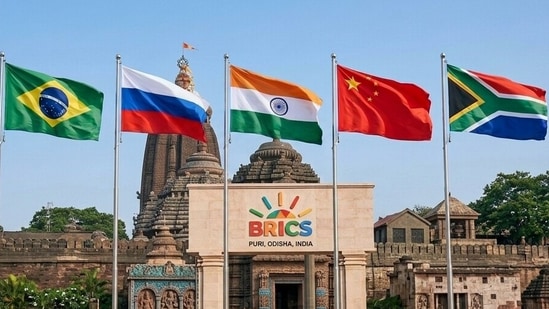
India-China relations have moved towards normalisation just as New Delhi prepares to host the 18th BRICS Summit on September 12-13. The shift remains cautious, but it is no longer marginal.
On August 25, national security adviser Ajit Doval and Chinese foreign minister Wang Yi, the two Special Representatives on the boundary question, reached an eight-point consensus. The measures included two additional military meeting points, two new hotline channels and the reopening of three designated border trading points. The two sides also agreed to hold the 26th round of Special Representatives' talks in India in 2027.
The military channel has also widened. On September 6, India and China held their first corps commander-level meeting in the eastern sector at Wacha-Damai in Arunachal Pradesh. Lt Gen Girish Kalia, commander of III Corps, led the Indian side. The meeting came amid tensions along the Arunachal Pradesh stretch of the Line of Actual Control.
The significance goes beyond the border question. It creates space for a format that Russia has been seeking to revive: Russia-India-China, or RIC.
{{/usCountry}}The significance goes beyond the border question. It creates space for a format that Russia has been seeking to revive: Russia-India-China, or RIC.
{{/usCountry}}Russian foreign minister Sergei Lavrov made the case at his annual press conference on January 20. He called for the RIC trilateral format to be activated and described it as “in a way, the foundation of BRICS”. Moscow has long viewed RIC as a precursor to the larger grouping.
The timing is now more favourable.
India and China have not settled their boundary dispute. Their recent engagement instead establishes mechanisms for managing it. The new military meeting points and hotlines can help contain tensions. Border trade and trans-border river discussions also create limited areas of practical cooperation.
That is managed normalisation, not strategic trust. For India, the distinction matters.
Economic facts make engagement difficult to avoid. India-China merchandise trade reached $151.1 billion in FY2025-26. India's trade deficit with China was about $112.16 billion. That imbalance makes economic separation far more complicated than political rhetoric suggests.
The shift is also unfolding as India seeks to build manufacturing capacity through China+1 diversification. India's own trade data shows how difficult it remains to separate Indian production from Chinese supply chains.
India's recent FDI adjustments towards countries sharing a land border reflect a similar calculation. New Delhi wants greater security scrutiny while allowing carefully screened investment and manufacturing partnerships where they serve Indian interests.
Russia provides the third side of the equation.
India's ministry of external affairs continues to describe the relationship with Moscow as a Special and Privileged Strategic Partnership. The partnership spans defence, energy, nuclear cooperation, space, fertilisers and connectivity. Bilateral trade stood at $59.86 billion in FY2025-26.
Prime Minister Narendra Modi and Vladimir Putin met in Bishkek on August 31 on the margins of the 26th Shanghai Cooperation Organisation summit. Their discussions covered bilateral economic ties, energy, defence and wider international issues.
Moscow's interest in a functioning RIC has a practical logic. Russia needs strong ties with both Asian powers. India needs working channels with Moscow and Beijing. China has an interest in keeping its relationship with India stable while deepening its partnership with Russia.
RIC could provide a forum for that.
The agenda need not be ideological. Energy security, critical minerals, supply chains, transport connectivity, food security, pharmaceuticals, space and financial connectivity offer areas where interests overlap.
RIC does not need to become another geopolitical bloc. It can first become a mechanism for regular consultation among three major Asian powers whose interests overlap but whose strategic priorities diverge.
BRICS is the natural setting for this conversation.
India's official BRICS 2026 agenda is built around ‘Building for Resilience, Innovation, Cooperation and Sustainability’. New Delhi has emphasised practical cooperation rather than another rigid geopolitical bloc.
That distinction should guide India's approach to RIC.
New Delhi has no interest in turning the three-country format into an anti-western grouping. India's partnerships with the US, Europe, Japan and Australia are too important. Its disagreements with China are also too serious.
At the same time, India has little reason to allow its relations with Moscow or Beijing to be defined by outside expectations.
The value of RIC lies in keeping these channels open.
The strongest outcome from the New Delhi summit may, therefore, be modest. The three countries could agree to restore regular RIC consultations and identify practical areas for cooperation. Most importantly, they could prevent tensions in one bilateral relationship from contaminating the others.
The old RIC of the early 2000s cannot simply be recreated. Galwan changed India-China relations. Russia's dependence on China has increased. India's strategic partnerships have also expanded.
The circumstances, however, may now be creating a new purpose for the format.
India does not need another bloc. It needs room to manoeuvre. A functioning RIC dialogue, operating alongside an increasingly consequential BRICS, could provide some of that room.
(The views expressed are personal)
This article is authored by Hriday Sarma, senior fellow, South Asia Democratic Forum, Brussels.