
 E-Paper



Salience of India-Singapore relations at 60
This article is authored by Rahul Mishra and Shashank Khandwe.

 Prefer HTon Google


Three decades ago, when India launched its Look East Policy in 1992, preceded by the economic reforms initiative and the opening up of its economy, Singapore played an instrumental role in India's institutional socialisation with the Association of Southeast Asian Nations (ASEAN) and engagement with ASEAN member countries. Singapore's 'India Fever' initiative made significant contributions in this regard.
Today, as India is swiftly growing to become the second largest economy in the next two decades, with a sharp focus on the semiconductor industry and Artificial Intelligence (AI), infrastructure development, connectivity, and economic modernisation, it is seeking friends and counterparts that can partner with it in sustaining its high economic growth rate.
In the rapidly changing and increasingly unpredictable regional and international dynamics, exacerbated by Trump's tariffs and China's bellicose postures in the South China Sea, India's deeper multi-sectoral cooperation with Singapore assumes vital significance.
As the two countries celebrate the 60th anniversary of their bilateral diplomatic relations and the 20th anniversary of their Comprehensive Economic Cooperation Agreement (CECA), signed in 2005-- India’s first such trade arrangement with any country--there is a shared sense of urgency in strengthening their bilateral partnership, which is consistently nurtured by high-level engagements.
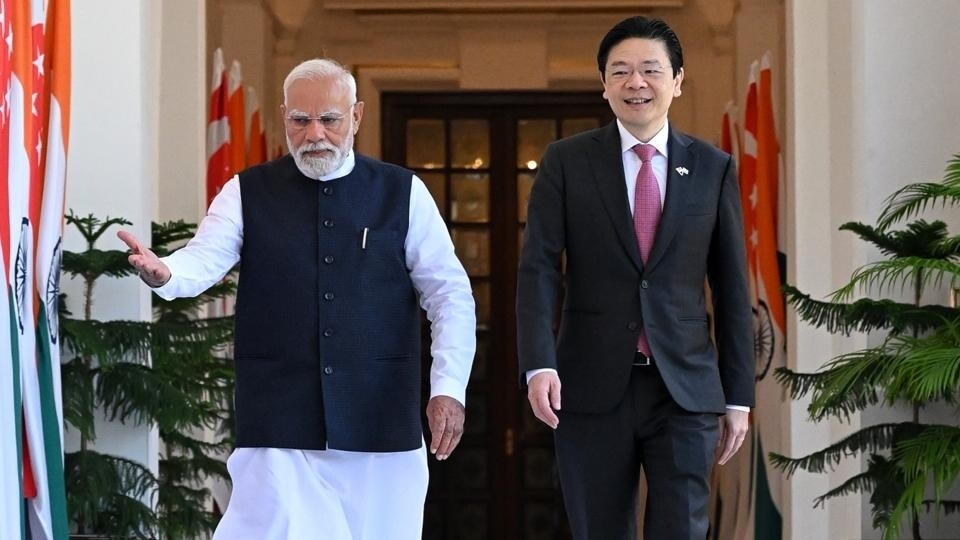
Singaporean Prime Minister (PM) Lawrence Wong's first trip to India as the PM, from September 2 to 4, 2025, should be assessed in this context. Wong's visit followed the 3rd India-Singapore Ministerial Roundtable (ISMR) Meeting and the 4th meeting of the Joint Working Group on Trade and Investment (JWGTI) held earlier in August.
During Wong's visit, the two sides agreed to boost collaborations in advanced manufacturing, connectivity, green energy, and the digitalisation of trade. With a share of over a quarter in India's foreign investments, Singapore holds a critical place in India's evolving trade policy.
While India figures at the top with a 50% tariff in Trump's list, Singapore's small, trade-dependent economy is disproportionately vulnerable to the repercussions of such policy practices, despite being within the 10% tariff bracket. The American trade and investments partly shaped the latter's economic success story.
Singapore has not shied away from criticising Trump's erratic tariff policies. Even before the Trump 2.0 administration took control, Singaporean scholar Danny Quah criticised protectionist forces in the US that aim to dismantle the multilateralism and international economic architectures, which are marked by free and fair trade and have nurtured developing economies and lifted millions out of poverty.
On the occasion of Singapore's 60th anniversary of independence, PM Wong called for the city-State to 'act on its own' and utilise the past investments the country had made in technological innovation and human resource development. Foresighted leadership of the past showcased a specific research and development (R&D) push in the information technology and biomedical domains.
Despite being a 'red dot' on the map, the benefits of such investments helped Singapore become a major economic power. Wong attributes this role to AI, as the technology requires increased research and development R&D efforts on a national scale. Singapore's capability to synergise technology with skills places it in a position of continued reliability worldwide.
Wong's call for a 'we first' approach appears as an administrative directive aimed at addressing Singapore's long-term interests and concerns.
First, this approach focuses on diversifying Singapore's economic relations and securing trade and investment agreements that align with national economic interests. The Singapore Economic Resilience Taskforce (SERT), under deputy PM Gan Kim Yong, holds importance here, along with the proposed Business Adaptation Grant to support local enterprises and worker consultancy through previously introduced initiatives, such as the Career Health SG movement. The former figured India as an essential component and included the previously-mentioned initiatives that were achieved, primarily the delegation visit led by Yong in early August.
Second, the 'we first' approach appears to recognise the domestic political churn and the country's overall health security concerns—a shared concern across East Asia —when it identifies the youth and senior citizens as its primary focus groups. Policy measures, such as the National AI Strategy 2.0, remain central in utilising technological advances to address issues of focus groups, while also reflecting the direction Singapore is taking on AI as a 'public utility tool.' As the ageing population puts pressure on the younger workforce for support, AI emerges as a valuable bridge that equips both groups for greater efficiency and independence.
Third, infrastructure development remains a key priority for the city-State, given its limited land resources and commitment to high standards of living. Wong's emphasis on land reclamation projects, specifically highlighting locations such as the Sembawang Shipyard, underscores the aspirations for sustainable infrastructure development, which is further complemented by essential connectivity initiatives with Malaysia, including the Johor Causeway, thereby establishing a comprehensive spatial solution for the city-state.
The constraints of limited land availability, combined with the humid climate conditions, have driven the development of innovative and sustainable cooling solutions through green architecture and the design of climate-responsive urban spaces. It has also positioned Singapore as a model for other countries confronting comparable challenges in urban environment management. Singapore's remarkable achievements in this sector could serve as a guidebook for fast-growing Indian cities, such as New Delhi, Mumbai, and Bangalore, which are marred by incessant demographic and urban management challenges.
Lastly, none of the previously mentioned objectives precedes the imperative of sustaining the 'Singapore Spirit,' conceived as a multicultural society underpinned by an efficient administration. While generational differences shape diverging perceptions of governance, a unifying thread is the shared aspiration for a resilient Singapore prepared to meet the future's domestic and structural challenges. Wong's call for 'we first' is a reminder of this aspiration, as well as the collective strength required to maintain what has already been achieved.
On these terms, 'we first' aligns with the ideas that guided the call for 'Atmanirbharta' in India. 'Atmanirbhar Bharat' as a national calling pivoted on the need for India to reposition its international economic calculations, and to integrate without overdependence on any single partner country. Without isolation, it calls for diversification of supply chains, accompanied by increased capacity building, thereby extending the Indian approach of strategic autonomy into national trade practices.
As India and Singapore celebrate their 60th anniversary, it is evident that not only do their interests converge, but their anxieties and concerns also share similarities. Greater policy coordination and follow-up action, combined with a problem-solving approach, can pave the way for stronger and more meaningful ties. Wong's visit highlights many of those issues that need joint action and deeper collaboration.
This article is authored by Rahul Mishra, associate professor and Shashank Khandwe, doctoral candidate, Centre for Indo-Pacific Studies, School of International Studies, Jawaharlal Nehru University, New Delhi.


