Visualise legendary poet-author Rabindranath Tagore’s central characters from the 19th century — Charu and Bimala — debating on the relevance of reality shows in 2026, with his sister-in-law Kadambari Devi. An unconventional scene forms shape in the mind, right? Though the life and tales of these three are well known worldwide, it’s the new book by singer-author Isheeta Ganguly that reinterprets and rediscovers these personalities in the modern day set-up. Yet, their dilemmas and debates continue to remain embedded in similar tropes such as how the ‘modern woman is still living for everyone else’ while being caught between emotions of love, intellect, and duty.
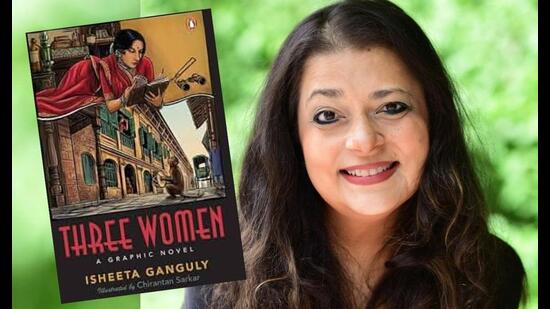
Adapted from Ganguly’s stage musical by the same name, this dram-com turned into a book engages the reader with illustrations that reflect the sincere work of Chirantan Sarkar. “The musical theatre morphed into a new form effortlessly with Chirantan’s detailed interpretations with a play of lines, curves and angles. The images bring to life, the range of Charu, Bimala and Kadambari’s lives from the parlours and gardens to the cafés and verandahs of today,” says Ganguly, adding, “The three women are much ahead of their times. Their conflict is one of the curtains and barriers imposed on them that keep them stuck to traditional roles and expectations as daughters, homemakers, wives and daughters-in-laws without any oxygen to express who they are. With career, relationships and society today, the question still remains as to how should women negotiate traditional roles and expectations and still find voice and give wings to their own purpose?”
It’s intriguing how the writer believed that 2026 would be an ideal setting for Tagore’s sister-in-law Kadambari Devi’s sassy spirit to leap across centuries and meet Tagore’s two iconic, fictional female characters. Reasoning this, Ganguly says, “Tagore’s heroines in the 19th century were nuanced, quick-witted, and intricately complex women who were isolated amidst drawing room silences and engulfed in deep loneliness. In 2026, women are just as intricate and complex yet still grappling with the loneliness of digital silences... The quest for second chances is a theme that resonates deeply for women who are reinventing and redirecting themselves.”
{{/usCountry}}It’s intriguing how the writer believed that 2026 would be an ideal setting for Tagore’s sister-in-law Kadambari Devi’s sassy spirit to leap across centuries and meet Tagore’s two iconic, fictional female characters. Reasoning this, Ganguly says, “Tagore’s heroines in the 19th century were nuanced, quick-witted, and intricately complex women who were isolated amidst drawing room silences and engulfed in deep loneliness. In 2026, women are just as intricate and complex yet still grappling with the loneliness of digital silences... The quest for second chances is a theme that resonates deeply for women who are reinventing and redirecting themselves.”
{{/usCountry}}It is, however, the writer’s confidence in her choice to reinterpret her musical into a graphical writing that leaves room for more intrigue. But Ganguly counters saying, “The women from my musical had renewed relevance for Gen Z and today’s women across generations. The themes of negotiating ambition, identity, balancing purpose with passion and defining beauty were central to their lives in the 19th century as much as they are relevant to Gen Z women today... Gen Z is direct like Charu, Bimala and Kadambari. So these roles are reimagined as there isn’t any suffocating sense of holding back, to masque vulnerability like the Carrie Bradshaw ‘rules’ girls are.”
Title: Three Women: A Graphic Novel
Author: Isheeta Ganguly
Publisher: Penguin Random House India
Price: ₹299
For more, follow HTCity Delhi Junction