A latest incident in India’s capital city has brought the focus on privacy issues related to use of smart glasses in public places like cafes and restaurants. In UK, certain pub chains, restaurants, and venues have issued bans on smart glasses inside their premises over concerns of unauthorised recording and guest privacy invasion. Will India need something similar?
What happened
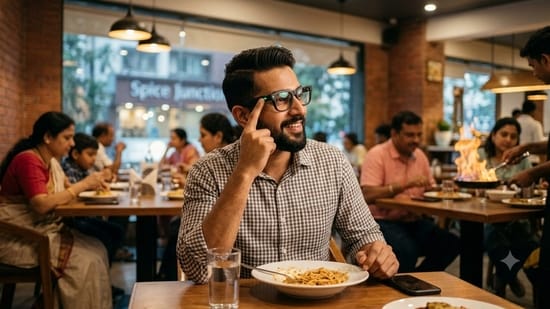
A Delhi man has sent a legal notice to Meta and an Instagram creator, alleging he was covertly recorded at a Khan Market café on July 24 using Ray-Ban Meta smart glasses. He alleges the creator approached him, questioned him and followed him after he moved seats. He says he did not know he was being filmed.
The footage was posted as an Instagram Reel on July 26. According to the Internet Freedom Foundation (IFF), which is assisting him pro bono, it had crossed 4.19 lakh views, 15,700 likes and 500 comments by August 6. The notice seeks removal of the video, an apology, preservation of evidence and ₹2.05 crore in damages.
Why does it matter
Unlike a phone, can you tell when smart glasses are recording? Not always. Ray-Ban Meta glasses have a front-facing white LED designed to indicate when the camera is capturing, but the wearer can record hands-free without visibly pointing a device at someone.
That has already prompted restrictions overseas. UK restaurants, theatres and pubs have moved to restrict camera-equipped smart glasses, while cinemas are considering similar measures over privacy and piracy concerns. However, multiple British entertainment venues have clarified that their existing rules against covert filming apply to smart glasses rather than imposing a blanket device ban.
Should Indian restaurants ban smart glasses?
{{/usCountry}}That has already prompted restrictions overseas. UK restaurants, theatres and pubs have moved to restrict camera-equipped smart glasses, while cinemas are considering similar measures over privacy and piracy concerns. However, multiple British entertainment venues have clarified that their existing rules against covert filming apply to smart glasses rather than imposing a blanket device ban.
Should Indian restaurants ban smart glasses?
{{/usCountry}}Kanishk Tuteja, founder, Mido House, Delhi, says smart glasses themselves would not be a reason to turn a diner away. “We don’t think the technology itself is the issue, it is how it is used. If they continued to record other guests or staff without permission after being asked to stop, we would expect our team to intervene and, if necessary, ask them to leave,” Tuteja says.
Varun Khera, National Restaurant Association of India’s Noida Chapter Head, says the responsibility also lies with people using the technology. “Technology will keep evolving and we will have new tools, but people need to be sensitive to how they use them. People come out to eat and drink in their personal space; they may not react the way another person wants them to. Especially if it is a famous person and you record them, it is very wrong. Content creators also need to understand what to record and what not to record,” he says.
Gathika Chabbra, founder, Before British Raj, Delhi NCR says, "I completely understand and enjoy the culture of people making reels and sharing their experience. It is a part of how people discover cafés today. But there is a very clear difference between choosing to record your experience and unknowingly recording everyone around you. Technology is going to keep evolving and cameras will probably become smaller and harder to notice. I don't think our understanding of basic courtesy should evolve backwards with it."
Hitesh Keswani, MD & CEO of Aspect Hospitality, which operates several restaurants, cafes, and bars in Mumbai, says rather than banning smart glasses outright, there needs to be clear etiquette around their use. “We should not begin by banning a technology simply because it presents a new challenge,” he says. “The industry should establish sensible etiquette around privacy, recording and guest comfort, while remaining open to innovation.”
What Meta says
Meta’s head of Instagram Adam Mosseri said in a recent weekly AMA on Instagram: “AI glasses have cameras in them, and right here you can see that there’s a little light that lights up if someone is actually filming. So we can’t stop people from filming other people, but we can try to make sure that that light is on if they are filming. We now actually have the glasses basically stop working if you drill that light out, because we saw that people were trying to drill that light out We don’t want people to be surreptitiously taking videos of other people and harassing them and then posting them on our platform. So we’re trying to fight that every way we can.”
Sharing their statement with HT City, Meta said, “Bullying and Harassment policies apply regardless of the device used to capture content, and Instagram has removed thousands of violating pieces of content and disabled accounts found to be systematically sharing footage of people without their awareness or consent. When people report content to us, it gets reviewed quickly and taken down if we find that it violates these policies.”
Can you legally record someone in public?
Tech expert Anirudh Suri, Founding Partner of the India Internet Fund, says, “It is a technology that ‘assumes’ consent of the other person(s) that are being recorded. Safeguards will require a clear set of guidelines for sale and use of this technology in India.”
Supreme Court lawyer Sana Raees Khan, Founder of SRK Legal, says privacy remains a fundamental right under Article 21 even in public spaces. “The doctrine of expectation of privacy will be less in a public area, but not eliminated. The context, intent of the recording, how it is recorded and what is done with the material can be all relevant,” she says. What happens to the recording also matters. Khan says recording an interaction does not automatically give someone the right to publish it, particularly if the publication causes humiliation, harassment or reputational harm.
Shreya Sharma, Founder & CEO, Rest The Case, adds, “The legal challenge is to strike a balance between encouraging technological innovation and protecting individual rights. Not every recording in a public space should automatically be treated as unlawful, however, the collection, storage, processing, and commercial use of personal data can create additional legal obligations.”
Section 66E of the Information Technology Act deals specifically with capturing, publishing or transmitting images of a person’s private areas without consent. It is not a blanket ban on filming people in public.
The Digital Personal Data Protection Act, 2023 also forms part of India’s emerging privacy framework, but its substantive obligations are being brought into force in phases; the government notified the Rules in November 2025, with key compliance provisions scheduled for May 2027.
How to use smart glasses safely
- Ask before recording: Get permission before filming identifiable people, especially during direct interactions.
- Don’t record private conversations: Avoid capturing conversations or interactions that don’t involve you.
- Look for the capture LED: When the glasses are taking a photo or recording video, a small white LED on the front is designed to indicate that the camera is active. If you are recording, don’t assume the glasses’ recording indicator is enough notice; tell people when you’re filming them.
- Respect a no: If someone asks you to stop recording, respect their request.
- Think before posting: Recording someone doesn’t automatically mean you have the right to publish the footage, particularly if it could cause embarrassment or harm.
- Follow venue rules: Restaurants and other public establishments may have their own policies on photography and recording.