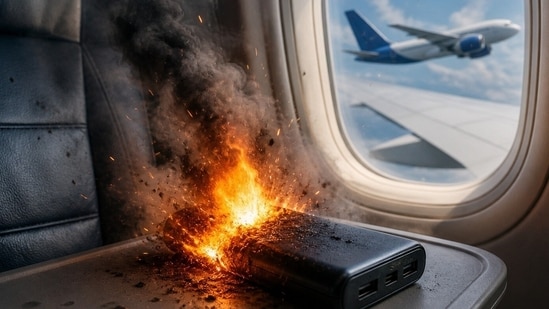
A Chennai-bound IndiGo flight had to make an emergency landing in Hyderabad on October 11, 2026, after a passenger’s power bank caught fire mid-air, filling the cabin with smoke. Coming just months after a similar power bank explosion on a Chandigarh-bound flight in May 2026, the incident has brought aviation safety back into focus. Frequent flyers and travel creators are urging passengers to take basic precautions:
Shenaz Treasury, Travel vlogger and content creator, says, “I keep my power bank strictly under the seat ahead, never in the overhead bin. Investing in reliable brands and checking for swelling or overheating before packing is crucial. Even a small oversight can put the entire flight at risk.”
Sayan Nath, travel filmmaker, further adds, “I stick to three simple rules: keep power banks under 20,000 mAh, carry all spare batteries in my hand luggage, and keep drone batteries with me in the cabin while checking in the body. Complying with precautions is non-negotiable.”
What the rules say across Indian carriers
IndiGo: All power banks and loose lithium-ion batteries must be in cabin baggage , never checked luggage. They cannot be used or charged mid-flight, nor stored in overhead bins. Maximum allowed capacity is 160 Wh, and the rating must be clearly printed on the device.
Air India: Devices up to 100 Wh (around 27,000 mAh) are allowed without paperwork. Keep them within reach under the seat, tape terminals or keep them in protective pouches, and never place them in overhead bins.
{{/usCountry}}Air India: Devices up to 100 Wh (around 27,000 mAh) are allowed without paperwork. Keep them within reach under the seat, tape terminals or keep them in protective pouches, and never place them in overhead bins.
{{/usCountry}}Akasa Air and SpiceJet: Power banks must stay in your hand luggage or on your person. Units up to 100 Wh are permitted (up to 2 units on Akasa), while 100–160 Wh requires prior approval. In-flight charging and overhead bin storage are strictly banned.
The DGCA mandate: 3 rules enforced on all flights
India’s aviation regulator, the Directorate General of Civil Aviation (DGCA), enforces three strict national rules across all Indian airspace:
Cabin baggage only: Power banks are legally banned from checked cargo. They must travel in hand luggage.
No overhead bins: Power banks cannot be stored in overhead lockers. They must remain accessible under the seat in front of you.
Zero in-flight use: You cannot charge your phone from a power bank or charge the bank itself at any point during the flight.
The science: Why the strict rules?
Damaged or overheated lithium batteries trigger thermal runaway, a chemical reaction that skyrockets temperatures in seconds and fuels its own fire without needing outside oxygen.
Why ban checked baggage? Cargo holds are unmonitored. Halon fire systems extinguish open flames but cannot cool a lithium chemical fire, allowing it to reignite hidden under luggage. In the cabin, crew can douse it with water and seal it in a fire-containment bag.
Why ban overhead bins? Closed lockers trap smoke. A battery can burn undetected until thick smoke fills the cabin. Under-seat placement ensures immediate detection.
Why ban in-flight charging? Both charging and discharging generate heat, the primary trigger for thermal breakdown in a pressurised cabin.