The Vijay-led Tamil Nadu government has courted controversy by granting 60 days’ parole to five men serving life terms for the 1998 Coimbatore serial blasts, which were also aimed at Bharatiya Janata Party (BJP) veteran L K Advani.
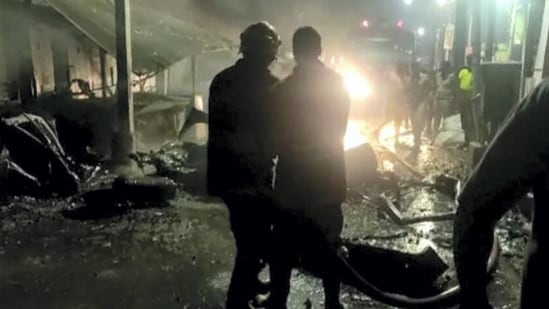
Fifty-eight people were killed and 250 were injured in a series of blasts over a span of four days.
On Monday, the Tamil Nadu government granted 60-days parole to five convicts on grounds of personal reasons, including health conditions, people aware of the details said. The convicts – Mohammed Ansari, Mohammed Ali, Monappa alias Mohammed Hassan, Mohammed Ajam and Nawab Khan – lodged in Coimbatore central prison have served over 20 years in prison.
One of the convicts sought parole, saying he has already served nearly 30 years in prison, the people cited above added.
The move came under sharp criticism from the Bharatiya Janata Party (BJP) which accused the Tamilaga Vettri Kazhagam (TVK) of insulting the victims and betraying the survivors.
BJP Tamil Nadu spokesperson Narayanan Thirupathy said granting parole to the men who helped plant the bombs that tore families apart reflects the government’s “one-sided lenient approach” towards convicted terrorists.
{{/usCountry}}BJP Tamil Nadu spokesperson Narayanan Thirupathy said granting parole to the men who helped plant the bombs that tore families apart reflects the government’s “one-sided lenient approach” towards convicted terrorists.
{{/usCountry}}“Granting long-term parole to those involved in the bombing incident that shattered many families is not only an insult to the memory of those who lost their lives but also a grave betrayal to the survivors. It sends the wrong message to the people of Tamil Nadu that those who wage war against society can also be shown mercy. Before the brutality of this terrorist attack, which is considered one of the darkest chapters in the state's history, personal reasons can never take precedence,” Thirupathy said.
There was no immediate comment from the TVK at the time of filing this report.
What happened in the 1998 Coimbatore blasts
At around 4 pm on February 14, 1998, as then BJP president L K Advani was due to address an election rally at RS Puram in Coimbatore, the city and its suburbs were rocked by 12 powerful bomb blasts that killed 47 people and injured 218.
The attackers were not able to target the election meeting due to the police cordon. The targets included the Coimbatore Medical College Hospital as well as the Coimbatore railway station.
Explosions were also reported elsewhere in the city. A pipe bomb went off at Poombuhar Town Hall at 5 pm, followed by blasts at the Ukkadam fish market at 5.30 pm and at Karunanidhi Nagar at 9 pm. The violence continued the next day, with an explosion at Thirumal Street at 4 pm and another at 6.30 pm at the closed ‘Mohan Radios’ shop on Oppanakkara Street. On February 16, a pipe bomb exploded at Kuniyamuthur, and a final device went off in a field at Al-Amin Colony.
The improvised explosive devices, with time delay mechanisms, were placed in cars, two-wheelers, abandoned bags, push carts, tea cans and so on.
In all, there were 19 bomb explosions between February 14 and 17, 1998, in which 58 people were killed and 250 were injured, and damages worth ₹4.37 crore were incurred.
Conspiracy and Al-Umma
Investigations revealed the bomb blasts were planned and executed by a now-banned fundamentalist organisation named 'Al-Umma' - headed by S A Basha (who died in 2024). They were carried out in retaliation to the killings of 18 Muslims in communal riots and police firings in the city. The riots broke out after a traffic police constable named R Selvaraj was stabbed to death.
Arrests and convictions
As many as 168 people were arrested in the case, of which 166 were tried and 158 were convicted. Around 40 of them, including the alleged mastermind Basha, were awarded life terms. Most of the life term convicts approached the Supreme Court in appeal.
Then DMK govt under fire
Earlier in December 1994 when Basha died, the state BJP had targeted the then Dravida Munnetra Kazhagam-led state government over his funeral procession for which around 2,000 cops were deployed.