Prime Minister Narendra Modi gave away the Shanti Swarup Bhatnagar Prize — India’s most coveted science and technology award — to 33 winners of past three years on the occasion of National Science Day in Delhi on Thursday.
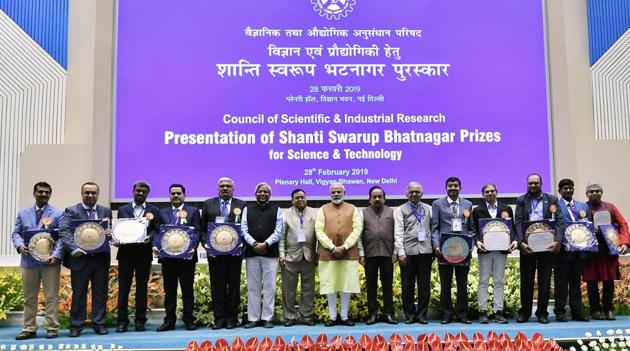
Dr Aditi Sen De of Harish Chandra Research Institute, Allahabad, is the only woman among the 33 scientists who were awarded for the year 2016, 2017 and 2018.
De was given the award in the “physical sciences” category for her contributions in quantum communication. She is the only woman to receive the award in this category.The last woman scientist to receive the award was Dr Vidita Vaidya, a neuroscientist from the Tata Institute of Fundamental Research, Mumbai. She received the prize in 2015 in the “medical sciences” category.
So far, the award has gone to 16 women and 519 men.
The award was instituted in 1958 in the honour of eminent scientist Dr Shanti Swarup Bhatnagar, who was also the founder director and chief architect of the Council for Scientific and Industrial Research (CSIR), a government-funded research and development organisation, which now runs several laboratories and institutes across the country.
The prize comprising a citation and ₹5 lakh in cash is given each year to outstanding researchers in seven disciplines.
{{/usCountry}}The prize comprising a citation and ₹5 lakh in cash is given each year to outstanding researchers in seven disciplines.
{{/usCountry}}“I feel that the science can be global but the technology should be local, suited to the needs of the people of the country. Our scientists and science organisations should not work in silos, rather they should work together to build a brighter future,” said Modi.
“If this is done, the farmer and the soldier will benefit from science and research,” he added referring to the phrase by Lal Bahadur Shastri “Jai Jawan, Jai Kisan” to which former Prime Minister Atal Bihari Vajpayee had added “Jai Vigyan” and in January this year PM Modi added “Jai Anusandhan” during the Indian Science Congress, an annual event.
Addressing the scientists, Modi said, “You all live your lives in laboratories and you have a tradition of pilot projects. After the pilot, a project is made scalable. So, recently there was a pilot project, now we need to do the real thing. Earlier, it was a practice. And the real thing is: today’s winners need a standing ovation.”
The PM went on to say that scientists and scientific institutes should come together to work for India’s future. Speaking at the event, Union science minister Dr Harsh Vardhan commended CSIR for improving its global ranking. “Over the last few years, under the guidance of our prime minister, our scientists have achieved a lot, especially CSIR that was ranked number nine on a list of 1,207 institutes of the world,” he said.