He is perhaps a contractor like no other in the country. On his shoulder rests the Chhattisgarh government’s ambitious plans of bringing development to the Maoist heartland by building roads — a project that is opposed by insurgents and has caused bloodshed.
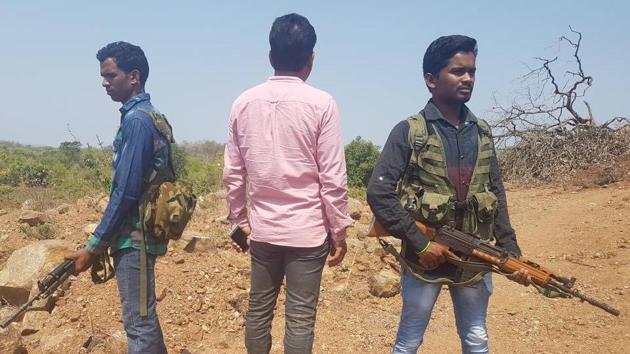
It is the army of workers of Pramod Rathore, the 46-year-old private contractor, who is building both the Injiram-Bheji and Dornapal-Jagargonda roads across south Sukma, which once completed is expected to usher in modern amenities to the doorstep of tribals and choke the Maoists of local support.
But building the roads is fraught with danger and Rathore moves with gun-toting bodyguards. The Maoists are hell-bent on not letting the roads get built and the two stretches have been the site of some 45 fierce encounters resulting in 45 deaths so far.
The incomplete Dornapal-Jagardonda road is where the Maoists struck last month, ambushing a Central Reserve Police Force (CRPF) patrol team and killing 25 soldiers. They had struck at the Injiram-Bheji road in March, killing 12 security personnel.
But Rathore is undeterred and has chosen to venture where others fear to tread. First the public works department of the Chhattisgarh government gave out tenders for the two roads but one by one, all the private contractors deserted the project.
{{/usCountry}}But Rathore is undeterred and has chosen to venture where others fear to tread. First the public works department of the Chhattisgarh government gave out tenders for the two roads but one by one, all the private contractors deserted the project.
{{/usCountry}}Then the state Police Housing Corporation stepped in and issued fresh tenders for construction of the roads, but once again the other contractors left, leaving Rathore with the the onerous responsibility.
It has come at a cost and Rathore is a marked man, forced to move around stealthily, encircled by bodyguards. “No one knows about my movements,” the contractor, 5 feet 10 inches tall and sporting a heavy gold chain round his neck, said. He also always carries a rifle and a pistol. “The rifle is to fight till the last breath and the pistol to shoot myself in case I am caught by Maoists,” he explained.
His reputation as a member of the now-disbanded Salwa Judum vigilante group that fought Maoists with state patronage is, however, an advantage. Locals respect him, either voluntarily or out of fear.
Having migrated from Rae Bareli of Uttar Pradesh in the early 1980s, Rathore has come a long way. The work he does is dangerous and painstakingly slow. His workers lay the road often only to be ripped apart by Improvised Explosive Devices (IED) planted by the Maoists.
There have been 43 IED blasts on the Injiram-Bheji road and 18 similar blasts on the Dornapal-Jagargonda road in the past three years.
Security personnel guard the work place but Maoist disruptions have meant that the twin roads are still far from completion. The average pace of road construction is just seven km every year.
Labour is cheap in Chhattisgarh’s interiors, but not many are willing to risk their lives. “I try and explain to the workers that Maoists will never hurt or kill labourers and drivers. Instances of locals being killed in exchange of fire have been very rare,” Rathore said.
So will the two roads at the heart of Chhattisgarh’s conflict ever be completed? Rathore is hopeful. “We have been promised security,” he said. As the work progresses, his challenges include dodging Maoist bullets.