India’s mechanised infantry is on the threshold of a critical transformation, with the army setting a brisk pace to equip its vital combat arm with a range of new indigenous capabilities ranging from futuristic vehicles, missile systems and night-fighting gear to loitering munitions, anti-drone weapons, and intelligence, surveillance and reconnaissance (ISR) platforms, officials tracking the army’s modernisation said on Sunday.
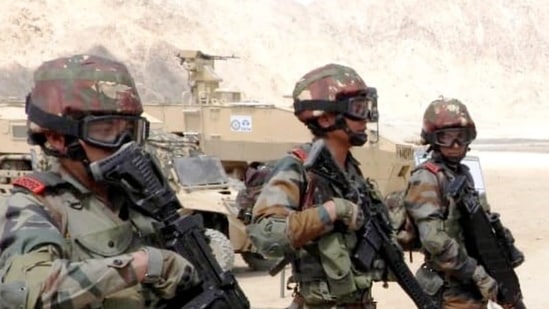
The comprehensive road map for its modernisation seeks to transform the mechanised infantry into a more lethal, agile and integrated force capable of delivering a swift and effective response in battle, said one of the officials cited above, asking not to be named.
The army’s mechanised infantry units, equipped with the hardy Soviet-era BMP-II amphibious combat vehicles, have played a crucial role in strengthening the Indian Army’s combat posture against the Chinese People’s Liberation Army during the ongoing, tense standoff along the Line of Actual Control in eastern Ladakh.
The versatile combat arm brings to battle a protected infantry component directly supported by the firepower of its integral combat vehicles.
Forming the core of the overarching capability enhancement plan — dovetailed with the Aatmanirbhar Bharat (self-reliant India) strategy — is the replacement of the BMP-IIs with 480 locally developed futuristic infantry combat vehicles (FICVs) for which government approval will be sought shortly, said a second official, who also asked not to be identified.
“The army will seek the defence acquisition council’s acceptance of necessity (AoN) for the FICVs at the earliest. We are simultaneously pursuing modernisation plans for tracked and wheeled vehicles. A few approvals have already come,” the second official added.
{{/usCountry}}“The army will seek the defence acquisition council’s acceptance of necessity (AoN) for the FICVs at the earliest. We are simultaneously pursuing modernisation plans for tracked and wheeled vehicles. A few approvals have already come,” the second official added.
{{/usCountry}}The defence acquisition council (DAC), chaired by the defence minister, is India’s apex weapons procurement body, and under the country’s defence procurement rules, its AoN is the first step towards buying or developing military hardware.
The army has already secured approvals for the Nag missile system (NAMIS) for reconnaissance and support battalions (13 Nag missile carriers and 293 missiles), 177 infantry combat vehicles (command), and 105 wheeled armoured fighting vehicles to replace Soviet-origin BRDM reconnaissance vehicles and 1080 anti-tank guided missiles, said a third official on the condition of anonymity.
Also on the mechanised infantry’s wish list are wheeled infantry combat vehicles for standard battalions and light armoured multi-purpose vehicles with enhanced mobility and protection for reconnaissance platoons that currently use the Maruti Gypsy.
The modernisation drive will enhance the mechanised infantry’s mobility and effectiveness, and also boost India’s capabilities along the northern borders with China, said former Western Army commander Lieutenant General RP Singh (retd).
“Injecting contemporary technologies at a swift pace will help exploit the capabilities of this man-machine combination… otherwise the arm is just a battle taxi. Even Pakistan is upgrading its mechanised forces. We can’t be left behind,” Singh added.
“A threat cum capability-based modernisation approach is being pursued with the acquisition of contemporary, adaptable and niche technology, which is interoperable with other combat arms. The modernisation drive is completely in sync with the Aatmanirbhar Bharat initiative,” the third official said.
Capability enhancement of existing military hardware with upgrades for night fighting, lethality and ISR systems forms an important element of the modernisation effort.
“Enhanced night fighting capability is a top priority. The focus is on a comprehensive solution for the gunner main sight, commander panoramic sight, fire control system, automatic target tracker and laser range finder. The new gear will enhance the night vision capability of the driver and commander too,” said a fourth official.
Enhancing fire power of mechanised infantry units is covered under the plan, and is a work in progress.
This is being done through third generation fire-and-forget anti-tank guided missiles, canister-launched loiter munition systems integrated on the BMP-II chassis, anti-drone capability, and integrated surveillance and targeting systems, the officials said.
“ISR capability is being strengthened with mini-unmanned aerial vehicles, see through armour for better situational awareness, autonomous combat vehicles and artificial intelligence-based integrated surveillance, detection and engagement systems,” said the first official.
India’s mechanised forces — the mechanised infantry and armoured corps — are also inducting swarm drone systems capable of carrying out offensive missions in enemy territory with scores of drones working in formations to identify, encircle and strike targets.