Protesters opposing the proposed 11,200-MW Siang Upper Multipurpose Project (SUMP) set fire to a National Hydroelectric Power Corporation (NHPC) office, a police station and several police vehicles, and vandalised the homes of three political leaders in Arunachal Pradesh’s Pasighat on Friday night, leaving several police personnel injured, East Siang Deputy Commissioner and District Magistrate Jayanti Pertin said on Saturday. Chief minister Pema Khandu condemned the violence and urged protesters to resolve their concerns through dialogue.
Stone pelting and tear gas
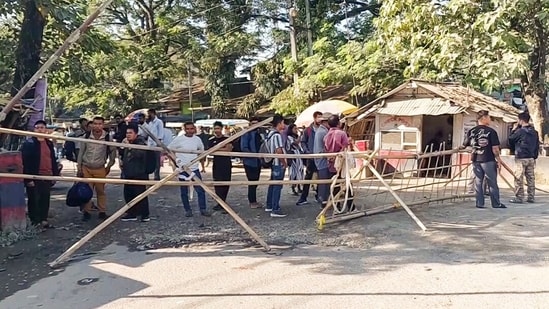
Hundreds of protesters, some identifying themselves as Gen Z, allegedly resorted to arson and vandalism after a 12-hour bandh ended at 5pm, Pertin said, adding that the houses of state BJP president Kaling Moyong and legislators Oni Panyang and Ninong Ering were damaged, with reports of looting and theft. “There was a 12-hour bandh on Friday from 5am till 5pm by some people opposed to the project. It went off peacefully in Pasighat, but after 5pm some protesters calling themselves Gen Z insisted on continuing the bandh and blocked the highway,” Pertin said.
She said the local magistrate and security forces tried to persuade the protesters to disperse for nearly two hours. When they refused, the magistrate ordered the firing of tear gas shells. “There was no baton charge. After that, the protesters got unruly and started pelting stones, which caused hurt to some policemen and officials,” the deputy commissioner added.
“The protesters subsequently targeted the NHPC office, Pasighat police station and seven to eight police vehicles,” she said, adding that eight protesters who sustained minor injuries were given first aid at a local hospital. “The situation remained tense until around 3.30am on Saturday, but was under control by morning. No arrests had been made in connection with the violence till Saturday evening,” Pertin added.
CM Khandu decries the destruction of law and order
Condemning the incidents, CM Khandu said peaceful protest was a democratic right but should not result in damage to property or disruption of public order. “I strongly condemn such violent protests and urge everyone who has concerns regarding the SUMP project to come and sit for talks instead of resorting to such means. Protesting is a democratic right, but should be done within limits and without causing harm or damage to anyone or properties.”
The chief minister said the government was willing to discuss the project’s potential benefits, possible adverse impacts and concerns raised by local communities. He offered to meet representatives of organisations from the Siang region in Itanagar, Pasighat or any other location convenient to them. He also said he was willing to visit a place chosen by the stakeholders for discussions. “The government’s doors are always open. Any organisation or association that wants to discuss the SUMP project is welcome. People should question the government, discuss the possible benefits and negative aspects of the project, and seek clarification on their concerns,” the CM said.
In the wake of the violence, the East Siang district administration imposed restrictions on public gatherings, processions and the carrying of weapons in Pasighat, Mebo and Ruksin from 5pm on Saturday under Section 163 of BNSS.
Earlies clashes over release of activists
The violence followed clashes earlier on Friday morning at the 65 Bridge in Dite-Dime near Geku, where four women protesting against the project were injured after police reportedly fired tear gas shells to disperse a crowd that allegedly attempted to breach barricades and attack security personnel. The shutdown disrupted normal life across Siang and Upper Siang districts and parts of East Siang, with shops and business establishments closed and residents largely staying indoors. It was called jointly by Adi Bane Kebang United, the SUMP Affected Area Youth Association, the Siang Indigenous Farmers’ Forum Youth Wing and the Adi Galo Welfare Society.
The organisations are demanding the release of 10 arrested activists, reinstatement of suspended gaon buras (village heads), withdrawal of pre-feasibility report activities in dam-affected areas and removal of paramilitary and central forces from the region.
Also Read I Row over ITBP chief's Arunachal 'face-off' remark, Congress questions govt
The proposed project is seen by the state government as a strategic safeguard against China’s hydropower development on the Siang River, which is called Yarlung Tsangpo upstream in Tibet. The river enters Arunachal Pradesh as the Siang before joining other tributaries to form the Brahmaputra. While the government says the project could help regulate downstream water flows through storage, local communities fear displacement, ecological damage and the loss of ancestral land.
The government maintains that the PFR is only a preliminary assessment of the project’s technical and geological feasibility, not approval for construction. Protesters, however, argue that survey activities are the first step towards a project that could fundamentally alter the region’s ecology and indigenous way of life.