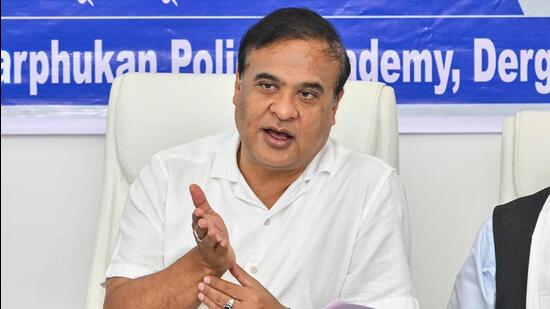
Assam to give arms licence to indigenous people in ‘vulnerable’ areas: Himanta Biswa Sarma
Assam chief minister Himanta Biswa Sarma said indigenous people in remote and vulnerable districts and those along the border with Bangladesh were feeling insecure
GUWAHATI: The Assam cabinet on Wednesday approved a special scheme to provide arms licences to indigenous people living in “vulnerable and remote areas” and those along the border with Bangladesh to help them protect themselves.
Assam chief minister Himanta Biswa Sarma said indigenous people “face the threat of attacks from the Bangladesh side and even in their own villages” (ANI)
{{^htLoading}} {{/htLoading}}
Chief minister Himanta Biswa Sarma said the special scheme for the grant of arms licences to original inhabitants and Indian indigenous citizens in vulnerable and remote areas of Assam would apply to districts such as Dhubri, Nagaon, Morigaon, Barpeta, South Salmara and Goalpara.
{{^usCountry}}{{/usCountry}}
He clarified that the decision to provide arms licences to the eligible individuals would rest with the district authorities.
“It’s a very important and sensitive decision. Indigenous people in these districts live in a sense of insecurity, especially after the developments in Bangladesh (where Hindus were targeted). They face the threat of attacks from the Bangladesh side and even in their own villages. In this backdrop, the cabinet decided that indigenous people in such vulnerable areas would be given arms licence,” the chief minister said.
{{^htLoading}} {{/htLoading}}
{{^usCountry}}
“We see instances where they live in fear and since there is an ongoing process to detect and deport illegal Bangladeshis, indigenous people who are in a minority in these vulnerable areas, we took this decision. There was a long-standing demand by indigenous people in these areas. The government won’t help them buy arms, but will give them the licence to procure them,” said Sarma.
{{/usCountry}}
{{#usCountry}}
“We see instances where they live in fear and since there is an ongoing process to detect and deport illegal Bangladeshis, indigenous people who are in a minority in these vulnerable areas, we took this decision. There was a long-standing demand by indigenous people in these areas. The government won’t help them buy arms, but will give them the licence to procure them,” said Sarma.
{{/usCountry}}
Sarma said the demand for arms licences had been around since the Assam agitation (1979-85) against illegal immigrants, but previous governments had not taken such a step to address the concerns of indigenous inhabitants of the state.
A seasoned senior journalist, I have nearly three decades of experience across print, digital, and online platforms, covering political transitions, insurgencies, environmental issues, and development stories in India and Nepal. I am skilled in breaking news, leading editorial teams and launch of newspaper editions. I am adept at leveraging digital trends and social media to expand global reach, with a strong ethical foundation and a reputation for impactful journalism. An alumnus of Asian College of Journalism, I joined Hindustan Times in New Delhi as a trainee reporter in May 1997. Over the years, I have been posted in Dehradun, Kathmandu (Nepal) and Guwahati. Currently, as Senior Assistant Editor at Hindustan Times, I lead a team reporting on India’s northeastern states. My work involves in-depth analysis, and engaging multimedia storytelling across formats, including text, photo, video, and interactive content. I am skilled in producing timely, shareable content, leveraging digital platforms and social media to engage global audiences. Throughout my career with the Hindustan Times, I have led diverse editorial teams, designed capacity-building activities, and supported reporters in developing strong story ideas, ethical reporting practices, digital skills, and fact-checking techniques. As Senior Assistant Editor for Northeast India, I have been responsible for guiding correspondents through complex political, humanitarian, and community-level stories using multimedia formats. Earlier, as Foreign Correspondent in Nepal, I produced extensive reporting during Nepal’s democratic transition and the 2015 earthquake and its aftermath.
Get Latest News, breaking headlines, and top India News, and today real-time updates from across the nation. Stay informed on politics, government policies, crime, Today Weather, and major developments on Hindustan Times
Get Latest News, breaking headlines, and top India News, and today real-time updates from across the nation. Stay informed on politics, government policies, crime, Today Weather, and major developments on Hindustan Times