...
...
Next Story

‘Baseless narrative’: India rejects Pakistan’s claim on reduced water flow in Chenab

The Permanent Indus Commission, formed under the Indus Waters Treaty was signed between India and Pakistan in 1960. Indus commissioners of both the countries act as representatives of the respective governments for the treaty matters.

Updated on: May 9, 2020, 14:45:09 IST
Advertisement

Pakistan has said that water discharge in Chenab river has come down significantly, a claim that has been termed by India as “baseless narrative”.
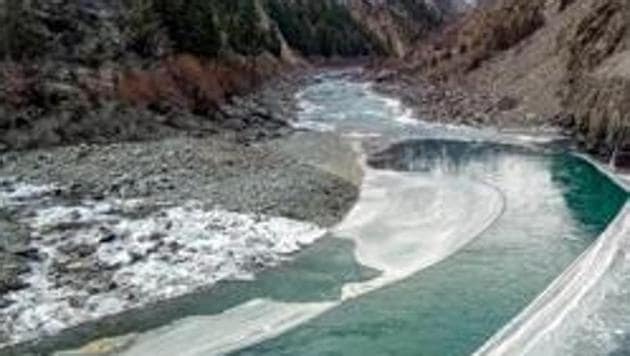
Under the Indus Waters Treaty, the western rivers, namely Indus, Chenab (in photo) and Jhelum, are allocated to Pakistan with India given some rights. (PTI File)

In a letter to Indian Commissioner Pradeep Kumar Saxena sent on Wednesday, his Pakistani counterpart Syed Mohammed Meher Ali Shah stated that the discharge at Marala Headworks on Chenab, which flows into Pakistan from the Indian side, has unexpectedly reduced to 18,700 cusecs from 31,853 cusecs.

He also asked Saxena to look into the situation and apprise him.

The Indian Commissioner for Indus Waters termed the claim as “another baseless narrative” by Pakistan and said the matter has been examined. “The discharges at Akhnoor and Sidhra which are the last gauge and discharge sites on Chenab and Tawi rivers respectively in India have been found consistent and show no significant variation during the stated period,” Saxena told PTI on Friday. He added the same response has been conveyed to Pakistan advising it to get the matter examined instead.

The Permanent Indus Commission, formed under the Indus Waters Treaty was signed between India and Pakistan in 1960. Indus commissioners of both the countries act as representatives of the respective governments for the treaty matters.

It specifies that the waters of three the eastern rivers namely Ravi, Beas and Sutlej, have been allocated exclusively to India. Of the total 168 million acre-feet, India’s share of water from the three allotted rivers is 33 million acre-feet, which constitutes nearly 20 per cent. India uses 93-94 per cent of water. The western rivers, namely Indus, Chenab and Jhelum, are allocated to Pakistan with India given some rights like agriculture, navigation, domestic use and also the unrestricted rights to develop hydroelectric power projects within the specified parameters of design and operations.

In March, the annual meeting between Indus Commissioners was postponed after New Delhi proposed deferment of consultations due to the coronavirus pandemic and lockdown.

The Indus Commissioners are supposed to hold meeting by March 31 every year, according to the Indus Waters Treaty.

 
ABOUT THE AUTHOR
HT News Desk

Follow the latest breaking news, major developments and agenda-setting stories from India and around the world with the newsdesk at Hindustan Times. Operating round the clock, the desk brings together experienced editors, reporters and correspondents to deliver fast, accurate and contextual reporting across subjects that influence public policy, governance, business, society and international affairs. The HT News Desk covers politics, elections, government policies, the economy, business and markets, science and technology, the environment, law and order, infrastructure, education, climate issues and geopolitics, while closely tracking developments across states, institutions and global capitals. The team also leads coverage of major breaking news events, policy announcements, court proceedings, natural disasters, public emergencies and significant international developments. Reports published by the newsdesk are based on information gathered from reporters on the ground, official statements, government agencies, court records, regulatory filings, recognised institutions and other authoritative sources. Stories undergo editorial scrutiny and verification processes to ensure accuracy, fairness and relevance, and are updated as events evolve and additional information becomes available. Whether covering a key political decision in New Delhi, an economic policy shift affecting millions, a landmark court ruling or a major global event, the HT News Desk aims to provide readers with reliable, fact-based journalism that delivers not only the latest developments but also the context and analysis needed to understand their wider implications.

Get Latest News, breaking headlines, and top India News, and today real-time updates from across the nation. Stay informed on politics, government policies, crime, Today Weather, and major developments on Hindustan Times
SHARE THIS ARTICLE ON
Notifications

Get breaking alerts directly from the newsroom

Notifications are on!You'll be notified when news breaks