The intervention of the chief justice’s court in the recent case of the arrests of prominent social activists and lawyers should mark a turning point in the way in which the judiciary has looked at “terrorist” cases. For too long the apex court has been deferential to the State, and it only needed the use of the word “terrorism” for the former to uphold the constitutional validity of security legislation. While dealing with the Armed Forces Special Powers Act (AFSPA) the Supreme Court upheld its constitutional validity despite glaring provisions allowing the killing of persons on the basis of “suspicion”. Subsequently, 300 persons every year for decades were killed in fake encounters in Manipur alone until the Supreme Court intervened in the Extra Judicial Execution Victim Family Association (EEVFAM) case holding that the security forces had no immunity in cases of fake encounters. That intervention had a miraculous result and brought down the killings to three a year. The Terrorists and Disruptive Activities Act (TADA) and The Prevention of Terrorism Act (POTA) were similarly upheld as constitutionally valid despite an alarming provision allowing for confessions to a police officer to be treated as legally valid evidence. It took widespread protests for Parliament to repeal the statute but not before hundreds were jailed in false cases akin to the emergency arrests. The equally repressive Unlawful Activities Prevention Act (UAPA) is today the main instrument of state terror.
What is remarkable about state repression from the Punjab massacres of young Sikh boys onwards is the pronounced story telling aspect of state prosecutions. Fanciful tales of despotic acts performed by “terrorists” rapidly replaced truthful investigations and carefully crafted charge sheets. In the Punjab cases the Central Bureau of Investigation found that many charge sheets were utterly false with made up stories and fabricated evidence. In the Manipur cases the Commission appointed by the Supreme Court and headed by Justice Hegde found all the six sample cases of terrorist attacks, fake encounters in reality. Not a single one of the accused persons were terrorists. In fact, they had no criminal background at all. Subsequently, CBI charge sheeted security personnel for “cold blooded murder” leading to a protest by 300 army personnel in the media and a case in the Supreme Court where the officers tried to intimidate the Court by reference to patriotism and national security. All this to hide serious criminal activity of murder by men in uniform.
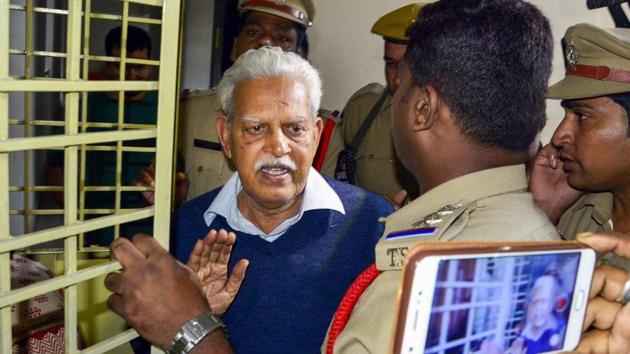
Gautam Navlakha’s case in the High Court was a fairy tale at its highest. One of the leading human rights activists of the Peoples Union for Democratic Rights, he was sought to be arrested on an FIR relating to the Bhima Koregaon protests by Dalit organisations. His name does not appear in the FIR. It is undisputed that he was not even present at the site. The case diaries were not produced by the police before the magistrate. Translated copies were not produced before the High Court. Therefore, there was no material to indicate the charges levelled against Navlakha on the basis of which his arrest was sought. Protesting his arrest he wrote “The entire case is a political ploy against political dissent to divert attention from the government scams and failures from Kashmir to Kerala. For the cause of democratic rights I have covered many trials. Now I will be witness to a political trial with a ring side seat”.
{{/usCountry}}Gautam Navlakha’s case in the High Court was a fairy tale at its highest. One of the leading human rights activists of the Peoples Union for Democratic Rights, he was sought to be arrested on an FIR relating to the Bhima Koregaon protests by Dalit organisations. His name does not appear in the FIR. It is undisputed that he was not even present at the site. The case diaries were not produced by the police before the magistrate. Translated copies were not produced before the High Court. Therefore, there was no material to indicate the charges levelled against Navlakha on the basis of which his arrest was sought. Protesting his arrest he wrote “The entire case is a political ploy against political dissent to divert attention from the government scams and failures from Kashmir to Kerala. For the cause of democratic rights I have covered many trials. Now I will be witness to a political trial with a ring side seat”.
{{/usCountry}}Similarly, in the case of Sudha Bhardwaj, now under house arrest and protected by the order of the Supreme Court, her name does not appear in the FIR. She wrote a statement on her arrest saying “when I asked whether they had moved any application before the concerned Court they said no. They showed me a copy of the FIR dated 8.1.18 regarding the Bhima Koregaon incident with which I have no connection whatsoever. When I asked what was my specific offence, they did not tell me. when I asked specifically if the letter shown on Republic TV regarding which I have already issued a public statement and legal notice, was the issue being investigated, Shinde said he did not know.”
In the Akshardham Temple “terrorist attack” case, the Supreme Court acquitted the accused persons with the observation “Before parting with the judgment, we intend to express our anguish about the incompetence with which the investigating agencies conducted the investigation of the case of such a grievous nature, involving the integrity and security of the nation. Instead of booking the real culprits responsible for taking so many precious lives, the police caught innocent people and got imposed the grievous charges against them which resulted in their conviction and subsequent sentencing.” I wish I had been there at Bhima Koregaon protesting with others in what could well turn out to be the beginning of a second national movement for genuine independence and democracy.
(Colin Gonsalves is a senior Supreme Court advocate and founder, Human Rights Law Network. Views expressed are personal.)