For families living along Bihar’s rivers, crossing the water is rarely an adventure. It is part of an ordinary day. A boat takes a farmer to his fields, a teacher to a school, a child to a classroom and a worker to a job on the other bank. Markets, hospitals and social gatherings can all lie across a stretch of water that is deceptively familiar.
Yet an everyday journey can turn into a last one.
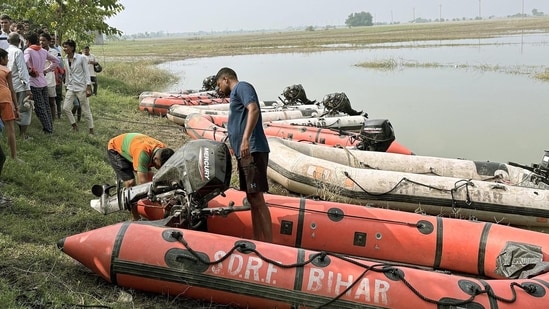
On the night of October 13, at least 13 people died when a boat capsized in the Ganga near Raghopur in Vaishali district. Twelve of the victims were reported to be children. The passengers were travelling at around 8.30pm to attend a feast when the boat overturned. Initial reports suggested that the vessel was small and may have been carrying more passengers than it could safely accommodate.
The tragedy was devastating in its immediate human cost. But it also raised a more uncomfortable question: why does crossing a river in Bihar remain so dangerous when the risks have been known for years?
For the families who lost loved ones, compensation and rescue operations may offer some immediate assistance. They cannot explain why an ordinary journey was allowed to become a catastrophe. Nor can they guarantee that another family will not face the same loss at another ghat.
A river is a road, but without its rules
Bihar’s rivers are both a lifeline and a hazard. Along the Ganga, Gandak, Kosi, Ghaghra, and other waterways, settlements in the diara areas remain dependent on boats for access to farms, schools, markets, and essential services. In some places, a bridge is unavailable; in others, reaching one requires a long detour.
{{/usCountry}}Bihar’s rivers are both a lifeline and a hazard. Along the Ganga, Gandak, Kosi, Ghaghra, and other waterways, settlements in the diara areas remain dependent on boats for access to farms, schools, markets, and essential services. In some places, a bridge is unavailable; in others, reaching one requires a long detour.
{{/usCountry}}The scale of this dependence is considerable. Information obtained from the Patna centre of the Inland Waterways Authority in January 2026 put the number of operational boat services across the state at more than 7,000, spread across 1,550 ghats. The state government has also planned community jetties at another 150 locations.
These figures describe more than a transport network. They represent thousands of daily decisions made by people who must weigh convenience, cost, and necessity against the river's dangers.
For many passengers, refusing to board an overcrowded boat may not be a straightforward choice. The next service could be far away, a road journey could consume precious hours, and a missed trip could mean lost wages or a day’s work abandoned. In such circumstances, risk becomes normalised. What should be an exceptional breach of safety becomes part of the routine.
That does not absolve passengers or boat operators of responsibility. But it does explain why public safety cannot depend entirely on individual caution. When a service is essential, the state must ensure that the risks are controlled.
A bridge does not end dependence
Raghopur illustrates the limits of infrastructure-led solutions. A six-lane bridge has recently improved connectivity between Patna and the area. It would be tempting to assume that the bridge has made river crossings obsolete.
It has not.
Raghopur is a large riverine area, and the bridge does not connect every village to every destination. Residents still need boats to travel between settlements and reach places such as Bidupur. The geography that makes a bridge valuable also ensures that smaller crossings remain necessary.
Dhirendra Kumar, a Patna-based journalist, said boat services at ten ghats in Raghopur—eight along the Ganga and two towards the Gandak.
“At Jameendari Ghat, motorised boats can be seen carrying motorcycles alongside passengers. No visible load lines to indicate safe passenger limits and no readily apparent life jackets for travellers, which resulted to the death of a teacher who had fallen from a boat the previous year. The warning signs are never invisible,” he said.
A bridge can shorten a journey. It cannot substitute for inspections, enforce passenger limits or ensure that a boat carrying children at night has the equipment needed to protect them.
The cycle of tragedy and forgotten promises
Bihar’s record of boat accidents reveals a familiar pattern: disaster, public outrage, official instructions and, eventually, a return to business as usual.
In September 2009, a boat capsized near Phultora Ghat in Khagaria district on the Bagmati, killing around 60 people. Overcrowding and bad weather were among the factors reported at the time.
In January 2017, a boat accident on the Ganga in Patna during the Makar Sankranti festivities killed 24 to 25 people, according to different reports. The passengers were returning from a kite-flying event in the riverine area.
Separate boat accidents in Khagaria and Saharsa in August 2020 claimed several lives, with adverse weather and strong winds reported as contributing factors. In 2021, another incident near Khagaria’s Sidhi Ghat left two people dead, while some passengers were reported missing. In May 2026, an accident near Umanath Ghat in the Patna region involving workers travelling by boat also prompted renewed questions about safety and oversight.
The circumstances differ. Weather, mechanical failure, overcrowding and darkness can each contribute to an accident. But the recurring absence of effective safeguards points to a common institutional weakness.
“After the death of teacher Avinash Kumar, who fell into the Ganga near Nasriganj Ghat in Patna in August 2024 while travelling to a school in the diara area, authorities issued directions concerning boat registration, life jackets, trained divers and passenger capacity,” said Kumar, adding, “Similar assurances followed later accidents. Yet the Raghopur tragedy suggests that instructions issued after one disaster do not necessarily become safeguards before the next.”
The problem is not simply that rules are missing. It is that their enforcement appears intermittent, often gathering momentum only when bodies have to be recovered from a river.
The unequal politics of safety
Consider the contrast with road transport. The Bihar transport department has increasingly emphasised road safety, including enforcement against motorcyclists riding without helmets. A violation can result in a challan, which is sometimes delivered electronically to the vehicle owner.
Such enforcement is justified. Helmets save lives, and rules that are not enforced quickly lose their force.
But passengers boarding boats face a different reality. There is often no visible load limit, no assurance that life jackets are available, and little indication that an inspection has taken place. Even large government-operated vessels that ferry people across the Ganga have raised concerns about the availability of life-saving equipment.
The contrast is difficult to defend. If a helmet is an essential safety requirement on a motorcycle, a life jacket should not be an optional extra on a boat. If a road vehicle must comply with safety standards, a passenger vessel should also be subject to checks appropriate to its risks.
The comparison is not entirely straightforward: rivers have different hazards, and small boats operating in remote areas are harder to regulate than vehicles on roads. But administrative difficulty cannot become an excuse for administrative neglect.
The government collects revenue from the management and settlement of ghats. At a minimum, passengers should be able to expect basic facilities, clearly displayed safety information and a system that identifies who is responsible for the service.
Like his predecessors, state transport minister Damodar Raut also said that the government has taken cognisance of the incident and a high-level committee will investigate it. “We’ll make everything in order, so that no such incident could take place in future,” he said.
Making safety part of the journey
Bhagwanji Pathak, a river expert from Bihar and the co-ordinator of the Kosi Consortium, says the solution is not to shut down boat services, as it would punish communities whose access to education, healthcare and livelihoods depends on them.
“The task is to make river transport safer without making it inaccessible. First, Bihar needs an updated public register of its operational boats and ghats, in which each vessel should have verifiable registration, a clearly specified passenger capacity, and a record of its safety equipment. Second, inspections must be routine rather than reactive, where officials should check vessels before they enter service, with particular attention to overloading, engine condition, life jackets, lighting, and other equipment appropriate to the type of boat. And finally, responsibility must be clearly assigned to the transport department, district administrations, ghat-management authorities, and those responsible for licensing or settling ghats cannot leave enforcement in a bureaucratic grey zone. Passengers should know where to report violations, while officials should be held accountable for repeated failures at crossings under their supervision,” he said.
He further said that the life jackets should be available in sufficient numbers and passengers should be instructed to use them.
“Emergency contact details, permitted passenger limits and the name of the responsible authority should be displayed prominently at ghats. Public reporting of inspections would help establish whether the rules are being followed,” he added.
The journey that should not end in grief
A boat ride across the Ganga may take only a few minutes. For families who depend on it, those minutes are woven into the rhythm of everyday life. They should not require a calculation about whether a child, a worker or a teacher will return home.
The deaths in Raghopur demand an investigation into the immediate causes of the capsizing. But the inquiry must also ask questions that extend beyond one vessel: Was its capacity exceeded? Were safety devices available? Was the boat authorised to operate at night? When was the ghat last inspected, and who was responsible?
Answers to these questions matter because the next boat is unlikely to wait for a comprehensive reform of Bihar’s waterways. It will probably leave as usual, carrying people who have somewhere to go.
The state has counted its ghats and boats. It has announced jetties and issued safety instructions. What remains missing is the assurance that these measures will work on an ordinary evening, long after public attention has moved elsewhere.
In Bihar, a bridge may change the landscape. Only consistent enforcement can change the odds of reaching the other bank alive.