The home ministers of BIMSTEC member countries on Tuesday approved a series of regional cooperation measures to strengthen the fight against human trafficking, drug trafficking, money laundering, terror financing and illicit financial flows, while enhancing preparedness and coordination to tackle natural disasters in the Bay of Bengal region.
The measures aim to improve cross-border cooperation, build institutional capacity, facilitate information sharing and strengthen joint efforts to address shared security and disaster management challenges, a government statement said.
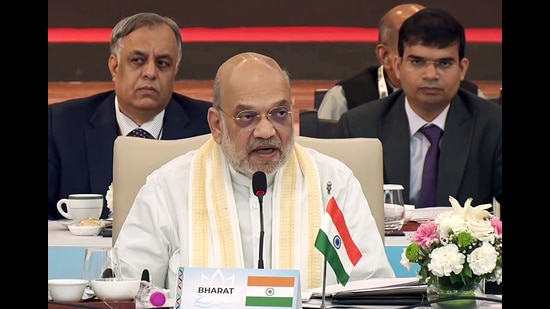
India hosted the first BIMSTEC Ministerial Meeting of home ministers chaired by Union home minister Amit Shah and attended by delegations from Bangladesh, Bhutan, India, Myanmar, Nepal, Sri Lanka, and Thailand.
Also Read: Shah calls for regional approach to tackle drug smuggling, seeks BIMSTEC cooperation
Deep Dive
What security measures did BIMSTEC home ministers approve?
Why did Amit Shah call for a regional approach to drug trafficking?
How will BIMSTEC countries strengthen cooperation against terrorism and organised crime?
“We are committed to full implementation of the BIMSTEC Convention on cooperation in combating challenges such as international terrorism, transnational organised crime, and illicit drug trafficking. India has the policy of zero tolerance against terrorism. Our shared resolve must be to ensure that no part of the region provides any scope for terrorist networks to seek shelter, recruit members, undergo training, raise funds, or carry out activities against neighbouring countries,” Shah said in his address at the start of the meeting.
Shah called for a whole-of-region approach to tackle drug smuggling and sought cooperation from the Bay of Bengal Initiative for Multi-Sectoral Technical and Economic Cooperation (BIMSTEC) member countries. He underlined that the illicit funds generated from drugs are used in financing organised crimes and terrorism.
{{/usCountry}}Shah called for a whole-of-region approach to tackle drug smuggling and sought cooperation from the Bay of Bengal Initiative for Multi-Sectoral Technical and Economic Cooperation (BIMSTEC) member countries. He underlined that the illicit funds generated from drugs are used in financing organised crimes and terrorism.
{{/usCountry}}Also Read: India’s Neighbourhood First policy: Need for strategic recalibration
“The security of one member country strengthens the security of the entire region, guided by this principle, India remains committed to a peaceful, secure, and prosperous Bay of Bengal region,” he said.
BIMSTEC, a regional grouping, aims to promote economic and technical cooperation among Bangladesh, Bhutan, India, Myanmar, Nepal, Sri Lanka and Thailand.
Shah said that cooperation in disaster management across the BIMSTEC region is one of his highest priorities. He said that during the 6th BIMSTEC Summit, Prime Minister Narendra Modi proposed establishing a BIMSTEC Disaster Management Centre in India.
“The centre is planned to be established in Jamnagar, Gujarat, underscoring India’s role as a first responder in disaster management across the region,” he said while urging BIMSTEC member countries to actively participate in making the proposed centre operational.
The government statement said that all member countries approved an Action Plan for enhancing preparedness and coordination to address natural disasters in the Bay of Bengal Region, proposing coordinated efforts by member countries in regional risk planning, joint exercises, early warning systems, disaster mapping, training centres, information sharing, research, technological innovation, and tsunami risk reduction.
At the meeting Shah reiterated the importance of timely intelligence sharing, financial investigations, mutual legal assistance, and extradition to ensure that criminals and terrorists are brought to justice.
“Our shared resolve should be to ensure that terrorist networks are not allowed to find safe havens, recruit members, provide training, raise funds, or carry out activities against neighbouring countries from any part of the region. In accordance with national laws and applicable treaties, cooperation in mutual legal assistance and extradition could strengthen our efforts to bring criminals to justice,” he said.
Shah referred to the so-called Golden Triangle—the drug smuggling route encompassing Myanmar, Laos and Thailand—as the death triangle, and said there is nothing golden about it.
“Drug trafficking is essentially death trafficking. There is nothing golden about the trafficking of narcotics. This is not merely the drug trade, but an attack on the lives of our youth, society, culture, and the future of coming generations. This cannot be tackled by the efforts of a single country alone. We must adopt a whole of region approach,” he said.
India has vowed to eradicate drug syndicates by December 31, 2029 and declare India drug free by 2047.
In its annual report released in June, India’s Narcotics Control Bureau said Myanmar overtook Afghanistan as the world’s largest illicit opium producer after the Taliban’s 2022 poppy ban, due to decade-high production amid economic collapse, civil war and the 2021 military takeover. India has begun fencing the India-Myanmar border.
Shah said PM Modi had described BIMSTEC as a model for inclusive development and security during the 6th BIMSTEC Summit in Bangkok on April 4, 2025. He urged Home Ministers to translate cooperation into practical mechanisms to strengthen citizen safety and agency capabilities, reaffirming India’s commitment to implementing the BIMSTEC Convention to combat international terrorism, transnational organised crime and illicit drug trafficking.