NEW DELHI:
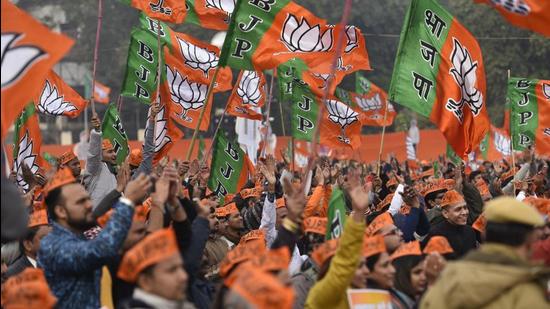
After changing chief ministers in Gujarat and Uttarakhand, the Bharatiya Janata Party (BJP) is looking to drop as many as half of the sitting legislators to blunt anti-incumbency in the states going to polls in 2022, said party functionaries aware of the details.
In the previous assembly elections, the party had dropped 15-20% of the sitting MLAs, but the figure could be much higher this time given public dissatisfaction over a host of governance issues, said a senior party functionary.
Assembly elections will be held in Punjab, Manipur, Uttarakhand, Uttar Pradesh, Goa, Gujarat and Himachal Pradesh in 2022.
“In several states, the party has carried out ground surveys to assess the mood. MLAs were also asked to submit their report cards of the work done in the last five years, which were tallied with the party’s own findings. Those whose performance has not been up to the mark will not be repeated,” the functionary said, requesting anonymity.
The legislators are being assessed on parameters such as the spending of local area development funds, projects done to empower the marginalised, and their contribution to the big-ticket Seva Hi Sangathan programme — the party’s welfare programme launched during the pandemic. Surveys were done across constituencies where people’s feedback on the government’s performance was sought.
“The Covid-19 pandemic came with an unprecedented challenge. While the government did its bit by ramping up the health infrastructure, ensuring vaccination and scaling up medical supplies, the party also did its bit by organising relief work. The party president (JP Nadda) had asked each state unit to carry out campaigns to feed the needy, assist those who lost their jobs and ensure 100% vaccination in their respective booths under the Seva Hi Sangathan campaign. The work done by the MLAs on the seva front will also be counted,” said the functionary.
{{/usCountry}}“The Covid-19 pandemic came with an unprecedented challenge. While the government did its bit by ramping up the health infrastructure, ensuring vaccination and scaling up medical supplies, the party also did its bit by organising relief work. The party president (JP Nadda) had asked each state unit to carry out campaigns to feed the needy, assist those who lost their jobs and ensure 100% vaccination in their respective booths under the Seva Hi Sangathan campaign. The work done by the MLAs on the seva front will also be counted,” said the functionary.
{{/usCountry}}Countering anti-incumbency has been a key concern for the party. It is for this reason that the central leadership decided to replace Vijay Rupani as the CM of Gujarat. An all-new cabinet was also sworn in to help reinvigorate the party cadre in the state that will go to the polls towards the end of 2022.
“It is not unusual for the party to deny sitting legislators tickets based on various reasons. For instance, in Rajasthan in 2018, the BJP dropped 43 sitting MLAs, including four ministers. In Jharkhand, too, over a dozen sitting MLAs were dropped for younger and newer faces representing women and SC/ST communities,” he said.
Performance isn’t the only factor that will determine ticket distribution. According to a second functionary, given the growing clamour for a caste-based census, BJP will also have to pick faces that will strengthen its outreach among castes that it courts for favourable electoral outcomes. The BJP has been eyeing a coalition of non-dominant castes to build its support base. In states such as Uttar Pradesh and Gujarat, it had invested in the non-dominant castes, but with a change in political discourse following the demand for a caste census, the party has had to revisit its policy. Subsequently, it has appointed a Patidar CM in Gujarat and a Thakur CM in Uttarakhand.
“The caste of a candidate has always been a key factor in deciding tickets. The party does not believe in appeasement of any caste and has ensured that government’s policies at the Centre and in the states benefit people across castes and classes,” said the second functionary based in Uttar Pradesh.
The issue of giving tickets to turncoats will also feature prominently. In the past few years, the BJP leadership has been accused of overlooking the party cadre for those who come from other political parties. “In many instances, the turncoats did not win. Take the case of Gujarat. In the 2017 polls, 81 BJP MLAs were repeated, while the rest were fresh faces or those who had contested in elections before 2012. Four of the six Congress turncoats who were given tickets lost. Similarly, in West Bengal recently, there was a lot of resentment in the party cadre for giving Trinamool Congress turncoats tickets and party positions,” said the first functionary.
Dropping sitting MLAs serves the twin purpose of diverting public attention and mitigating public anger, said professor M M Semwal, head of the political science department at the HNB Garhwal Central University in Uttarakhand. “When governments fail to deliver on their promises, they pass the buck. Instead of taking collective responsibility, the government will blame the individual legislators, so when elections come and people ask questions they react by such posturing,” he said.
.