E-Paper



Buddha statue, dancing Ganesha: Inside the $14 million-worth 657 antiquities that the US returned to India
The artefacts were handed over at an event attended by Rajlakshmi Kadam from the Consulate General of India in New York

 Prefer HTon Google


India has received 657 antiquities from the United States, collectively valued at nearly $14 million. These artefacts were stolen and trafficked through international networks before being sold in the US. Two key figures linked to the racket are disgraced art dealer Subhash Kapoor and convicted trafficker Nancy Wiener.
Announcing the repatriation, Manhattan District Attorney Alvin Bragg said more efforts are needed to return stolen cultural property to India. The artefacts were handed over at an event attended by Rajlakshmi Kadam from the Consulate General of India in New York.
“The scale of the trafficking networks that targeted cultural heritage in India is massive, as demonstrated by the return of more than 600 pieces today,” Bragg said, adding that much work remains to bring back looted antiquities.
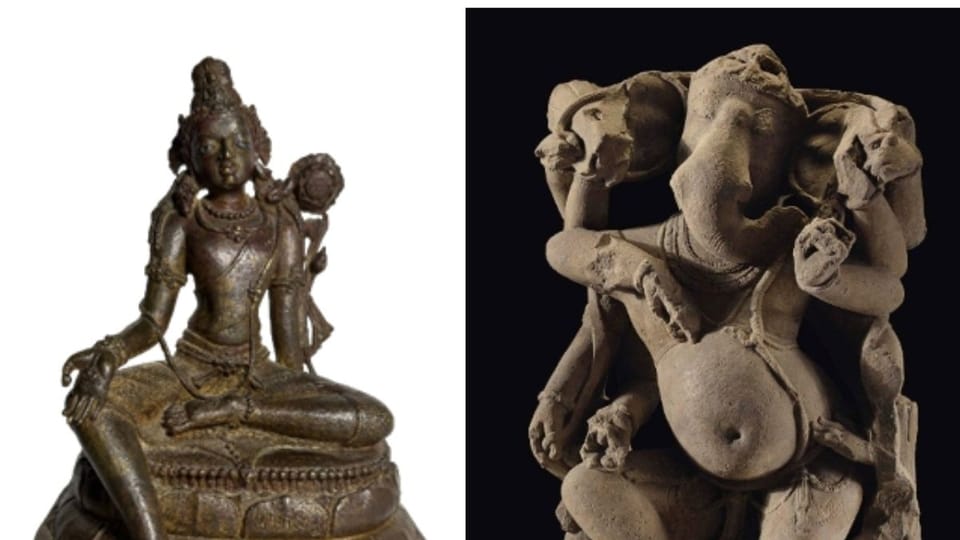
1. Avalokiteshvara bronze statue
A bronze figure of Avalokiteshvara, valued at $2 million, depicts the deity seated on an inscribed double-lotus base above a lion-flanked throne. The inscription names the craftsman as Dronaditya of Sipur, near present-day Raipur in Chhattisgarh.
The sculpture was one of a large hoard of bronzes discovered near the Lakshmana Temple in 1939 and later housed at the Mahant Ghasidas Memorial Museum in Raipur. The statue was stolen from the museum and smuggled into the US by 1982, ultimately ending up in a private collection in New York by 2014.
Also Read | In photos: Artefacts from 1,000 years of samurai history
2. Dancing Ganesha sandstone sculpture
A sandstone statue of a dancing Ganesha was looted from a temple in Madhya Pradesh in 2000. In 2012, Wiener fabricated its provenance and sold it through Christie's New York after consigning it for auction. The piece was purchased by a private collector, who later surrendered it to authorities earlier this year.
3. Red sandstone Buddha in abhaya mudra
Another significant artefact is a red sandstone Buddha statue, depicted standing with the right hand raised in the abhaya mudra—a gesture symbolising protection.
The statue is damaged, with the feet broken below the knees and only fragments of the halo remaining, likely due to the circumstances of its theft from northern India. The $7.5 million-statue was smuggled into New York by Kapoor and was seized by the Antiquities Trafficking Unit from one of his New York storage units.
Consul General of India in New York, Binaya Pradhan, appreciated the sustained cooperation of the Manhattan District Attorney's Office, the US Department of Homeland Security, and the law enforcement agencies whose "continued vigilance," he said, "made the recovery and return of these culturally significant artifacts possible."
(With inputs from PTI)