The Union Cabinet chaired by Prime Minister Narendra Modi on Wednesday approved the Phase-Ill of the Centrally Sponsored Scheme (CSS) to strengthen and upgrade existing medical institutions in the country for increasing 5,000 postgraduate (PG) medical seats and 5,023 MBBS seats with an enhanced cost ceiling of ₹1.50 crore per seat.
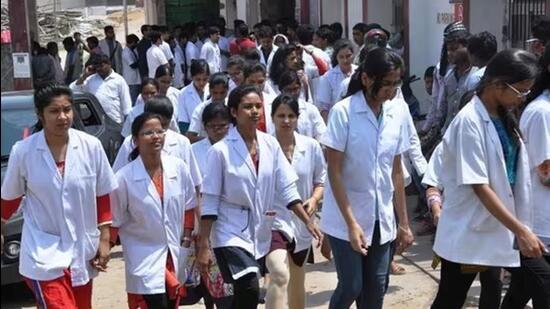
A Press Information Bureau (PIB) statement said the aim is to augment the undergraduate medical capacity, increase availability of specialist doctors by creating additional postgraduate seats, enable introduction of new specialties across government medical institutions, and strengthen the overall availability of doctors in the country.
It will strengthen and upgrade existing state and central government medical colleges, standalone post graduate (PG) institutes and government hospitals for increasing PG seats and extend CSS for upgrading existing government medical colleges for new MBBS seats.
The total financial implications of these two schemes is ₹15,034.50 crore for a period from 2025-26 to 2028-29. Out of ₹15034.50 crore, the central share is ₹10,303.20 crore and the state share is ₹4731.30 crore.
“The target of these schemes is to increase 5000 PG seats and 5023 UG seats in government institutions by 2028-2029,” said the PIB statement.
{{/usCountry}}“The target of these schemes is to increase 5000 PG seats and 5023 UG seats in government institutions by 2028-2029,” said the PIB statement.
{{/usCountry}}“It will also leverage existing infrastructure for cost-effective expansion of tertiary healthcare in the government institutions as expansion of postgraduate seats ensures a steady supply of specialists in critical disciplines. These schemes aim to promote balanced regional distribution of healthcare resources, while being cost-effective by leveraging existing infrastructure. In the long run, they strengthen the country’s health systems to meet existing and emerging health needs,” it said.
Also Read: Rajya Sabha elections for 4 J&K seats vacant since 2021, plus Punjab bypoll, on October 24
The ministry of health and family welfare said in a statement that realising Universal Health Coverage (UHC) for 1.4 billion people critically depends on building a robust healthcare system capable of delivering timely, high-standard services at all levels—particularly in rural, tribal, and hard-to-reach communities. A robust healthcare system hinges on availability of skilled and adequate workforce, it said.
India has 808 medical colleges with a total intake capacity of 1,23,700 MBBS seats. In the past one decade, at least 69,352 new MBBS seats and 43,041 PG seats have been added.
Further, the twenty-two new All India Institute of Medical Sciences (AIIMS) under the Pradhan Mantri Swasthya Suraksha Yojana (PMSSY) have also been approved to provide tertiary healthcare services.
To expand the pool of qualified faculty, new Medical Institution (Qualifications of Faculty) Regulations 2025 have been issued by adopting a more inclusive and competency-based approach to faculty eligibility and recruitment. “These changes aim to address the growing requirement of teaching personnel, and meeting the academic and professional standards,” said the health ministry.