Researchers have found a promising tiger population in the upper reaches of Dibang Valley in Arunachal Pradesh, the highest range in the Indian part of eastern Himalayas.
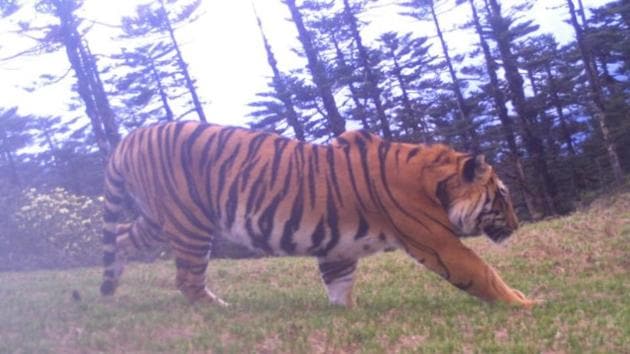
GV Gopi, a scientist with the Wildlife Institute of India who carried out the study, said as many as 11 tigers were caught on camera traps in a study from 2015 to 2017. Gopi carried out the study with Aisho Sharma Adhikarimayum, a research scholar.
The paper, First Photographic Record of Tiger Presence at Higher Elevations of the Mishmi hills in the Eastern Himalayan Biodiversity Hotspot, Arunachal Pradesh, India published in the journal Threatened Taxa, records tiger presence at an altitude of 3,630 metres.
One of the 108 camera traps deployed in and around the protected area for the study captured a tiger wading through thick snow in January 2017. Dibang Wildlife Sanctuary (DWS) is not a designated tiger reserve and is the highest site for the 2018 tiger census.
“In Bhutan, in the Eastern Himalayas, tigers have been spotted at an altitude of 4,200 metres,” Gopi said. “Once we survey the upper reaches of DWS, the more high altitude areas, we are hopeful we will find tiger population even above 4,200 metres,” he said.
It all started in December 2012, when two tiger cubs were rescued near the sanctuary. A rapid assessment study commissioned by the WII and National Tiger Conservation Authority (NTCA) found the partial image of a tiger in one of the camera traps leading to commissioning of the full-fledged study.
{{/usCountry}}It all started in December 2012, when two tiger cubs were rescued near the sanctuary. A rapid assessment study commissioned by the WII and National Tiger Conservation Authority (NTCA) found the partial image of a tiger in one of the camera traps leading to commissioning of the full-fledged study.
{{/usCountry}}“Considering we could only cover 336 square kilometres of the 4,149 square kilometres of the DWS, 11 tigers shows a high density. We are certain the actual population will be much higher once we cover the entire area in the next course of study,” Gopi said.
The 2014 census reported 201 tigers in the northeastern hills and the Brahmaputra plains out which five were reported in DWS, which extends over the Mishmi hills. The All India Tiger Estimation is held every four years.
Researchers claim the tigers spotted in DWS could be genetically different from those found in other parts of Arunachal Pradesh. The state has three tiger reserves including the Pakke Tiger Reserve, the Kamlang Tiger Reserve and the Nampdhapa Tiger Reserve.
“Those tiger populations are far from DWS. This one is isolated. Dibang is not even a designated tiger reserve,” Gopi said explaining why the genetics could be different.
Unlike other striped cats which like to feed on the Sambar deer or the spotted deer, the tigers of the DWS prey on Mishmi Takin, a goat-antelope unique to Arunachal Pradesh, as the scat analysis shows.
“It is the forest department of the state which needs to be more proactive now,” Gopi said.
The region inhabited by the Idu Mishmi tribe reveres tigers as elder brothers in the local folklore.
About 28.8% of India’s tigers live outside the tiger reserves, according to NTCA. With about 70% of the world’s free-ranging tigers, India is home to 2,226 of this endangered species, of which about 640 are outside the tiger reserves.