Authorities in Delhi will step up Covid-19 testing, including by resuming random sampling at metro stations, bus stops and markets, to bolster disease surveillance at a time when there has been an uptick in positive cases.
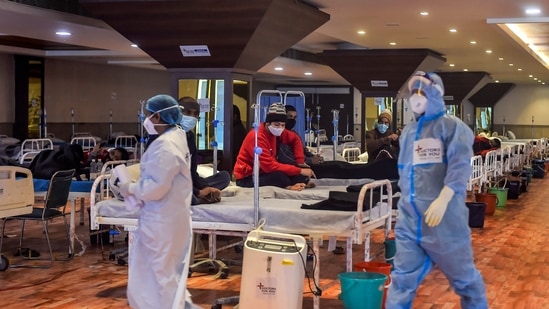
The Capital recorded 461 cases on Saturday, with 5.33% of all tests turning positive. Hospitalisation and fatality trends have remained flat and suggest there is no cause for alarm and experts have said the current rise in positivity rate may be exaggerated since only those developing symptoms are likely to be tested. But the recent uptick has prompted officials to reconsider some of the protocols, including the dropping of penalties on not wearing a mask.
The other step, a senior official in the Delhi government said on Saturday, includes more testing. “The gradual increase in the number of Covid-19 tests again will start from Monday. It will start showing from Tuesday’s bulletin. District administrations will soon be formally directed to intensify the testing and tracking strategy,” this person said, asking not to be named.
The matter will also be discussed in the Delhi Disaster Management Authority (DDMA) meeting scheduled on Wednesday (April 20). “Concrete guidelines to health and district teams are expected after the DDMA meeting but even before that, as cases continue to rise, some districts are planning to gradually intensify random testing at public places such as metro stations, bus stops, railway stations and, most importantly, markets,” the official said.
{{/usCountry}}The matter will also be discussed in the Delhi Disaster Management Authority (DDMA) meeting scheduled on Wednesday (April 20). “Concrete guidelines to health and district teams are expected after the DDMA meeting but even before that, as cases continue to rise, some districts are planning to gradually intensify random testing at public places such as metro stations, bus stops, railway stations and, most importantly, markets,” the official said.
{{/usCountry}}A government spokesperson confirmed that testing will be increased in coming days. “The health and revenue departments will come out with a plan in 2-3 days. The Delhi government never reduced its testing capacity. We still have one of the highest Covid-19 testing capacities compared to any other state or city with similar population size as ours or even more. Delhi has a capacity to test at least one lakh (100,000) samples every day and if needed, it can be increased to three lakh too. But, that much is not needed as of now since the situation is very much under control,” he said.
The spokesperson added that the testing numbers were particularly low in the past two days because of the gazetted holidays on Thursday and Friday, making it a long weekend.
There has also been an increase in the number of people testing positive in the Capital’s satellite towns. The Uttar Pradesh government said in a statement that on Saturday that it was putting National Capital Region cities of Ghaziabad and Noida on alert.
Data shows that the number of Covid-19 tests in Delhi has drastically declined this month. In April 2022 so far, Delhi has conducted merely 11,396 Covid-19 tests every day on average. The last time numbers were this low was in June, 2020. Throughout 2021, when the city was hit by two Covid-19 waves, the range of average daily Covid-19 tests was between 49,592 and 85,871. The dip began this year, dropping from an average of over 70,000 in January to the levels at present.
The Omicron variant that caused the most recent wave led to significant proportions of asymptomatic and mild cases, making positive infections a less crucial metric in terms of outbreak severity and authorities pivoted to focussing more on hospitalisation and fatality rates. This led to several protocol changes.
“One reason is that since January this year, the Indian Council of Medical Research (ICMR) revised the Covid-19 guidelines under which now contacts of Covid-19 patients no longer need to be tested, unless identified as high-risk based on age or comorbidities. Second, all curbs, including the rule of mandatorily wearing masks have been lifted as a result of which fewer people are taking tests in general. Third, people by now are used to the treatment and isolation process if one has mild to moderate symptoms. So, they get tested using the home kits and get treated by their known doctors mostly. Fourth, overall also, the government drive of Covid-19 tests slowed down because the positivity rate hit an all-time low,” a second senior official said, asking not to be named.
Dr Lalit Kant, former head of the epidemiology and communicable diseases department in the Indian Council of Medical Research (ICMR) said now that the rise in Covid-19 cases has been established in Delhi, the government should start increasing testing to pinpoint areas where the caseload may be high. “We need to be vigilant. Now that the numbers are increasing continuously, the authorities should consider measures to improve testing in Delhi,” Dr Kant said.