In the time of Covid pandemic, the Central government has made a record payment to MG-NREGA workers, the world’s biggest job guarantee scheme, in the financial year 2020-21, resulting in the rural development ministry being left with 10% of the total funds to be spent on the scheme in the remaining four months of the current fiscal year, shows government data.
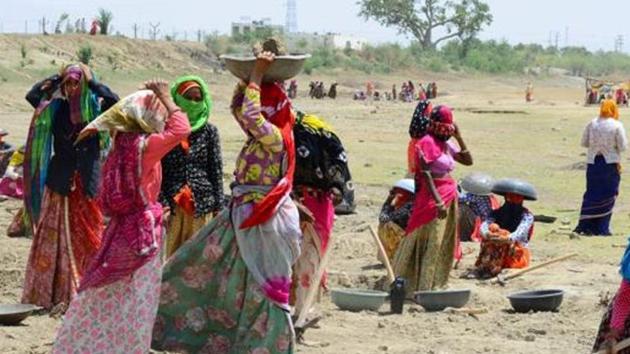
The rural development ministry, which administers Mahatma Gandhi National Rural Employment Guarantee Act (MG-NREGA) scheme, was provided with Rs 84,900 crore for the current financial year by the finance ministry in two instalments. Of this amount, the ministry data shows, Rs 76, 800 crore has already been spent. In comparison, till November 2019, the ministry had spent about Rs 50,000 crore on the scheme.
In fact, the ministry has spent 12 percentage points more than the allocation in the budget and has the highest expenditure rate among all Central government ministries, shows the Controller General of Accounts website. A finance ministry official privy to the matter, said there would be no shortage of funds for MG-NREGA and additional money will be provided as and when needed.
A MG-NREGA tracker released on Thursday said the huge expenditure on the scheme was on account of 10 million more households getting work under the MG-NREGA this year (till November), 243% increase in person days (work) generated and higher wage paid to workers as compared to previous years. “The total active job cards this year was 90.2 million and of them, 83.09% sought work,” the tracker prepared by People Action for Employment Guarantee (PAEG), a network of NGOs, said.
{{/usCountry}}A MG-NREGA tracker released on Thursday said the huge expenditure on the scheme was on account of 10 million more households getting work under the MG-NREGA this year (till November), 243% increase in person days (work) generated and higher wage paid to workers as compared to previous years. “The total active job cards this year was 90.2 million and of them, 83.09% sought work,” the tracker prepared by People Action for Employment Guarantee (PAEG), a network of NGOs, said.
{{/usCountry}}The higher demand for MG-NREGA work was because of close to 20 million workers returning to their villages from cities after the Central government announced nation-wide lockdown on March 24. Although the demand peaked in the month of May, it slowed down in subsequent months as workers from poorer states such as Odisha, Bihar and Jharkhand started returning to cities for work.
The report said the average work provided to individual households was less than the previous years.
Till November end, an average household got 41.59 days of work as compared to 48.4 in 2019-20 and 50.88 in 2018-19 financial years. Only 1.9 million households got work for 100 days as mandated under the NREGA law as compared to 4.06 million last year. Of them, 21,000 were in Rajasthan and 350,000 in Andhra Pradesh, which had to spend money from the state kitty to ensure NREGA workers got money on time. The number of households getting 100 days of work was lowest in Jharkhand and Tamil Nadu among all Indian states.
Also Read: Jharkhand man chased for Rs 3.5cr GST fraud turns out to be a daily wage worker
The report also said that around 13% of the 75 million households, who demand work, got no work. “The data shows that there was a surge for NREGA work demand due to the pandemic and the government failed to meet the demand,” the report said.
Uttar Pradesh and Jharkhand were the two states, where one-fourth of households demanding work, were not engaged even for a single day, the data showed. Rajasthan and West Bengal did well by keeping the unmet demand lower than the national average.
Jharkhand rural development secretary Aradhana Patnaik said they were one of the best performing states in creating man days under NREGA. “We have been stagnating around 70 million man days for the past three years. But, we have already achieved 77.7 million man days against the target of 80 million,” she said. A UP government official said that they have provided 87% more employment under NREGA then last year.
Also Read: Realty, hospitality sectors in Maharashtra yet to feel full force of migrant workers
Rajasthan MG-NREGA commissioner, PC Kishan said the scheme implementation in the state is completely demand-driven and right-based, hence unmet demand is less and employment provided is higher than previous years. “People are quite aware about their rights and entitlements and seek unemployment allowance if they do not get work within 15 days,” he said.
Nikhil Dey, a former member of MG-NREGA council, said the data clearly showed that the scheme provided a balm to poor and marginalized people during Covid but the governments did not do enough to ensure that all get sufficient work under the scheme.
“We would have been happy if more people would have got at least 100 days of work as compared to previous year. That did not happen and it proves government inefficiency,” he said.
(with inputs from Sanjoy Dey in Ranchi and Sachin Saini in Jaipur)