NEW DELHI: Beijing on Monday welcomed Prime Minister Narendra Modi’s remarks on India-China cooperation being essential for global stability and prosperity, and said the Chinese side stands ready to work with New Delhi to rebuild bilateral ties.
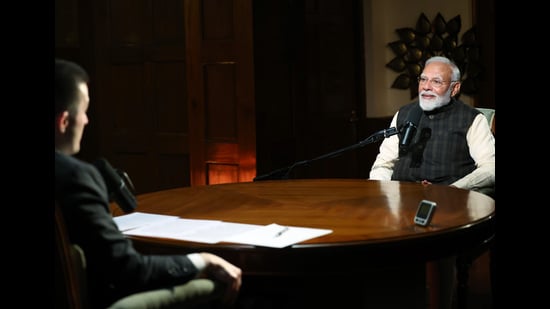
Modi said in a podcast aired on Sunday that differences between neighbours such as India and China are natural, but these shouldn’t turn into disputes since bilateral cooperation is necessary for global stability and prosperity. He acknowledged that incidents on the Line of Actual Control (LAC) in 2020 created “significant tensions” and said the two sides are working to normalise their relationship.
Chinese foreign ministry spokesperson Mao Ning responded to Modi’s remarks at a media briefing in Beijing on Monday by describing them as “positive” and saying that China is prepared to work with India to rebuild the relationship.
“China stands ready to work with India to implement the important common understandings between [Modi and President Xi Jinping], take the 75th anniversary of China-India diplomatic relations as an opportunity, promote exchange and cooperation in various fields and at all levels, and advance China-India relations on the track of sound and stable development,” Mao said.
China appreciates Modi’s “positive statements” on bilateral relations, and the successful meeting between Xi and Modi in Kazan last October “provided strategic guidance” for improving and developing bilateral ties, she said.
{{/usCountry}}China appreciates Modi’s “positive statements” on bilateral relations, and the successful meeting between Xi and Modi in Kazan last October “provided strategic guidance” for improving and developing bilateral ties, she said.
{{/usCountry}}“Both sides have earnestly followed through on the important common understandings of our leaders, strengthened exchanges and practical cooperation at all levels, and achieved a series of positive outcomes,” she said.
Last October, India and China reached an understanding on ending the military face-off along the LAC, which was triggered by skirmishes between troops in Ladakh sector in April-May 2020. The understanding was followed by the meeting between Modi and Xi in the Russian city of Kazan, and the two leaders agreed to revive several mechanisms to address the border dispute and normalise ties.
Mao also reiterated Modi’s remarks that India and China have no history of conflict in their relations going back thousands of years, and said the “mainstream of China-India interactions has been friendly exchanges and mutual learning”.
She said China and India, as the two largest developing countries, “should understand and support each other, and help each other succeed”. This serves the interests of more than 2.8 billion people in the two countries, “meets the common aspiration of regional countries, follows the historical trend of the Global South growing stronger, and is conducive to world peace, stability, development and prosperity”, she added.
“The two countries should be partners that contribute to each other’s success. A cooperative pas de deux [dance for two] of the dragon and the elephant is the only right choice for both sides,” Mao said, repeating a phrase used by Chinese foreign minister Wang Yi earlier this month.
Modi also said in the podcast that India has emphasised dialogue, instead of discord, with China to build a stable cooperative relationship. “Instead of discord, we emphasise dialogue, because only through dialogue can we have a stable cooperative relationship that is in the best interests of both nations,” he said.
Following his meeting with Xi last October, the two sides have seen a return to normalcy at the border and are now working to “restore conditions to how they were before 2020”, Modi said. “Our cooperation isn’t just beneficial, it’s necessary for global stability and prosperity...Competition is not a bad thing but there should not be conflict,” he added.