GUWAHATI: Union external affairs minister S Jaishankar on Tuesday said the India-Myanmar-Thailand highway will be a game changer for connectivity and economic prosperity between the eastern part of India and the South East Asian region.
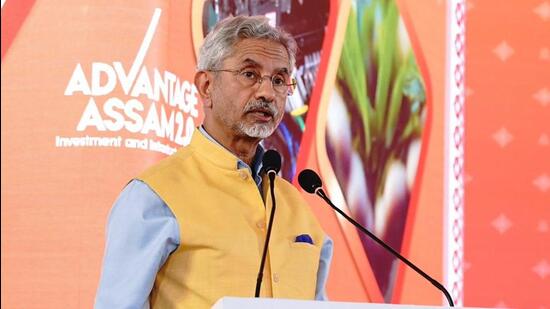
Addressing the Act East, Act Fast and Act First session of the Advantage Assam 2.0 infrastructure and investment summit, he said, “The real game changer will be the completion of the India-Myanmar-Thailand trilateral highway. Progress is currently challenged by the internal strife in Myanmar, but we can’t allow this to block something which is so momentous. Practical solutions will have to be found to ensure the advancement of this initiative”.
The 1,400-km-long highway that connects the three nations is nearly 70% completed, but the rest of the work has been affected at several places due to political changes in Myanmar since the military coup in 2021.
“South East Asia which has a population of almost 700 million, which is around half of India’s, and a GDP of about $ 4.25 trillion is a partner of enormous consequence. We can be mutually supportive in our journey towards prosperity and progress,” the external affairs minister said.
Jaishankar said that India’s neighbourhood first policy since 2014 has made significant progress whether it was in the context of Bangladesh, Bhutan, Nepal or Myanmar. It has resulted in new roads, checkpoints, railway lines, waterways, power grids, fuel pipelines and transit facilities with neighbouring countries especially in the east and northeast.
{{/usCountry}}Jaishankar said that India’s neighbourhood first policy since 2014 has made significant progress whether it was in the context of Bangladesh, Bhutan, Nepal or Myanmar. It has resulted in new roads, checkpoints, railway lines, waterways, power grids, fuel pipelines and transit facilities with neighbouring countries especially in the east and northeast.
{{/usCountry}}He said following the challenges of Covid pandemic and the fallout of the Ukraine conflict, India had acted fast and acted first in terms of vaccine supplies, flow of grains, supply of fertilisers and availability of fuel for its neighbours.
“For this foundation to be built upon, it is crucial that our partners have an equally positive view of its prospects. There are neighbours who have fully leveraged the economic opportunities that the growth of India presents. We welcome that and believe that the track record since 2014 should be set to rest and ambivalence,” said Jaishankar.
“There is, however, a tendency in some quarters to see just problems rather than look for solutions. At the end of the day, regional growth requires a genuine and wholehearted approach to cooperation. After all it takes two hands to clap,” he added.
Speaking on the issues in the east and northeast, he said the most glorious periods in Indian history were when the eastern region of the country was most prosperous.
“Unfortunately, that also made it a target for plundering and pillaging which accompanied the arrival of western powers to India. As they gained increasing control, the very direction of India’s international exchange changed. Resources shifted increasingly to the western coast, which faced Europe. As a result, historical ports in the Bay of Bengal saw a decline with the hinterland witnessing the related consequences,” said Jaishankar.
He added that partition of Bengal after Independence also inflicted damage to the prospects of Assam and the rest of northeast.
“The historical connectivity became deeply disrupted and it has been a challenge for Indian diplomacy to rebuild it. As today India recovers and rejuvenates, it is logical that there should be a greater focus on the east,” the minister said.
“We are not only correcting past mistakes but laying the foundation to explore new opportunities. It is only when the northeast and east realize their potential more fully that we can progress in our quest for Vikshit Bharat (Developed India),” added Jaishankar.