
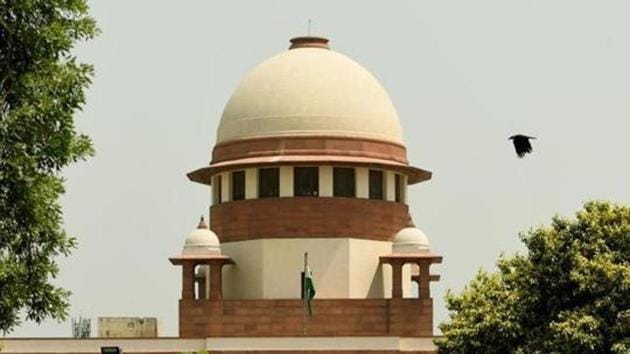
The Supreme Court on Wednesday decided to form a five-judge Constitution bench to scrutinize a Central law introducing 10% reservation in government jobs and college admissions for the poor among the general category of citizens.
The law titled Constitution (One Hundred and Third) Amendment Act, 2019 was passed by Parliament in January 2019 and made applicable to even private, unaided educational institutions.
It introduced two new clauses - Articles 15(6) and 16(6) -- by which the Government extended a helping hand to the economically weaker sections (EWS) in the general category of citizens.
Dealing with a host of petitions challenging the validity of the 2019 law, a three-judge bench headed by Chief Justice of India (CJI) SA Bobde felt it appropriate to refer the matter to a Constitution bench. The bench was of the view that the petitions raised a substantial question of law as to whether reservation could be granted on an economic criterion alone. No interim stay was ordered by the court, meaning that the states will be free to implement the 10% EWS quota.
A quota based on economic grounds had never been provided in the past. Beneficiaries of the 10% EWS quota were identified based on criteria set out by the government to identify the so-called creamy layer among reserved categories of citizens. This included households earning less than Rs 8 lakh annually. They were to own not more than 5 acres of agricultural land, or a residential flat with an area of 1,000 square feet and above, or residential plots not more than 100 yards in notified areas and 200 yards in non-notified municipal areas.
{{/usCountry}}A quota based on economic grounds had never been provided in the past. Beneficiaries of the 10% EWS quota were identified based on criteria set out by the government to identify the so-called creamy layer among reserved categories of citizens. This included households earning less than Rs 8 lakh annually. They were to own not more than 5 acres of agricultural land, or a residential flat with an area of 1,000 square feet and above, or residential plots not more than 100 yards in notified areas and 200 yards in non-notified municipal areas.
{{/usCountry}}The bench, also comprising justices R Subhash Reddy and BR Gavai, said, “By virtue of the impugned amendments, very Constitution is amended by inserting new clauses in Articles 15 and 16 thereof, which empower the State to make reservations by way of affirmative action to the extent of 10% to economically weaker sections….we are of the view that such questions do constitute substantial questions of law to be considered by a Bench of five judges.”
The lead petitioner, the non-government organisation Janhit Abhiyan, demanded that the law be referred to a Constitution bench for an added reason. Senior advocate Rajeev Dhavan, appearing for the NGO, submitted that the 10% quota will breach the existing ceiling of 50% on reservation fixed by a nine-judge bench of the apex court in the 1992 Indra Sawhney case.
Other petitioners argued that extending reservation benefits to private, unaided institutions violated Article 19(1)(g) which gives citizens the right to carry out any trade or profession. Attorney general KK Venugopal submitted for the Centre that the 50% rule can be breached in extraordinary situations.
Presently, there exists a 49.5% reservation in admissions and public appointments, apportioned between Scheduled Castes (15%), Scheduled Tribes (7.5%) and Other Backward Classess (27%).
The bench said, “It is the case of Union of India that though ordinarily 50% is the rule but same will not prevent to amend the Constitution itself in view of the existing special circumstances to uplift the members of the society belonging to economically weaker sections. Even such questions also constitute as substantial questions of law to be examined by a Bench of five Judges as per Article 145(3) of the Constitution read with Order XXXVIII Rule 1(1) of the Supreme Court of Rules, 2013.”
Following the three-judge bench order, the batch of more than 20 petitions will be placed before the CJI on the administrative side to form a five-judge bench.
ABOUT THE AUTHOR
Follow the latest breaking news, major developments and agenda-setting stories from India and around the world with the newsdesk at Hindustan Times. Operating round the clock, the desk brings together experienced editors, reporters and correspondents to deliver fast, accurate and contextual reporting across subjects that influence public policy, governance, business, society and international affairs. The HT News Desk covers politics, elections, government policies, the economy, business and markets, science and technology, the environment, law and order, infrastructure, education, climate issues and geopolitics, while closely tracking developments across states, institutions and global capitals. The team also leads coverage of major breaking news events, policy announcements, court proceedings, natural disasters, public emergencies and significant international developments. Reports published by the newsdesk are based on information gathered from reporters on the ground, official statements, government agencies, court records, regulatory filings, recognised institutions and other authoritative sources. Stories undergo editorial scrutiny and verification processes to ensure accuracy, fairness and relevance, and are updated as events evolve and additional information becomes available. Whether covering a key political decision in New Delhi, an economic policy shift affecting millions, a landmark court ruling or a major global event, the HT News Desk aims to provide readers with reliable, fact-based journalism that delivers not only the latest developments but also the context and analysis needed to understand their wider implications.