India has seen 66,286 new cases of Covid-19 on average every day in the week ended Monday. That works out to 5.3 cases per 100,000 people (assuming India’s population at 1.3 billion). One way of looking at the Covid-19 challenge is to target reducing the number of new cases to less than one per 100,000. This isn’t a number picked without basis – it is the trend seen in countries that managed to crush the virus, if only temporarily. That’s a huge challenge for India.
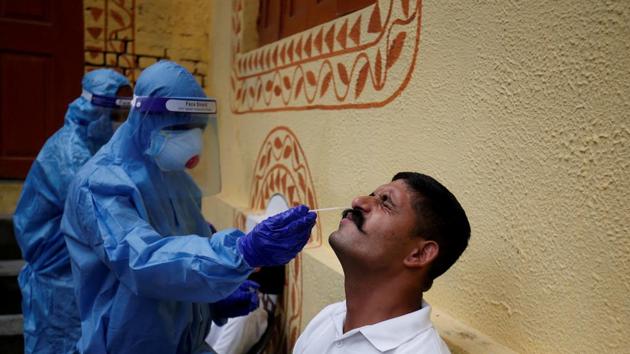
India’s Covid-19 numbers could well see an increase in the coming weeks – as testing increases (although states are blindly using rapid antigen tests without understanding when they should be used – a theme discussed several times in this column), and as the virus moves into rural India. Indeed, the pandemic’s progress in India has been outward – from the metros to the other cities and towns; and from urban districts to rural ones (see front page).
India and the US are similar in terms of their approach to the pandemic – they opened up when cases were still rising (unlike Europe, where countries opened up only after the number of new cases started declining). Sure, the US saw a dip and then a long plateau between mid-April and mid-June, but cases rose rapidly after that. They rose till late July, when they started falling again. Interestingly, the seven-day average of daily cases in the US is well off its peak seen in late July, but still higher than the peak seen in early April. In contrast, India’s seven-day average has never dipped – the trajectory of the coronavirus disease, in terms of number of cases, has been one steady upward curve as the infection spread across the second-most populous country in the world.
In the week ended Monday, India added 463,999 cases, according to the HT dashboard. This is 26% of the 1.75 million new cases recorded around the world in the same period (the second number is from the New York Times database). This statistic is worrying, although India’s case fatality rate of 1.85% is among the lowest in the world, and of the 3.16 million cases recorded till Monday night, 76% had recovered. The disease is yet to peak in India but doctors have clearly become better at saving lives.
{{/usCountry}}In the week ended Monday, India added 463,999 cases, according to the HT dashboard. This is 26% of the 1.75 million new cases recorded around the world in the same period (the second number is from the New York Times database). This statistic is worrying, although India’s case fatality rate of 1.85% is among the lowest in the world, and of the 3.16 million cases recorded till Monday night, 76% had recovered. The disease is yet to peak in India but doctors have clearly become better at saving lives.
{{/usCountry}}There has been some debate about a possible second lockdown in the US. There hasn’t been much talk of one in India. Through August, even some of the states that insisted on partial lockdowns (on certain days) have eased up. This is understandable – the lockdown has wreaked havoc on livelihoods and the economy. Once it became clear that the virus wasn’t going away anytime soon, and that a vaccine wouldn’t be available till early 2021, the focus moved to living and working with the virus.
The buzz in Delhi is that the next set of so-called unlock guidelines issued by the home ministry could reflect that. HT reported on Tuesday that Delhi Metro could soon begin operations. This is a good move, provided the safety protocols that have been put down on paper are faithfully implemented. That could be problematic, though. Many Indians have shown poor discipline when it comes to wearing masks or practising social distancing. Police departments around the country do not seem keen to enforce the home ministry’s guidelines on masks (there is very poor monitoring in markets and parks, especially). Many people who wear masks, wear them improperly. And experience around the world has shown that crowds, especially in enclosed places, are a magnet for the virus. Talk of restarting the Delhi Metro also comes at a time when the number of cases in Delhi is beginning to inch up again (although it is still 60-70% off its peaks) – all the more reason why safety and social distancing protocols will need to be strictly followed, and monitored.
There is no point in pretending things have returned to normal – because they haven’t.
Note: This article has been corrected to reflect the correct weekly average of daily cases.