A month after Xi Jinping was given unprecedented third term mandate by a rubber stamp 20th national party congress, cracks have appeared in fortress Communist China with Covid-lockdown frustrated Han Chinese raising slogans against the party and the core leader in Shanghai.
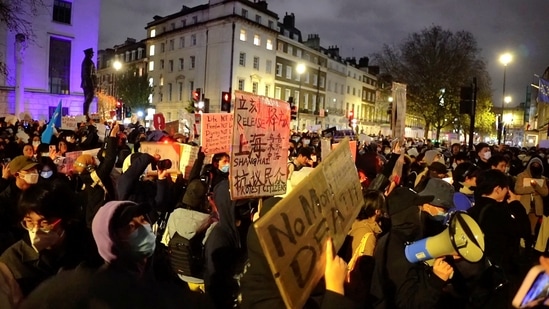
While many civil disobedience protests have erupted in major cities of Beijing, Shanghai, Nanjing, Wuhan, Lanzhou, Guangzhou, and Chengdu over draconian zero Covid policies of the Xi Jinping regime, the total clampdown in restive provinces of Tibet and Xinjiang have ensured that hardly any noise comes out of these once occupied territories.
The protests in Urumqi, capital of Muslim Xinjiang province, last Friday came as a deadly fire enraged residents who had been facing more than 100 days of Covid lockdown. The social media was flooded with comments that stringent covid restrictions led to death of 10 persons as there was delay in putting out the conflagration in a high rise apartment building. Reports from remote Tibet are equally grim with social media and blogs reporting Lhasa in a state of near lockdown in pursuit of zero lockdown policy.
Although the protests are unprecedented in China, but they will be put down by the authorities as the activists will be identified by face recognition cameras and sent for “re-education” in prison by the present regime. Protesters in remote Xinjiang and Tibet will be treated harshly and made example to those who have quietly suffered during three-month long lockdowns.
{{/usCountry}}Although the protests are unprecedented in China, but they will be put down by the authorities as the activists will be identified by face recognition cameras and sent for “re-education” in prison by the present regime. Protesters in remote Xinjiang and Tibet will be treated harshly and made example to those who have quietly suffered during three-month long lockdowns.
{{/usCountry}}However, the protests do take the sheen off the ascendence of President Xi as the supreme leader out to make China a global super power rivaling US. It also betrays the efficacy of Chinese vaccines, the logic of a zero Covid policy and the never-ending lockdowns. It was not so long ago that a banner opposing President Xi was unfurled on the highway overpass in Beijing in the run up to the 20th National Party Congress.
That the Han Chinese have come out in the open against the draconian Covid policy is also a measure what must be happening in the restive regions of Tibet and Xinjiang. Unverified reports from these regions indicate large scale arrests after protests in provincial capital of Lhasa and Urumqi but there is absolute radio silence from other cities on the Tibetan plateau and Sunni Muslim Xinjiang province.
Even though the protestors are merely asking for “freedom” from zero Covid policy, the Xi Jinping regime and the Communist Party of China will ensure through strong arm tactics that this disaffection with the government does not turn political. Neither the communist regime nor the public have forgotten the 1989 Tiananmen Square protests and the brutal reprisals that followed the massacre of democracy seeking activists.