As Cyclone Arnab weakened into a deep depression on Thursday, the remnant weather system continued to trigger torrential rainfall across southern Odisha districts of Gajapati and Ganjam, causing landslides, road damage, river swelling, and inundation of low-lying areas.
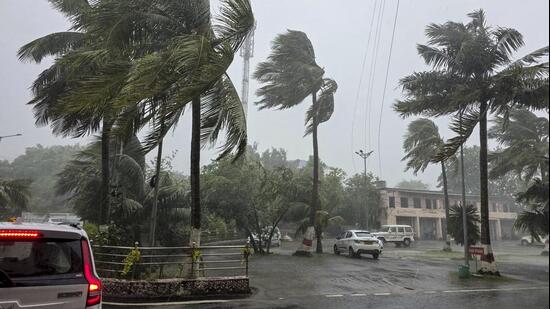
Puri: Coconut trees sway amid gusty winds and heavy rainfall triggered by Cyclone 'Arnab', in Puri, Odisha, Wednesday, Oct. 28, 2026. (PTI)
{{^htLoading}} {{/htLoading}}
The weather system was centred about 60 km south of Malkangiri district headquarters and was moving northwards at a speed of 15 kmph, the India Meteorological Department (IMD) said. It is likely to weaken further into a depression over the next few hours and, by evening, into a well-marked low-pressure area, it said.
{{^usCountry}}{{/usCountry}}
In Gajapati district, continuous rainfall for more than 36 hours disrupted transportation in hilly areas, with landslides and uprooted trees reported at several places.
Deep Dive
What damage did Cyclone Arnab’s rains cause in southern Odisha?
Heavy rain triggered landslides, uprooted trees and damaged roads in Gajapati, while rising rivers and waterlogging inundated villages and neighbourhoods. Flooding also stranded people and disrupted road connectivity, including near Sorada and on National Highway 326.
Which rivers overflowed in Gajapati and Ganjam after Cyclone Arnab?
The Vamsadhara was flowing at 55.58 metres at Kashinagar, above its 54.60-metre danger mark, while the Mahendratanaya inundated villages in Goshani and Rayagada blocks. The Ghodahada also swelled, with about five feet of water reportedly flowing over a bridge near Palaspur.
How was Cyclone Arnab expected to weaken after bringing rain to Odisha?
The system had weakened into a deep depression and was moving north at about 15 kmph. The IMD said it was likely to weaken into a depression within hours and become a well-marked low-pressure area by evening.
Powered ByAsk HT
Rising water levels in the Vamsadhara and Mahendratanaya rivers have heightened concerns, particularly in low-lying and riverside areas.
The Vamsadhara river at Kashinagar in Gajapati district was flowing at 55.58 metres at 7 am on Thursday, above its danger mark of 54.60 metres. Authorities at the Gotta barrage in neighbouring Andhra Pradesh sounded a flood warning, officials said.
{{^htLoading}} {{/htLoading}}
{{^usCountry}}
Although the water level showed signs of receding, the river continued to flow above the danger mark, posing a threat to settlements along its banks. Further rainfall could aggravate the situation, they said.
{{/usCountry}}
{{#usCountry}}
Although the water level showed signs of receding, the river continued to flow above the danger mark, posing a threat to settlements along its banks. Further rainfall could aggravate the situation, they said.
{{/usCountry}}
The rising water level of the Mahendratanaya river has inundated several villages in Goshani and Rayagada blocks of Gajapati district. Waterlogging has left people stranded in some areas and disrupted movement and daily activities.
In neighbouring Ganjam district, several localities in Sorada town, including Adarsha Colony, Matha Sahi and Kali Temple Sahi, have been inundated, with many people still stranded. Road connectivity to Sorada has also been disrupted.
The Ghodahada river has swollen following heavy rainfall in the Sanakhemundi and Digapahandi areas. Around five feet of floodwater was reportedly flowing over the Ghodahada bridge near Palaspur, disrupting traffic on National Highway 326, which connects Digapahandi with Aska.
{{^htLoading}} {{/htLoading}}
Meanwhile, the IMD has warned that a fresh low-pressure area is likely to form over the south Andaman Sea and adjoining areas within the next 24 hours under the influence of an upper-air cyclonic circulation extending up to 5.8 km above mean sea level.
Odisha chief minister Mohan Charan Majhi said on Wednesday that officials shifted 2,245 pregnant women to healthcare institutions ahead of the cyclone’s landfall as a precautionary measure. Of them, 931 delivered during the cyclone period.
Local media reports said some families named their newborns after the weather system and stormy conditions, with boys named Arnab, Toofan and Pavan, and girls named Barsha and Batasi. At Patrapur Community Health Centre in Ganjam district, 30-year-old Sukanti Pradhan of Bengei Sahi delivered a baby boy and named him Arnab. At the same hospital, 22-year-old Rukmuni Behera of Chikarada gave birth to a girl at 9.08 am and named her Barsarani.
Debabrata Mohanty is a senior assistant editor of Hindustan Times who works as state correspondent from Odisha covering the state's politics, governance, public policy, natural disasters, environment and its society for close to three decades. With his long years of reporting from the state capital of Bhubaneswar, Mohanty has been known as one of the most experienced and credible journalists covering Odisha for the national English dailies. His reporting combines on-ground detail with deep institutional knowledge detailing the state's changing politics, governance issues, administrative reforms and the functioning of its public institutions. He has regularly reported on issues ranging from legislative developments and public policy implementation. Politics is his core areas of expertise as he closely tracks Odisha's political landscape, including the rise and transformation of the Bharatiya Janata Party (BJP), the Biju Janata Dal (BJD), the two principal political parties in Odisha. His long association with the state's political establishment enables him to write on contemporary developments in a larger political context. Mohanty takes a deep interest in writing human interest stories, environmental issues and documenting the impact of cyclones, floods, heatwaves, and other climate-related events in one of the most disaster-prone states. His coverage extends to public health, governance reforms and stories on accountability of government institutions. Before joining Hindustan Times, Mohanty worked with The Indian Express, Mail Today, and The Telegraph, where he covered at least six general elections and as many assembly elections. In 2007, he was selected for the prestigious Chevening Young Indian Print Journalist Programme at the University of Lincoln, United Kingdom, where he received advanced training in print journalism. In 2009 he won the Press Institute of India-International Committee of Red Cross award on conflict reporting for his on-ground reportage of 2008 Kandhamal riots.
Get Latest News, breaking headlines, and top India News, and today real-time updates from across the nation. Stay informed on politics, government policies, crime, Today Weather, and major developments on Hindustan Times
Get Latest News, breaking headlines, and top India News, and today real-time updates from across the nation. Stay informed on politics, government policies, crime, Today Weather, and major developments on Hindustan Times
Home/India News/Cyclone Arnab weakens to deep depression; triggers rains in south Odisha districts
{{^htLoading}}
Advertisement
{{/htLoading}}
SHARE THIS ARTICLE ON
{{#usCountry}}{{/usCountry}}
Notifications
Get breaking alerts directly from the newsroom
Notifications are on!You'll be notified when news breaks