
 E-Paper



2 JNU controversies, 10 years apart: 'Anti-national' charge from 2016 returns over slogans against PM, Shah
Much like 2016, alleged “anti-national” slogans have led to a high-decibel dispute involving the ruling BJP and the opposition Congress and other parties

 Prefer HTon Google


Almost exactly a decade after Delhi's Jawaharlal Nehru University (JNU) was at the centre of a controversy over allegedly seditious slogans raised at an event, a similar script is playing out for yet another row on the politically charged campus.
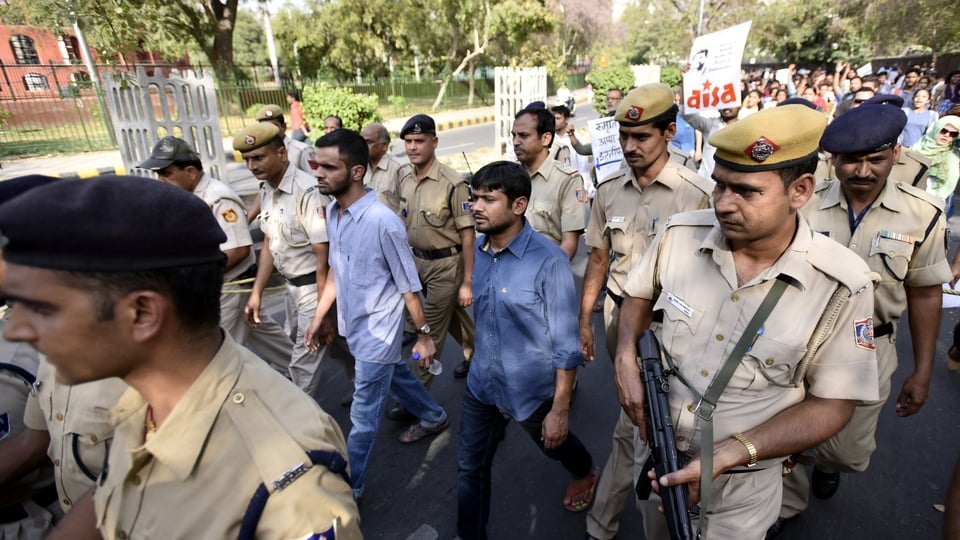
At the nub of the latest row is a protest against the January 5 Supreme Court decision to refuse bail to activists Umar Khalid and Sharjeel Imam, both JNU alums, in the 2020 Delhi riots “conspiracy” case. Khalid was among those at the centre of the 2016 controversy too.
The protest meet on Monday night was originally a commemoration of the violence that took place on the university campus on January 5, 2020, when students were agitating against the Citizenship (Amendment) Act.
Purported videos from the protest showed students raising slogans that condemned Prime Minister Narendra Modi and Union home minister Amit Shah.
The JNU security chief has since sought an FIR, describing these slogans as “objectionable, provocative, and inflammatory”. The university administration has argued that such sloganeering was “inconsistent with democratic dissent” and violated the JNU Code of Conduct.
Aditi Mishra, president of the JNU Students' Union, who is among those mentioned the FIR-request letter, has said these slogans were “ideological in nature” and not intended as personal attacks.
Echoes of terms used a decade ago: ‘Anti-national’, ‘urban naxal’
Much like 2016, the alleged slogans led to a high-decibel, national-level dispute between the ruling BJP and the opposition Congress and other parties.
Union minister Giriraj Singh, among the firebrand leaders of the BJP, repeated a term coined a decade ago — "tukde-tukde gang" ("those who seek to divide India"). The Lok Sabha member from Bihar used the adjective “anti-national”, as did BJP national spokesman Shehzad Poonawalla who called the protesters an "anti-India urban naxal gang".
Delhi minister Kapil Mishra and UP deputy CM Keshav Prasad Maurya also condemned what they saw as unfair dissent over a judicial order denying bail to Khalid and Imam, both of whom have spent over five years behind bars while their trial is yet to begin.
Opposition party leaders such as Sandeep Dikshit of the Congress and Manoj Jha of the RJD asserted that students have a right to protest even against court judgments, but must be mindful of language.
Rajya Sabha member Jha, however, noted that there is often "selective anger" under the Modi regime. He pointed towards offensive remarks in the country being “ignored”, when uttered by BJP leaders, for instance.
Where the 2016 JNU row's main faces stand
The January 2026 controversy may be viewed as a redux of the events of February 2016, when a campus event was organised over the execution of Afzal Guru, a Kashmiri separatist hanged for the 2001 Parliament attack. Alleged “anti-national” slogans raised during that event led to a national controversy, and the arrest and booking of several students.
- In both cases, video clips played a central role. In 2016, a forensic probe later found that some videos had been manipulated, though the case is ongoing after a chargesheet was filed three years later.
- In both instances, the BJP government and its supporters deployed terms like "anti-national" and “urban naxal” to describe the protesting students.
- The university administration in both matters sought police intervention and conducted internal inquiries.
The lives of the central figures from 2016 have changed significantly over the decade.
Umar Khalid, one of the main faces in 2016, spent over three weeks in jail then. He remained a prominent activist later, including in the 2020 protests against the amendments to the Citizenship Act that he and others saw as discriminatory on the basis of religion, specifically against Muslims. The Narendra Modi government has rubbished those allegations.
He was arrested in 2020 in a case linked to the riots that broke out amid the anti-CAA protests. By 2026, he has spent over five years in prison as an accused. He and Sharjeel Imam were the ones denied bail by the SC on January 5, 2026, while five others were granted the relief.
Khalid expressed resignation, telling his partner, “This is my life now.”
His defence lawyers have argued there was nothing provocative in his speeches or acts during the anti-CAA protest.
Kanhaiya Kumar was the JNUSU president in 2016 and was arrested on sedition charges. He later entered mainstream politics, first via the CPI and later the Congress. By 2026, he is a national spokesperson for the Congress and among its major young faces, though he has not won the elections he has contested in Delhi and Bihar.
He has repeatedly asserted that the 2016 row was “manufactured”, and has challenged the BJP government and Delhi Police to prove the allegations in court.
Shehla Rashid Shora was a prominent leader of the 2016 protests following the arrests of Kanhaiya and Umar Khalid. However, she later changed her political stance and now praises the policies of Prime Minister Modi and Amit Shah. She has cited “positive changes” in the ground situation in her home state of Jammu and Kashmir among reasons for the shift in her perspective.
Anirban Bhattacharya also spent over three weeks in jail in 2016, and has since kept a low profile. He later noted that his career options became limited because of the incident. He has observed that while he maintains some anonymity, Umar Khalid has remained a constant target of public scrutiny, often because of his religious identity being Muslim.
Ten years later, the current JNUSU president, Aditi Mishra is among those named by the university administration while seeking an FIR.


