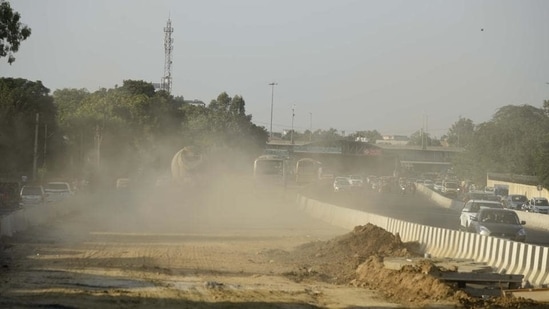
With the onset of winters, Delhi's air quality worsens every year. The climatic change leaves more than 75 per cent of the children feeling suffocated, according to Hindustan Times' sister publication Livehindustan; the report is based on a study conducted by The Energy and Resources Institute (TERI).
The health survey was conducted on 413 children, out of which 75.4% complained of breathlessness, 24.2% complained of itchy eyes, 22.3% complained of regular sneezing or runny nose and 20.9% of children complained of coughing in the morning.
The children in the survey aged between 14-17 years.
The TERI report also stated that air in Delhi has a high concentration of major pollutant PM2.5, which it claimed is pushing Delhiites, especially children, towards respiratory and heart diseases.
Researchers also identified heavy metals as a major component of PM 2.5 that may result in potential health effects. In October 2019, the concentration of zinc in the city's PM 2.5 (particles less than 2.5 micrometres in diameter) was 379 ng/m3 (nanograms per cubic meter of air). In September 2020, this increased to 615 ng/m3 (nanograms per cubic meter of air).
Similarly, the lead content in Delhi's air was 233 ng/m3 (nanograms per cubic meter of air) in 2019, which increased to 406 ng/m3 (nanograms per cubic meter of air) in 2020, with an arsenic content of 3 ng/m3.
{{/usCountry}}Similarly, the lead content in Delhi's air was 233 ng/m3 (nanograms per cubic meter of air) in 2019, which increased to 406 ng/m3 (nanograms per cubic meter of air) in 2020, with an arsenic content of 3 ng/m3.
{{/usCountry}}According to experts, some of these metals are extremely hazardous to human health and regular exposure to them could lead to some fatal health consequences. The increased amount of cadmium and arsenic in the air also put the locals at higher risk of cancer, kidney problems and high blood pressure, diabetes and heart diseases.
"PM 2.5 level - less than 60 ug/m3 - is considered an acceptable norm, but if there is a high concentration of toxic metals in the air, then it may lead to Your health is at risk," the Live Hindustan quoted TERI Associate Fellow (Environment and Health), Kanhaiya Lal, as saying.