The first stage of the Graded Response Action Plan (GRAP) restrictions took effect in the national capital on Tuesday, as air quality remained in the ‘poor’ category for the third straight day.To tackle winter pollution, Stage 1 of the GRAP includes measures like dust control at construction sites, effective waste management, and frequent road cleaning.
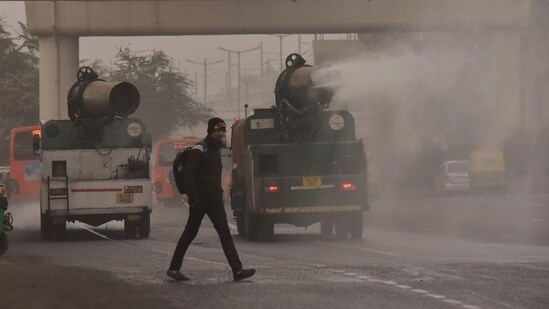
An anti-smog gun sprays water into the atmosphere to reduce dust pollution at Anand Vihar in New Delhi in January 2024. (Sakib Ali/HT File Photo)
{{^htLoading}} {{/htLoading}}
Delhi's air quality has continued to stay in the 'poor' category, with a reading of 207 on Tuesday, according to the Central Pollution Control Board (CPCB). The city's AQI fell into the 'poor' zone after Dussehra.
{{^usCountry}}{{/usCountry}}
The weather department reported a minimum temperature of 17.4 degrees Celsius on Tuesday, two degrees below normal. Humidity was at 64 percent at 8.30 am, according to the India Meteorological Department (IMD).
The IMD also predicted cloudy skies for the day, with the maximum temperature expected to reach around 35 degrees Celsius.
An AQI of 0-50 is classified as 'good', 51-100 as 'satisfactory', 101-200 as 'moderate', 201-300 as 'poor', 301-400 as 'very poor', and 401-500 as ‘severe.’
What will change with Stage 1 into force?
The plan enforces strict monitoring of polluting vehicles, improved traffic management, and tighter emission controls for industries, power plants, and brick kilns.
Regular mechanised road sweeping and water sprinkling to reduce dust.
Strict dust control measures at construction sites and efficient waste management practices.
Rigorous checks on polluting vehicles, improved traffic management, and emission reductions in industries, power plants, and brick kilns.
Prohibition of open waste burning, restricted use of diesel generators, and bans on coal or firewood in eateries.
Prompt response to pollution-related complaints through the 311 APP, Green Delhi App, SAMEER App, and other social media channels.
Offices are encouraged to implement unified commuting for employees to reduce road traffic.
Advisory promoting eco-friendly celebrations by avoiding the use of firecrackers during festivals.
Follow the latest breaking news, major developments and agenda-setting stories from India and around the world with the newsdesk at Hindustan Times. Operating round the clock, the desk brings together experienced editors, reporters and correspondents to deliver fast, accurate and contextual reporting across subjects that influence public policy, governance, business, society and international affairs. The HT News Desk covers politics, elections, government policies, the economy, business and markets, science and technology, the environment, law and order, infrastructure, education, climate issues and geopolitics, while closely tracking developments across states, institutions and global capitals. The team also leads coverage of major breaking news events, policy announcements, court proceedings, natural disasters, public emergencies and significant international developments. Reports published by the newsdesk are based on information gathered from reporters on the ground, official statements, government agencies, court records, regulatory filings, recognised institutions and other authoritative sources. Stories undergo editorial scrutiny and verification processes to ensure accuracy, fairness and relevance, and are updated as events evolve and additional information becomes available. Whether covering a key political decision in New Delhi, an economic policy shift affecting millions, a landmark court ruling or a major global event, the HT News Desk aims to provide readers with reliable, fact-based journalism that delivers not only the latest developments but also the context and analysis needed to understand their wider implications.
Get Latest News, breaking headlines, and top India News, and today real-time updates from across the nation. Stay informed on politics, government policies, crime, Today Weather, and major developments on Hindustan Times
Get Latest News, breaking headlines, and top India News, and today real-time updates from across the nation. Stay informed on politics, government policies, crime, Today Weather, and major developments on Hindustan Times
Home/India News/Delhi brings Stage 1 of anti-pollution plan into force: What will change?
{{^htLoading}}
Advertisement
{{/htLoading}}
SHARE THIS ARTICLE ON
{{#usCountry}}{{/usCountry}}
Notifications
Get breaking alerts directly from the newsroom
Notifications are on!You'll be notified when news breaks