The Delhi high court on Tuesday sought the Centre’s response in a petition seeking implementation of Standard Operating Procedures (SOPs) to regulate protests and prevent disruptions to traffic and businesses amid demonstrations demanding the resignation of chief election commissioner (CEC) Gyanesh Kumar.
A bench of acting chief justice Nitin Sambre and justice Sanjay Sharma asked Centre’s lawyer additional solicitor general Chetan Sharma to seek instructions and listed the petition filed by advocate Rishabh Saxena, a traders body and Santosh Kushwaha, a street vendor for Friday.
“In the meantime, we direct the respondents to take instructions in the matter,” the court said in the order.
Deep Dive
What is the Delhi High Court being asked to do about regulating protests?
Why are petitioners asking that protests be held at designated sites?
Which venues were designated for protests after Jantar Mantar was denotified?
Senior advocate Sacchin Puri and Sanjay Poddar, appearing for the petitioners, submitted that the protests were disrupting business activities and urged the court to direct that demonstrations be held at designated sites to ensure that professionals and businesses are not affected.
Also Read:Student leader Neha Bora marches alongside Rahul, Priyanka Gandhi at protest; video goes viral
The petition stated that the Supreme Court, in Mazdoor Kisan Shakti Sangathan v. Union of India, had directed the Commissioner of Police to formulate a regulatory mechanism for protests. Following the directions, binding conditions were laid down for demonstrations, including a prohibition on blocking traffic, office gates and arterial roads.
{{/usCountry}}The petition stated that the Supreme Court, in Mazdoor Kisan Shakti Sangathan v. Union of India, had directed the Commissioner of Police to formulate a regulatory mechanism for protests. Following the directions, binding conditions were laid down for demonstrations, including a prohibition on blocking traffic, office gates and arterial roads.
{{/usCountry}}Saxena’s petition further said that at 2pm on October 12, while travelling to the Competent Authority’s office on Barakhamba Road, New Delhi, in connection with a professional matter, he encountered a gathering of people occupying the carriageway and the central traffic island near the Mandi House roundabout.
“The incident of 12.10.2026 is not an isolated one. Between 01.01.2022 and 12.10.2026, at least 82 major agitations were held at Jantar Mantar, several of them sit-ins lasting over a month, with attempted marches towards Parliament. Press reports show that the overall number of protests at the site has been rising: 292 protests between January and March 2025, against 202 in the same period of 2024. Sit-ins lasting weeks, marches and gatherings spilling onto the surrounding roads are, on their face, inconsistent with the conditions of Standing Order,” the petition said.
Also Read:Judge unwell, Supreme Court defers hearing on Delhi protest crackdown till Thursday
Apart from the petitions seeking implementation of the SOPs governing protests, the court also heard a plea filed by National Students’ Union of India (NSUI) president Vinod Jhakhar, seeking an investigation by a Special Investigation Team (SIT) into the alleged assault on members of the public by anti-social elements during a protest demanding CEC’s resignation on October 10. The plea sought the identification of those involved and appropriate legal action against them.
The court also heard a petition filed by advocate Anshika Tripathi challenging the closure of Jantar Mantar as a protest site and raising concerns over alleged disruptions, including the closure of metro stations and disruption of railway services.
In Jhakhar’s petition, the court permitted Centre to file preliminary objections concerning the maintainability of the petition, while in Tripathi’s petition, the court directed her to produce the copies of the petition pending before the Supreme Court on the same issue.
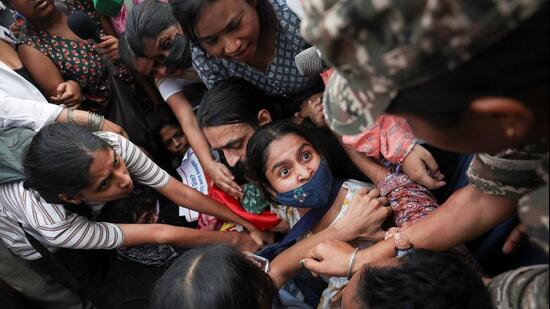
On October 10, security personnel turned the Capital into a fortress to thwart the planned protest, launching an unprecedented clampdown that saw the detention of 7,000 people, suspension of internet services near Jantar Mantar, cancellation of many long-distance trains to Delhi and closure of 45 Metro stations.
In addition, right-wing groups thrashed many protesters, laid spike strips on arterial roads, erected thousands of yellow barricades that choked traffic, and put up loudspeakers that blared prerecorded police warnings against unlawful gatherings.
Sunday was relatively calmer, with the Metro stations open, trains back on track and some roads opened. However, central Delhi was shrouded in a security blanket even as some protesters made it past barricades for short-lived agitations that melted away as police bundled them away into buses, triggering allegations of brutality. Many journalists and bystanders were also picked up, sparking a controversy.