
Delhi’s air quality remained in the poor category on Monday morning, with the AQI recorded at 249, higher than Sunday’s average of 239, as calm winds continued to hinder pollutant dispersion while the minimum temperature was recorded at11.1°C on Monday, 0.2 degrees below the seasonal average.
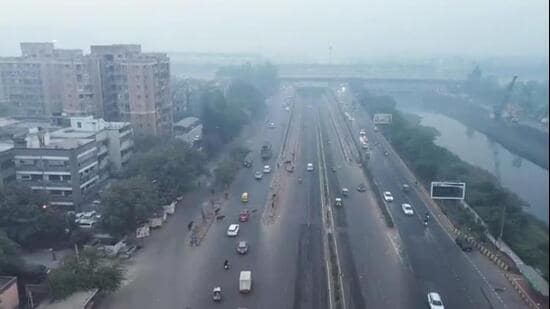
At 7am, particulate matter 2.5 (PM2.5) was the predominant pollutant at 50 of the national Capital’s 58 monitoring stations, while PM10 was the leading pollutant at the remaining eight stations.
A day earlier, PM2.5 was the dominant pollutant at 45 of 56 stations, while PM10 led at 11 stations.
Deep Dive
What does an AQI of 249 mean for Delhi?
Why did Delhi’s AQI rise from 239 to 249?
Can CPCB’s AQI understate how polluted Delhi’s air is?
The air quality index at 8:05am was 249.
The city’s air remained largely stagnant overnight, with Safdarjung airfield recording calm winds in 12 of its 15 observations since 4pm on Sunday. The airfield also reported no rainfall during the period.
Of Delhi’s monitoring stations, 26 recorded air quality in the ‘very poor’ category and six in the ‘moderate’ category.
NSUT Jaffarpur recorded the worst AQI in the city at 346, while Ghoga reported the lowest at 133.
{{/usCountry}}NSUT Jaffarpur recorded the worst AQI in the city at 346, while Ghoga reported the lowest at 133.
{{/usCountry}}According to the Central Pollution Control Board’s (CPCB) classification, an AQI between 0 and 50 is considered good, 51–100 satisfactory, 101–200 moderate, 201–300 poor, 301–400 very poor and 401–500 severe.
Also Read: Delhi’s air quality shows modest year-on-year improvement
Farm fires data
NASA satellites detected 5,290 farm fires in Punjab and Haryana between October 1 and November 22. However, the count is likely to be significantly lower than the actual number of fires, as the satellites pass over the region at around 1:30pm, while a large proportion of stubble-burning activity now takes place later in the day.
Minimum temperature at 11.1°C
Delhi recorded a minimum temperature of 11.1°C on Monday, 0.2 degrees below the seasonal average, while the maximum temperature on Sunday settled at 27.6°C, 0.9 degrees above normal, according to the India Meteorological Department (IMD).
The minimum temperature at Safdarjung, Delhi's base weather station, dropped by 0.7°C over the past 24 hours. Palam recorded a minimum of 11.6°C, 0.3 degrees below normal, while Lodhi Road and the Ridge recorded 11.6°C and 12.1°C, respectively.
The maximum temperature at Palam was 24.5°C, two degrees below normal. Lodhi Road recorded a maximum of 27.2°C, 1.2 degrees above normal, while the Ridge and Ayanagar recorded 26.5°C and 26.2°C, respectively.
There was no rainfall recorded at any of the five weather stations in Delhi during the 24-hour period ending at 8:30am on Monday.
ABOUT THE AUTHOR
Saloni Bhatia is a journalist with over 15 years of experience in reporting and storytelling, with a strong focus on the Delhi government and political developments in the Capital. Over the years, she has closely tracked policy decisions, governance issues, and political shifts. She started off as an entertainment journalist but then moved to covering beats like crime and education. Her experience on the crime beat helped her develop an eye for detail and accuracy, while education reporting allowed her to explore policy impact on students, teachers and institutions. Outside the newsroom, she enjoys reading both fiction and non-fiction. She also has a keen interest in watching Bollywood films.