E-Paper



Delhi AQI remains ‘very poor’ amid thick haze; Bawana, Narela, Punjabi Bagh among 8 areas in ‘severe’ category
Delhi’s air quality index (AQI) stood at 334 at 10am on Tuesday. Data from 58 of the 59 monitoring stations showed that eight were in the severe category.

 Prefer HTon Google


A thick haze shrouded Delhi’s skyline on Tuesday morning, as the national capital’s air quality remained in the “very poor” category, just days ahead of Diwali.
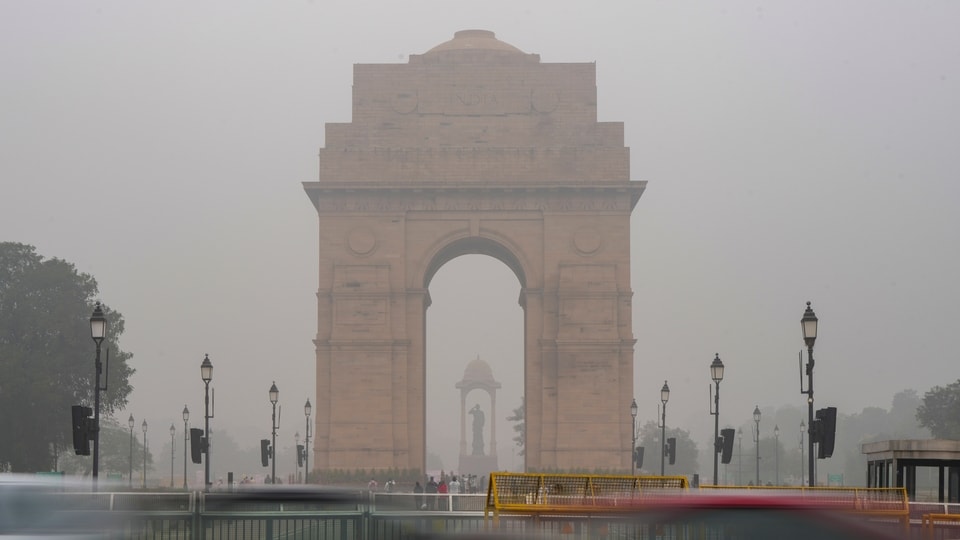
Delhi’s air quality index (AQI) stood at 334 at 10am on Tuesday. The 24-hour average AQI on Monday was 324, the worst in 271 days, up 63 points from Sunday’s 261. It was 60 on Friday, when the air quality was “satisfactory”.
Also read | GRAP-2 comes into effect in Delhi-NCR as AQI slips into 'very poor' category
Bawana, Narela, among 8 areas in ‘severe’ category
Data from 58 of the 59 monitoring stations showed that eight were in the severe category on Tuesday morning, including Bawana, Narela and Punjabi Bagh. Only one station, IGNOU in Maidangarhi, was in the moderate category.
Weekly forecast for Delhi weather
Delhi is likely to witness mainly clear skies over the next seven days, with no major change in weather conditions expected. The minimum temperature is forecast to remain between 14 degrees Celsius and 16 degrees Celsius, while the maximum temperature is likely to range from 28 degrees Celsius to 29 degrees Celsius between November 3 and November 9.
According to the India Meteorological Department (IMD), the weather is expected to remain mainly clear throughout the week, with no weather warnings issued for the national capital.
GRAP-2 comes into effect in Delhi-NCR
Delhi’s air quality deteriorated sharply for the fourth consecutive day on Monday, pushing the city into the “very poor” category for the first time this season and prompting the Commission for Air Quality Management (CAQM) to invoke Stage 2 of the Graded Response Action Plan (GRAP) across the National Capital Region (NCR).
Also read | Delhi: Light rain expected; min temp 3.1°C above normal, 3 stations record very poor air
Under Stage 2, the Delhi government and NCR state governments have been directed to stagger office timings for government and municipal employees in Delhi and the districts of Gurugram, Faridabad, Ghaziabad and Gautam Buddha Nagar.
Other measures include higher parking fees to discourage private vehicle use and ensuring resident welfare associations (RWAs) provide electric heaters to security staff to prevent open burning. These measures are also part of Delhi’s winter action plan, which came into effect on November 1.
According to Delhi traffic police, a total 8,263 vehicles were checked, 37 challaned, two impounded, and 1,228 returned in border checks on Monday.
The Delhi Metro Rail Corporation (DMRC) announced 20 additional weekday train trips from Tuesday, taking the total number of additional trips across its network to 40. The move is aimed at encouraging commuters to use public transport, it said.
Deep Dive

ALSO READ: GRAP-II pollution curbs imposed in Delhi-NCR as air quality dips further
The Central Pollution Control Board (CPCB) classifies an AQI of 0–50 as “good”, 51–100 as “satisfactory”, 101–200 as “moderate”, 201–300 as “poor”, 301–400 as “very poor” and 401–500 as “severe”.
CPCB notes PM2.5 as main pollutant
On Tuesday morning, CPCB listed PM2.5 as the main pollutant at 53 of Delhi’s 58 reporting stations and PM10 at five. At the same time a day earlier, the corresponding figures were 51 and seven, respectively.
NASA satellite data detected 1,561 farm fires in Punjab and Haryana between October 1 and November 2, 1,406 in Punjab and 155 in Haryana. Of these, 167 were recorded on November 2.
Over the same period last season, the satellite counted 2,068 fires. However, the figures need to be viewed in context that burning has shifted to later hours each year.
In 2025, 98 per cent of the fire heat recorded by Meteosat came after 3 pm, compared with 94 per cent in 2024. The two counts could therefore differ for this reason alone. Both figures are undercounts, as most of the burning now takes place after the satellite passes over the region at around 1:30 pm.
Minimum temp 1.1 degree above season normal
The minimum temperature in Delhi settled at 16.4°C on Tuesday, 1.1 degrees above the season's normal, while the maximum temperature recorded on Monday was 29.5°C, one degree below normal, according to India Meteorological Department (IMD) data.
Safdarjung, Delhi's base weather station, recorded a minimum temperature of 16.4°C, while Palam and Lodhi Road recorded 16.2°C each. The minimum temperature at the Ridge was 17.7°C and at Ayanagar 17.2°C.
On Monday, the maximum temperature was 29.5°C at Safdarjung, 27.2°C at Palam, 29.3°C at Lodhi Road, 28.3°C at the Ridge and 29.2°C at Ayanagar. The maximum temperature at Palam was 3.6 degrees below normal, while the departures at Safdarjung, Lodhi Road, the Ridge and Ayanagar were -1°C, -0.7°C, -1.6°C and -1.3°C, respectively.
No rainfall was recorded at any of the five weather stations in the 24 hours ending at 8.30am on Tuesday.
GRAP 2 imposed in Delhi-NCR
The deteriorating air quality prompted the Commission for Air Quality Management (CAQM) to invoke Stage 2 of the Graded Response Action Plan (GRAP) across the national capital region on Monday.
Under Stage 2, the Delhi government and NCR state governments have been directed to stagger office timings for government and municipal employees in Delhi and the districts of Gurugram, Faridabad, Ghaziabad and Gautam Buddha Nagar.
ALSO READ: Gurugram records season’s worst AQI at 246, Grap Stage 2 imposed in Delhi-NCR
Other measures include higher parking fees to discourage private vehicle use and ensuring resident welfare associations (RWAs) provide electric heaters to security staff to prevent open burning. These measures are also part of Delhi’s winter action plan, which came into effect on November 1.