The hourly air-quality readings missing from Delhi’s official record for Diwali night were released by the Delhi Pollution Control Committee (DPCC) around 8pm on Monday. They show PM2.5, the fine particles that firecracker smoke fills the air with, at up to 3,744 micrograms per cubic metre (µg/m³), more than 60 times the national 24-hour standard of 60.
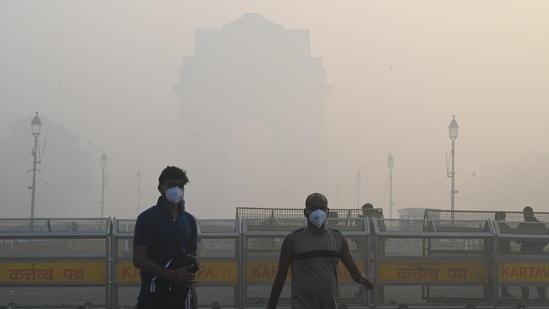
A thick layer of smog engulfs Kartavya Path near India Gate following Diwali celebrations in New Delhi, India. (Arvind Yadav/HT Photo)
{{^htLoading}} {{/htLoading}}
The highest readings came in the small hours of November 9. Mundka recorded 3,744 µg/m³ at 2am, JNU 3,023 at 4am and NSUT’s West Campus 3,008 at 5am. Mandir Marg reached 2,908 at 3am, Nehru Nagar 2,808 at 3am and Wazirpur 2,721 at 1am. Eleven of DPCC’s stations went past 2,000.
{{^usCountry}}{{/usCountry}}
Every one of the 125 station-hours missing from the Central Pollution Control Board’s (CPCB) records is above 1,000 µg/m³ on DPCC’s website. Where both sources have a reading, the figures match. The highest reading anywhere in CPCB’s records for the night is 1,000.
Deep Dive
How high did Delhi’s PM2.5 readings reach on Diwali night?
After the missing hourly readings were released, Mundka recorded the night’s highest PM2.5 level: 3,744 µg/m³ at 2am on November 9. That was more than 60 times the national 24-hour standard of 60 µg/m³.
Why were PM2.5 readings missing from Delhi’s monitoring stations on Diwali night?
Many stations stopped reporting PM2.5 as pollution rose, although most continued to send readings for gases. A government official cited technical glitches; the reason for the gaps was not confirmed.
How did the missing readings affect Delhi’s official AQI?
Including the released readings, HT estimated Delhi’s AQI at about 384 for the 24 hours to 9am on November 9, compared with CPCB’s published 370. The AQI scale also tops out at 500, so extremely high PM2.5 readings add little to the score once that limit is reached.
Powered ByAsk HT
HT had reported earlier that PM2.5 readings at many of Delhi’s stations went blank as the air worsened on the night of November 8. At 1am, 36 of the city’s 59 stations had no PM2.5 reading in CPCB’s records.
Counting the released readings, CPCB’s own method of calculation puts Delhi’s air quality index (AQI) for the 24 hours to 9am on November 9 at about 384, against the 370 CPCB published, and its 4pm bulletin figure at about 360, against 344, HT estimates show. The index stops at 500 for any hour above about 420 µg/m³, so readings in the thousands add little to it.
{{^htLoading}} {{/htLoading}}
{{^usCountry}}
A government official who asked not to be named said: “The air quality monitors are giving hourly data. There were some technical glitches, but all our 43 stations are giving data.”
{{/usCountry}}
{{#usCountry}}
A government official who asked not to be named said: “The air quality monitors are giving hourly data. There were some technical glitches, but all our 43 stations are giving data.”
{{/usCountry}}
The figures are provisional. As of CPCB’s records read at 7.58pm, the released readings had not appeared there.
Binayak Dasgupta is a senior editor at Hindustan Times, New Delhi, where he has worked since 2013. He heads the paper's Page 1 team and is part of the editorial leadership overseeing daily news operations. He has previously led the national news desk. His work sits at the intersection of specialist depth and emerging public consequence — stories where complexity and nuance are in themselves the journalistic challenge. He shapes Hindustan Times's coverage and editorial positions on technology and artificial intelligence, information security, environment, health and science — steering these subjects from the commissioning of reporting to editing and the framing of the paper’s institutional view. His work spans analysis, commentary and reportage and in the past has led the paper's coverage of Covid-19 pandemic science. His interviews and hosted sessions include Nobel laureates, technology leaders, economists and climate justice scholars. In recent months, Binayak has overseen the coverage of the Air India Flight 171 crash and its investigation, India's energy exposure during the West Asia conflict, the trade dispute with the US, Delhi's air quality emergency and the evolving conversations around AI, including the IndiaAI Summit.
Get Latest News, breaking headlines, and top India News, and today real-time updates from across the nation. Stay informed on politics, government policies, crime, Today Weather, and major developments on Hindustan Times
Get Latest News, breaking headlines, and top India News, and today real-time updates from across the nation. Stay informed on politics, government policies, crime, Today Weather, and major developments on Hindustan Times
Home/India News/Delhi’s missing Diwali night data released; PM2.5 at over 60 times national standard
{{^htLoading}}
Advertisement
{{/htLoading}}
SHARE THIS ARTICLE ON
{{#usCountry}}{{/usCountry}}
Notifications
Get breaking alerts directly from the newsroom
Notifications are on!You'll be notified when news breaks