The Centre has notified new guidelines for groundwater use in the country, prescribing a penalty of Rs 1 lakh on industrial and commercial users who extract it without permission, but exempting farmers and the agriculture sector, the largest users of groundwater, from the requirement of a no-objection certificate or penalties for drawing water up to a limit.
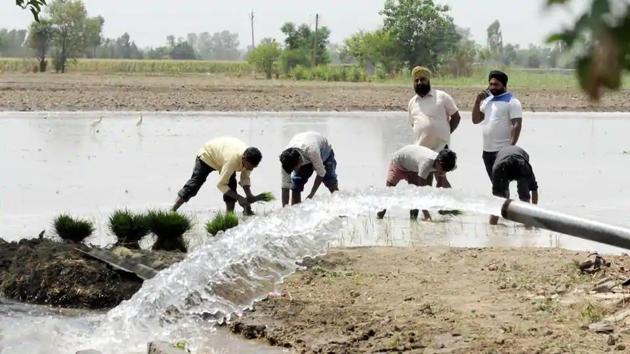
An environmental compensation of Rs 1 lakh on industrial, mining and infrastructure users for extracting water illegally could be increased depending on the quantum of illegally extracted water, states the new notification issued by the Central Ground Water Authority (CGWA) under the Jal Shakti ministry on September 24.
Also read: Rules go up in smoke as farm fires rage in Punjab
For industries, the new guidelines state that a no-objection certificate shall be granted “only in such cases where local government water supply agencies are not able to supply the desired quantity of water”. All industries will be required to adopt “latest water efficient” technologies to “reduce dependence on groundwater resources”, guidelines in the fresh notification state.
The revised guidelines, which will apply across India, however, state that rural drinking water schemes, armed forces, agriculture activities, and small enterprises will not require any prior permission for groundwater use.
{{/usCountry}}The revised guidelines, which will apply across India, however, state that rural drinking water schemes, armed forces, agriculture activities, and small enterprises will not require any prior permission for groundwater use.
{{/usCountry}}Agriculture consumes nearly 90% of all water resources in the country. According to the think-tank Niti Aayog report in 2017, groundwater accounts for 63% of all irrigation water and over 80% of the rural and urban household water supplies.
Yet, the Centre’s new guidelines say that regulating water use in agriculture “will prove to be an arduous task” given that the sector is the backbone of the Indian economy.
Also read| Paddy procurement begins early: Farmers, arhtiyas in Ambala allege absence of arrangements in mandis
The guidelines state that according to the country’s minor irrigation census 2013-14, 87.86% of groundwater wells are owned by marginal, small and semi-medium farmers having land holding up to four hectares. Around 9.18 % of wells are owned by medium farmers having land holding of 4-10 hectares and 2.96% of the wells are owned by big farmers having land holding more than 10 hectares.
Although the new rules exempt farmers from the requirement of prior permission from the CGWA for groundwater extraction, it highlights free electricity for farmers as the main reason for over-extraction of groundwater. The guidelines advise states to “review their free/subsidised electricity policy to farmers”, “bring suitable water pricing policy and may work further towards crop rotation/diversification/other initiatives” to reduce over-dependence on groundwater.
Also read: BJP plans farm outreach to counter Oppn’s drive
In December, the government launched the Atal Jal Yojana scheme to conserve groundwater in seven states facing the biggest declines in aquifer levels mainly due to over-extraction for water-intensive crops. These are Maharashtra, Haryana, Karnataka, Rajasthan, Madhya Pradesh, Uttar Pradesh and Gujarat.
“Some states like Punjab have started to adopt policies to reduce agriculture’s dependence on groundwater but they are yet to be adopted by a large number of farmers,” said Ashok Desai of the Natural Resources Institute, Pune.
Punjab State Power Corporation Limited (PSPCL) has come up with a new scheme of direct benefit transfer for electricity to agricultural consumers. Under the “Paani Bacho, Paise Kamao” (save water, earn money) scheme, farmers will get Rs 4 as direct benefit for each unit of electricity saved.