After Beijing protested Chief of Defence Staff Gen Bipin Rawat’s remark that China was the biggest security threat to India, one gets a sense of déjà vu. Some 23 years ago, then defence minister George Fernandes faced a barrage of protests and criticism both from China and their sympathisers within for calling China a potential threat to India in an interview.
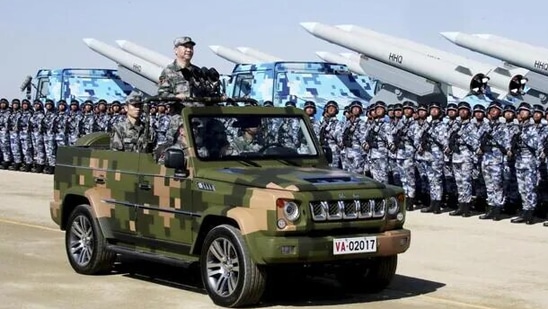
Chinese defence ministry spokesperson Senior Colonel Wu Qian told media on Thursday: “Indian officials speculate on the so-called Chinese military threat for no reason, which is a serious violation of the strategic guidance of the leaders of the two countries that China and India do not constitute a threat to each other, and incites geopolitical confrontation, is irresponsible and dangerous.”
While China is known in the past to cherry-pick statements to suit its political purpose, the defence ministry spokesperson conveniently forgot that Gen Rawat’s observation comes from the PLA attempts to unilateral change the ground position in Doklam in 2017 and on the Ladakh LAC in May 2020. That India and China virtually came to war on both occasions is enough to substantiate Gen Rawat’s assessment. Gen Rawat was the Indian Army chief when Doklam happened and CDS when Pangong Tso transgressions took place in May 2020.
{{/usCountry}}While China is known in the past to cherry-pick statements to suit its political purpose, the defence ministry spokesperson conveniently forgot that Gen Rawat’s observation comes from the PLA attempts to unilateral change the ground position in Doklam in 2017 and on the Ladakh LAC in May 2020. That India and China virtually came to war on both occasions is enough to substantiate Gen Rawat’s assessment. Gen Rawat was the Indian Army chief when Doklam happened and CDS when Pangong Tso transgressions took place in May 2020.
{{/usCountry}}Even as the Chinese defence ministry reminds Gen Rawat about the strategic guidance of the leadership of two countries, the spokesman inexplicably forgot that the PLA threw the written, signed, and sealed 1993 and 1996 bilateral border agreements out of the window when it tried to impose on India the rejected 1959 Line on the Ladakh LAC. The same happened in 2013 in Depsang Bulge in Daulet Beg Oldi (DBO) sector and at Charding Nullah Junction (CNJ) in Demchok.
The fact is that Chinese PLA actions on the LAC after the 2008 Tibet uprising before Beijing Olympics cannot be justified by any logic other than military. With PLA deploying nearly 50,000 troops across the Ladakh LAC with missile, tank and rocket regiments to back them and fighter aircraft on standby since June 2020, one has to be either naïve or weak to view this as a guarded benign posture of the Chinese army. To date, China has not even explained why it decided to unilaterally change the ground position on the north banks of Pangong Tso and put the growing bilateral relations into a deep freeze. Why did the Chinese President Xi Jinping, who is also the Commander in Chief of PLA, throw the hours and hours of Wuhan and Chennai understandings with Prime Minister Narendra Modi under the bus? Why is China coercing a tiny Himalayan kingdom of Bhutan to open its borders to trade and diplomatic ties with Beijing with the help of the Chinese army?
The timeline of bilateral ties between India and China shows that Beijing has not yielded a millimetre from its position for resolution of the boundary issue or its ties with Pakistan to accommodate the Indian point of view. The May 2020 transgressions show that PLA wants the 1959 line to be imposed on Ladakh LAC and still has eyes on Tawang in Arunachal Pradesh. The spurt in upgrading military infrastructure in Tibet and Xinjiang post-Beijing Olympics not only poses a serious threat to India but also is a part of the Fortress Tibet campaign of President Xi. George Fernandes and Gen Rawat were right in their observations about the escalating threat, but the onus is on China to take positive actions on the border to show the CDS his place. India has not forgotten how the Hindi-Chini Bhai Bhai slogan was torn to shreds when China surreptitiously build the Tibet-Xinjiang highway via Aksai Chin before the 1962 betrayal.