In its latest guidelines on disposal of Covid-19 waste, pollution watchdog CPCB has directed that masks and gloves used by everyone, whether infected or not, should be cut and kept in paper bags for minimum 72 hours before disposing of them.
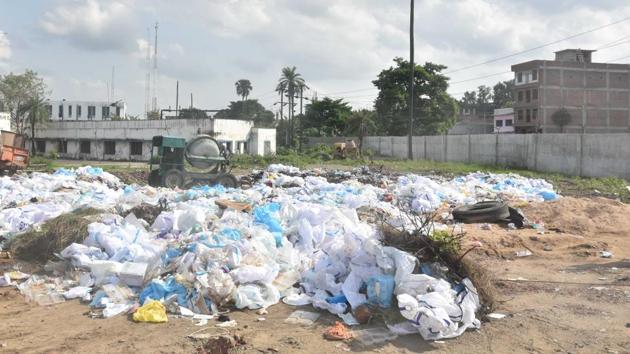
Central Pollution Control Board (CPCB) also directed commercial establishments like malls and offices to follow the same procedure with discarded protective personal equipment (PPE) from general public.
“Discarded PPEs from general public at commercial establishments, shopping malls, institutions, offices, etc. should be stored in separate bin for 3 days, thereafter, disposed of as dry general solid waste after cutting/shredding.
“Waste masks and gloves in general households should be kept in paper bag for a minimum of 72 hours prior to disposal of the same as dry general solid waste after cutting the same to prevent reuse,” the CPCB said.
This is the fourth time the CPCB has issued guidelines on management of bio-medical waste generated from coronavirus. It, however, said that leftover food and empty water bottles handled by infected patients should not be collected along with bio-medical waste but with other general solid waste.
“Leftover food, empty juice bottles or tetra packs, empty water bottles, packaging material, and any other items, generated or handled by Covid-19 patient should be collected along with other general solid waste in bags securely tied for handing over to waste collectors.
{{/usCountry}}“Leftover food, empty juice bottles or tetra packs, empty water bottles, packaging material, and any other items, generated or handled by Covid-19 patient should be collected along with other general solid waste in bags securely tied for handing over to waste collectors.
{{/usCountry}}“Yellow coloured bag should not be used for general solid waste,” it said.
Yellow bags are dedicated for bio-medical waste from Covid-19, as per the guidelines issued time and again.
The CPCB also recommended use of bio-degradable or non-disposable cutlery to minimize waste generation.
“In order to minimize waste generation, as far as possible, non-disposable items must be used for serving food, which are to be handle with appropriate precautions and cleaned and disinfected as per hospital guidelines. “If use of disposable items is inevitable, use bio-degradable cutlery. The wet and dry solid waste bags to be tied securely in leak-proof bags, sprayed with sodium hypo-chlorite solution and hand over to authorized waste collector. Yellow coloured bags should not be used for collecting general solid waste. Compostable bags should be used for collecting wet-waste,” it said.
It has also directed that isolation wards, including temporary healthcare facilities like rail coaches, must keep separate colour coded bins to maintain segregation of waste and use a dedicated bin to collect and store Covid-19 waste and keep it separately, use double layered bags for collection of Covid-19 waste and disinfect all bins/containers every day.
From Covid-19 isolation wards, used PPEs such as goggles, face-shield, splash proof apron, plastic coveralls, hazmat suits, nitrile gloves must be collected into a red bag, it said.
“Collect used masks (including triple layer mask, N95 mask etc.), head cover/cap, shoe-cover, disposable linen gown, non-plastic or semi-plastic coverall in yellow bags. Used masks, tissues and toiletries, of Covid-19 patient shall become biomedical waste and shall be segregated in yellow bag,” it said.