The government has cleared eight hydropower projects of 144 MW on the Indus river and its tributaries in Ladakh, the highest so far, sources in the Jal Shakti Ministry said on Thursday. At present, there are several small projects, with a collective capacity of 113 MW on Indus in Ladakh, and the new projects will have much more capacity than those constructed so far, a senior official added.
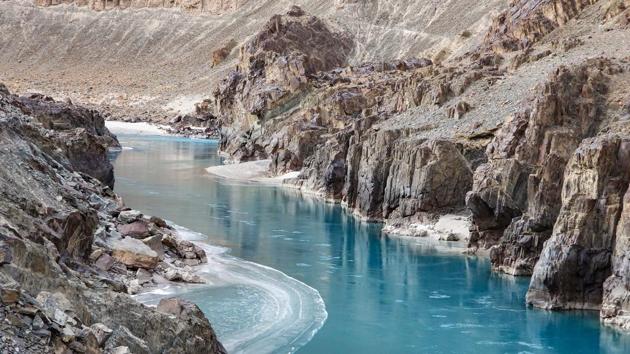
The official said the new projects have been cleared by the Central Water Commission as well as the Indus Commissioner after a separate Union Territory of Ladakh was announced last year. These projects will come up in Kargil and Leh districts of Ladakh.
Because of its topography, it is not feasible to construct big hydropower projects in the Ladakh region.
Durbuk Shyok (19 MW), Shankoo (18.5 MW), Nimu Chilling (24 MW), Rongdo (12 MW), Ratan Nag (10.5 MW) hydropower projects have been cleared for Leh, while Mangdum Sangra (19 MW), Kargil Hunderman (25 MW) and Tamasha (12 MW) have been cleared for Kargil, the official added.
Many of the existing projects as small as 1 MW of capacity.
The construction of the new projects will begin after other mandatory clearances are obtained, the official said. “The designs of these projects have been certified as compliant with the Indus Waters Treaty by the Central Water Commission. The information on the design of these projects is being provided to Pakistan as per the provisions of the treaty,” the official said.
“The development of projects on the Indus river has been slow, especially in the Ladakh region. Only two major projects have been constructed so far --- Chutak project of 44 MW on Suru, a tributary of the Indus, and Nimoo Bazgo of 45 MW on the Indus,” the official said.
{{/usCountry}}“The development of projects on the Indus river has been slow, especially in the Ladakh region. Only two major projects have been constructed so far --- Chutak project of 44 MW on Suru, a tributary of the Indus, and Nimoo Bazgo of 45 MW on the Indus,” the official said.
{{/usCountry}}Under the Indus Waters Treaty between New Delhi and Islamabad, the usage of water of Indus and its five tributaries flowing from India to Pakistan have been divided.
The treaty specifies that waters of three eastern rivers namely Ravi, Beas and Sutlej, have been reserved for India while that of western rivers, namely Indus, Chenab and Jhelum, are for Pakistan.
However, India claims it has unrestricted rights to develop hydroelectric power projects on the western rivers within the specified parameters of design. Of the total 168 million acre-feet, India’s share of water from Ravi, Beas and Sutlej is 33 mcf, which is nearly 20 per cent.
India uses nearly 93-94 per cent of its share under the Indus Water Treaty. The rest of the water remains unutilised and goes to Pakistan. The efforts to tap that water through a number of projects like Ujh Multipurpose project, Shahpurkandi Dam project and the second Ravi Beas Link are being made, the official added.