
The government plans to make the law banning manual scavenging more stringent by introducing a bill in the Monsoon Session of Parliament, which is scheduled to begin from Monday.
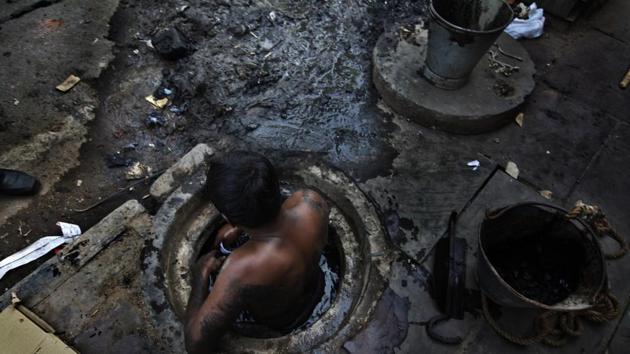
The Prohibition of Employment as Manual Scavengers and their Rehabilitation (Amendment) Bill, 2020, also proposes to completely mechanise sewer cleaning and provide better protection at work and compensation in case of accidents, officials said.
Currently, engaging any person for hazardous cleaning of sewers and septic tanks by any person or agency is punishable with imprisonment of up to five years or a fine up of to Rs 5 lakh or both.
The bill proposes to make the law banning manual scavenging more stringent by increasing the imprisonment term and the fine amount, the officials said.
The bill is among the 23 bills to be tabled in Parliament during the Monsoon Session.
The amendment bill comes amid increasing number of deaths during cleaning and maintenance of sewers in the country.
The Prohibition of Employment as Manual Scavengers and their Rehabilitation Act, 2013 prohibits construction or maintenance of insanitary latrines, and employment of any person for manual scavenging or hazardous cleaning of sewers and septic tanks. The bill comes under the Social Justice and Empowerment Ministry’s National Action Plan which aims at complete elimination of hazardous cleaning of sewers and septic tanks, a more serious, stringent and focused strategy framework.
The plan aims to modernise existing sewage system and coverage of non-sewered areas; setting up of faecal sludge and septage management system for mechanised cleaning of septic tanks, transportation and treatment of faecal sludge; equipping the municipalities, and setting up of Sanitation Response Units with help lines, according to a document by the Ministry of Social Justice and Empowerment.
{{/usCountry}}The plan aims to modernise existing sewage system and coverage of non-sewered areas; setting up of faecal sludge and septage management system for mechanised cleaning of septic tanks, transportation and treatment of faecal sludge; equipping the municipalities, and setting up of Sanitation Response Units with help lines, according to a document by the Ministry of Social Justice and Empowerment.
{{/usCountry}}ABOUT THE AUTHOR
Follow the latest breaking news, major developments and agenda-setting stories from India and around the world with the newsdesk at Hindustan Times. Operating round the clock, the desk brings together experienced editors, reporters and correspondents to deliver fast, accurate and contextual reporting across subjects that influence public policy, governance, business, society and international affairs. The HT News Desk covers politics, elections, government policies, the economy, business and markets, science and technology, the environment, law and order, infrastructure, education, climate issues and geopolitics, while closely tracking developments across states, institutions and global capitals. The team also leads coverage of major breaking news events, policy announcements, court proceedings, natural disasters, public emergencies and significant international developments. Reports published by the newsdesk are based on information gathered from reporters on the ground, official statements, government agencies, court records, regulatory filings, recognised institutions and other authoritative sources. Stories undergo editorial scrutiny and verification processes to ensure accuracy, fairness and relevance, and are updated as events evolve and additional information becomes available. Whether covering a key political decision in New Delhi, an economic policy shift affecting millions, a landmark court ruling or a major global event, the HT News Desk aims to provide readers with reliable, fact-based journalism that delivers not only the latest developments but also the context and analysis needed to understand their wider implications.