
Sign in

If Navy joined in, Pak would’ve split into four: Rajnath

Rajnath Singh said it would be in Pakistan’s best interests to  “uproot nurseries of terrorism” operating on its soil on its own

Updated on: May 31, 2025, 10:23:07 IST
Share
Share via
  • facebook
  • twitter
  • linkedin
Copy link
  • copy link

New Delhi/Panaji: Had the Indian Navy swung into action during Operation Sindoor, Pakistan would have been split into four parts, defence minister Rajnath Singh said on Friday, adding that the navy will draw first blood should Pakistan choose to repeat its misdeeds and direct terror against India.
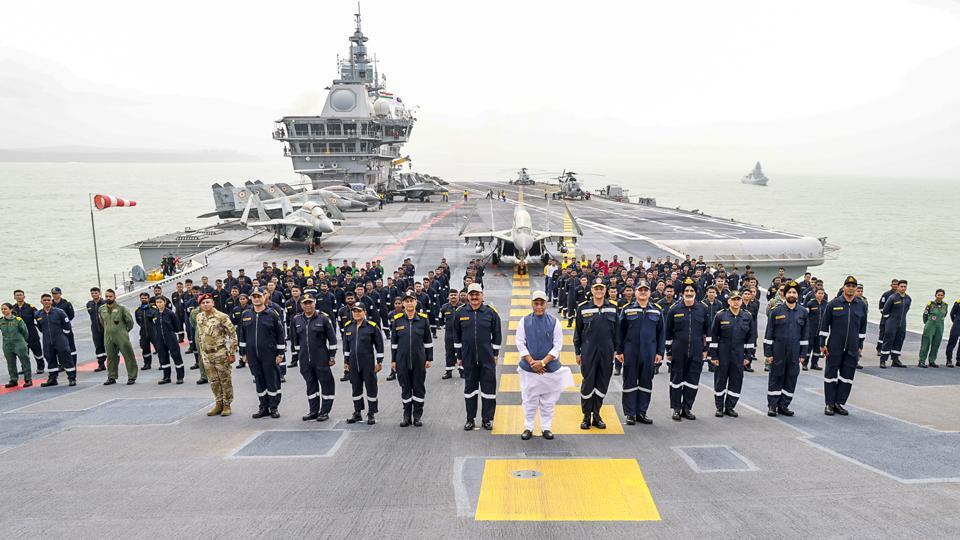
Union defence minister Rajnath Singh (centre), Chief of the Naval Staff Admiral Dinesh K Tripathi and others aboard aircraft carrier INS Vikrant off Goa. (Defence ministry)

He warned Pakistan of severe and unthinkable retaliation and said if Islamabad is serious about talks, terror masterminds such as Hafiz Saeed and Masood Azhar must first be handed over to India to face justice.

“When the Indian Navy swung into action in 1971, Pakistan was divided into two. If the navy had demonstrated its form in Operation Sindoor, then I think it would have been split into four parts... If Pakistan resorts to anything evil or unethical, it will face the firepower and ire of the Indian Navy,” Singh said on board INS Vikrant off the Goa coast.

The India-built aircraft carrier, commissioned into service barely three years ago, was the centrepiece of the navy’s forward deployment in the Arabian Sea after tensions with Pakistan sharply escalated following the Pahalgam terror strike that led to the May 7-10 military confrontation under Operation Sindoor.

The operation was not just military action, but India’s frontal assault on terrorism, he said, addressing navy personnel on board INS Vikrant. “India will use every method Pakistan can think of against terrorism. We will also not hesitate to use even those methods that Pakistan cannot even imagine.”

The operation triggered four days of strikes and counterstrikes before the two sides reached an understanding on stopping all military action on May 10. Between the launch of the operation on May 7 and the ceasefire, Indian forces bombed nine terror camps in Pakistan and PoK, killing at least 100 terrorists, and the IAF struck targets at 13 Pakistani airbases and military installations.

Singh hailed the navy for its “silent service,” saying its aggressive deployment in the Arabian Sea, supremacy and unmatched maritime domain awareness “confined the Pakistan Navy to its own shores.”

He reiterated that Operation Sindoor was not yet over. “It is just a pause, a warning. If Pakistan makes the same mistake again, India’s response will be harsher.”

On Pakistan’s repeated calls for talks, Singh said, “Talks will only be on terrorism and PoK. If Pakistan is serious, it should hand over Hafiz Saeed and Masood Azhar to India...They are not only on India’s list of ‘most wanted terrorists’; they are also UN-designated terrorists.”

  • Rahul Singh
    ABOUT THE AUTHOR
    Rahul Singh

    Rahul Singh is Defence Editor at Hindustan Times and has covered military affairs and national security for nearly 25 years. Apart from extensive and deep reporting on the Indian military, including several newsbreaks that have set the national news agenda over the years, Rahul has reported from conflict zones including Jammu & Kashmir, India’s North-east and the Democratic Republic of Congo. Rahul has co-authored the bestselling 'India's Most Fearless' series of books on recent Indian military operations. Widely read and translated into multiple languages, the books place an emphasis on firsthand accounts of daring missions across the three services. His work has been adapted into web series and films including the National Award-winning Amaran. Rahul comes from an Army background and attended schools across the country before completing his education from Panjab University, Chandigarh. Grew up playing tennis, now mostly cheers from the sidelines. Works in Delhi, heart in the mountains.Read More

  • Gerard de Souza
    ABOUT THE AUTHOR
    Gerard de Souza

    Gerard de Souza is a Special Correspondent based in Goa and has been reporting on and about issues concerning the state and the wider western coast of India for over 18 years. His wide range of stories covers politics, crime, environment and tourism-related concerns emerging from India’s smallest state. Born and brought up in Goa, he has a deep understanding of the former Portuguese enclave’s evolution from a laidback collection of idyllic villages that first drew flower power generation of counter culture enthusiasts to its shores to one that has become synonymous in Indian popular culture with an aspirational holiday, seeing the best (and worst) that holidayers have to offer. He also keenly follows criminal trials. Most notably, he covered the trial surrounding the killing of Scarlett Keeling, a British teenager found dead on Anjuna beach, and that of Danielle McLaughlin similarly killed in south Goa, among others. He authored the book ‘Crimes of Passion: When Desire Turns Deadly,’ chronicling cases of romance turning to rage and murder. A graduate of Goa University, he learnt the trade on the job and has experience on both the reporting and editorial sides of the profession. When not sniffing around for a worthy headline, he likes to spend time outdoors to help ensure his heart is always in the right place.Read More

Get the latest India News, breaking headlines, and real-time updates from across the nation. Stay informed on politics, government policies, crime, weather, and CEC Gyanesh Kumar row Live.