DNA samples collected from two human skeletons unearthed at a necropolis of a Harappan-era city site in Haryana have been sent for scientific examination, the outcome of which might tell about the ancestry and food habits of people who lived in Rakhigarhi region thousands of years ago.
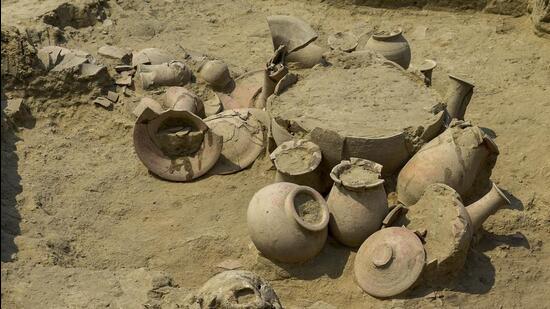
The skeletons of two women were found a couple of months ago at mound number 7 (named RGR 7 by the Archaeological Survey of India), believed to be nearly 5,000 years old. Pots and other artefacts were also found buried next to them in a pit, part of the funerary rituals back in the Harappan Civilisation era, ASI officials said.
“Seven mounds (RGR 1- RGR 7) scattered around two villages (Rakhi Khas and Rakhi Shahpur) in Hisar district are part of the Rakhigarhi archaeological site. RGR 7 is a cemetery site of the Harappan period when this was a well-organised city. The two skeletons were unearthed about two months ago by our team. And, DNA samples were collected by experts about two weeks ago,” Joint Director General, ASI, S K Manjul told PTI.
At present RGR 1, RGR 3 and RGR 7 have been taken up for investigation.
{{/usCountry}}At present RGR 1, RGR 3 and RGR 7 have been taken up for investigation.
{{/usCountry}}Manjul, who is leading the excavation team at Rakhigarhi site, about 150 km north-west of Delhi, since it commenced on February 24, 2022, said the DNA analysis will help answer a lot of questions, anthropological or otherwise.
The samples will be first examined by Birbal Sahni Institute of Paleosciences, Lucknow for preliminary investigation and scientific comparison, before being sent further for forensic analysis from anthropological perspective, he said.
“The outcome of the DNA analysis will help tell about the ancestry of the people who lived at this ancient city, whether they were native or had migrated from elsewhere to settle. Besides, samples taken from the teeth area would tell about their food habits, what kind of food they consumed and other anthropological patterns related to that human settlement which must have been one of the largest, dating from the Harappan Civilisation period,” said Manjul, who had also led the excavation at Sanauli in Uttar Pradesh in 2018 where pre-Iron Age artefacts were unearthed.
For collection of DNA samples, experts had done it while wearing special uniform so as to not contaminate the samples. And, samples were taken from teeth region and petrous part of the temporal bone, located at the base of the skull in the ear region.
Rakhigarhi site is one of the “five iconic sites” declared by the central government as per the Union budget 2020-21.
The two skeletons were found lying in supine position with head pointing in the north direction. They both were buried with plethora of pottery and adorned jewellery like jasper and agate beads and shell bangles. A symbolic miniature copper mirror was found buried along with one of the skeletons, officials said.
Animal bones were also found at the site, they said.
First attempts to archaeologically explore the Rakhigarhi site is said to have been done in late 1960s.