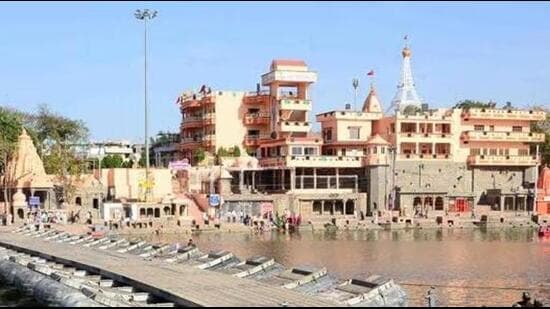
Ujjain, recently in the news over the demolition of a portion of the Shahi Masjid, is a town of undisputed antiquity. Its antecedents comprise being one of the capitals of Mauryan empire and the Malwa sultanate, the setting of unforgettable classical literary works such as Meghdoot by Kalidasa and Padataditaka of Shyamalika, and much later for the firmans by emperor Aurangzeb granting clemency and lands to priests and religious establishments.
Early history
According to the eminent archaeologist, the late V.
Ujjain, recently in the news over the demolition of a portion of the Shahi Masjid, is a town of undisputed antiquity. Its antecedents comprise being one of the capitals of Mauryan empire and the Malwa sultanate, the setting of unforgettable classical literary works such as Meghdoot by Kalidasa and Padataditaka of Shyamalika, and much later for the firmans by emperor Aurangzeb granting clemency and lands to priests and religious establishments.
Early history
According to the eminent archaeologist, the late V. S. Wakankar, four thousand years ago humans were living in and around Ujjain, as is evidenced, according to him by Chalcolithic finds discovered near the village of Kaytha. Northern Black Polished Ware (700-200 BCE) has been excavated from the Garh Kalika mound and other areas in the town.
By the 6th century BCE, with growing urbanisation, Avanti emerged as one of the 16 Mahajanapadas or clan-based kingdoms, with Ujjain as its capital. Before Ashoka became emperor, he was appointed governor of Ujjain. After embracing Buddhism, he commissioned the construction of a massive stupa and monastery- complex, much of which remains unexcavated.
Wakankar also discovered 40 skeletons and ash urns in the 1940s; these remain unexamined and probably contain important information about Buddhist history of Ujjain. It is likely that the Shunga dynasty exercised some form of control over Malwa and Ujjain in 2nd CE as is
indicated by reference to this effect in the Malavikagnimitra of Kalidasa believed to be written in 4 th CE. Historical references suggest Ujjain was second only to Takshashila (Taxila in present-day Pakistan) in importance as a centre of learning, trade and power.
Situated on the ancient north-south and east-west routes, Ujjain served as the transit hub for Bharuch (Barygaza of Periplus of the Erythrean Sea) bringing precious goods such as gems like onyx, pearls, perfumes, scents, silks, muslin and spices. The unknown Greek sailor calls the town Ozene, which is close to Uzain, which is what the Turko-Mughals would call it a 1,000 years later. Buddhist texts describe the route from Mathura to Mahishmati (present-day Maheswar) as passing through Ujjain.
The legend of Vikramaditya and Historical Dynasties
Folklores about the legendary king Vikramaditya and his companion Vetal, the spirit who hangs upside down from a tree and enters dead bodies, are still popular. Vetal is largely benign but difficult to catch and keeps giving Vikramaditya the slip after being captured to be taken to a sorcerer or tantrik. The legendary king is most likely based on Chandragupta II (375-415 CE) who took the title of Vikramaditya or the sun of valour.
A Vaishnavite, he is credited with rediscovering and reviving Vishnu worship and Vaishnava centres such as Ayodhya. He is believed to have delivered more than one defeat to the Indo-Scythian rulers of western India and also turned Ujjain into the second most important city in the Gupta empire.
Shiva’s association with Ujjain
The worship of Shiva in this city is today considered its raison d’etre. Among Shiva’s various cults, the Pashupatas are considered the oldest. Founded around 200 BCE by Lakulisha, believed to be the 28th and last avatar. According to Shaiva tradition he travelled to Ujjain from Karovana in Gujarat and found his first disciple Kaushika. However, the first stone temples were likely built during the Paramara dynasty’s reign between the 9th -13th centuries.
During Sultan Iltutmish’s campaigns against Paramaras, the Mahakaleshwar temple was plundered in 1234-35. Sultanate period hagiographers such as Barani and Khusrau contain references to similar plundering which happened during the Khalji dynasty’s rule (1290-1320).
Ujjain as a centre of astronomy
The Surya Siddhanta, believed to be a 4th century text refers to Ujjain as the place where the zero longitude and the Tropic of Cancer meet. It is well accepted that Greek and Roman astronomical treatises and Indian ones influenced each other. The Surya Siddhanta, referring to Ujjain, says “situated upon the line which passes through the haunt of the rakshasas and the mountain which is the seat of the gods (Mount Meru, the axis of the world in Hindu cosmology, and for astronomers, equivalent to the North Pole), are Rohitaka (possibly Rohtak), and Avanti (present-day Ujjain)...”
Ujjain was a great centre of learning and also enjoyed a strategic location because it was nearer to the sea than other centres. Reverend Ebenezer Burgess, the acclaimed translator of the Surya Siddhanta, rightly states, “...of all the centres of Hindu culture, it lay nearest to the great ocean-route by which, during the first three centuries of our era, so important a commerce was carried on between Alexandria, as the mart of Rome, and India… That the prime meridian was made to pass through this city proves it to have been the cradle of the Hindu science of astronomy, or its principal seat during its early history…”
Several Indian mathematicians, astronomers, and litterateurs lived and worked in Ujjain. Perhaps more than any other Indian city, Ujjain deserves the epitaph of India’s greatest scholarly city. To name a few there was, Varahamihira, Kalidasa and Shudraka, and Bhasa among others.
Surya Siddhanta is attributed to divine revelations and doesn’t have an attributable authorship. Nevertheless, it became the preeminent work in Indian astronomy. Therefore, more than a thousand years later when Sawai Jai Singh, a noble under Muhammad Shah decided to build astronomical observatories, he started with Ujjain in 1725, and then constructed the other four in Delhi, Varanasi, Mathura and Jaipur.
(HistoriCity is a column by author Valay Singh that narrates the story of a city that is in the news, by going back to its documented history, mythology and archaeological digs. The views expressed are personal.)
One Subscription.
Get 360° coverage—from daily headlines
to 100 year archives.
Archives
HT App & Website