Those detained in view of October 10 protest in Delhi against the Election Commission of India (ECI) over alleged discrepancies were given food, tea, coffee and other refreshments and were not lodged in jails, the Delhi Police told the Supreme Court on Thursday.
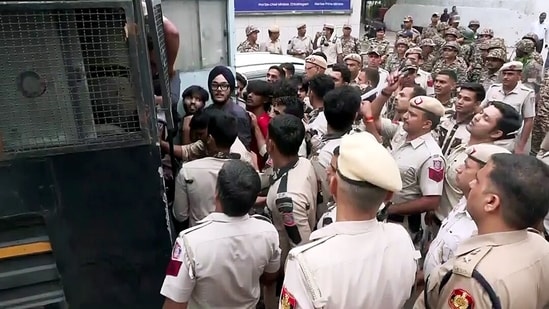
In an affidavit, cops said that the detained leaders were accommodated in police station offices. Track live updates on Delhi protests
The Delhi Police made the claims in a counter-affidavit filed in response to contempt proceedings over alleged non-compliance with the Supreme Court’s directions on regulating public transport during the protest.
Detainees released within few hours, served fresh meals
Deep Dive
How were protesters detained on October 10 treated by Delhi Police?
How long were the October 10 protesters detained?
Why did Delhi Police detain protesters before the October 10 march?
As stated in an earlier HT report, police said the detainees were released within a few hours, before the maximum 24-hour period contemplated under the relevant provisions; they were not lodged in police lock-ups or jails, were provided food and allowed to leave once the circumstances necessitating their removal had ceased.
Defending the move to deny permission for the CJP's anti-CEC protest at Jantar Mantar, Delhi Police commissioner Anurag Kumar reportedly said that people were removed under Section 65 of the Delhi Police Act and Section 172 of the Bharatiya Nagarik Suraksha Sanhita (BNSS) only where Section 163 orders were in force.
{{/usCountry}}Defending the move to deny permission for the CJP's anti-CEC protest at Jantar Mantar, Delhi Police commissioner Anurag Kumar reportedly said that people were removed under Section 65 of the Delhi Police Act and Section 172 of the Bharatiya Nagarik Suraksha Sanhita (BNSS) only where Section 163 orders were in force.
{{/usCountry}}Those removed were kept in "makeshift centres", given "hot, fresh and good meals" and let go within two to six hours, the affidavit adds. Political leaders were seated in SHO chambers and offered “tea, coffee, meals and other refreshments,” the Commissioner was quoted as saying in a Bar and Bench report.
Abhijeet Dipke-led CJP on had called for a protest against the Chief Election Commissioner (CEC) Gyanesh Kumar on October 10 over the alleged SIR irregularities. However, the Delhi Police responded with a mass crackdown, detaining major leaders, including CJP's Dipke, Saurav Das and Abhijeet Ranka. The trio reached Delhi from Mumbai on the morning of October 10 and were picked up from the plane itself by Delhi Police personnel after it landed at the airport.
An estimated 7,000 people were detained, including four former chief ministers, MPs, student activists, social media influencers and civil society members.
Major unrest prevented, says Delhi Police
The Delhi Police has also said the mass detentions ahead of the anti-CEC protest helped avert a ‘major public order situation’, HT reported earlier.
“A major public order situation was averted by timely, proportionate and lawful measures taken by the Delhi Police,” maintained the affidavit.
Commissioner Kumar described the detentions as “proportionate to the legitimate objective of maintaining law and order and preventing harm to persons and property”, adding that the police could not have allowed breach of public order by an organisation with a recent history of ‘mob violence, destruction of properties and incidents causing injuries to several people,’ referring to the Jantar Mantar clashes on July 20 during NEET exam row protests.
The police commissioner described the July 20 march by CJP over the NEET-UG paper leak as “unauthorised, unlawful and illegal”. The police have argued that those participating in the previous march were part of an unlawful assembly, seeking to justify the action taken against the mobilisation on October 10.
The commissioner sought to justify the restrictions by citing what he describes as CJP’s repeated disregard of police directions and the conditions imposed for public demonstrations. The affidavit says the organisation had given a written undertaking for an earlier protest in June, including assurances that the gathering would remain peaceful, would not exceed 1,000 participants and would not turn into a march towards Parliament without prior permission.
The police alleged that the undertaking was subsequently breached and that the organisation later mobilised people for an unauthorised march towards Parliament on July 20. These allegations concerning the July event led to the police’s decision to deny permission for the October 10 mobilisation, according to the affidavit.
(With inputs from Utkarsh Anand, Bar and Bench).