
Nisarga, the deep depression that is currently moving northwards in the Arabian Sea, will hit the Maharashtra coast on Wednesday.
The India Meteorological Department said in its weather outlook on Tuesday morning that Nisarga is expected to become a cyclonic storm on Monday morning and a severe cyclonic storm by 5.30 pm on June 2.
It further said that Nisarga is moving at a speed of 11 kmph. “It lay centred over East-Central Arabian Sea about 280 km west-southwest of Panjim (Goa), 490 km south-southwest of Mumbai (Maharashtra) and 710 km south-southwest of Surat (Gujarat),” said the IMD.
“It is very likely to move nearly northwards during next six hours and recurve north-northeastwards thereafter and cross north Maharashtra and adjoining south Gujarat coast between Harihareshwar (in Maharashtra’s Raigad) and Daman during the afternoon of June 3,” the IMD further said.
The storm is currently packing in winds upto 90-100 kmph. The wind speed is expected to be 105-115 kmph gusting to 125 kmph when it nears landfall. Scientists said that Nisarga could inundate low-lying areas especially in cities like Mumbai and cause structural damage from falling trees and power poles. This has raised concern over how the city, already strained for healthcare resources on account of the Covid-19 pandemic, will cope.
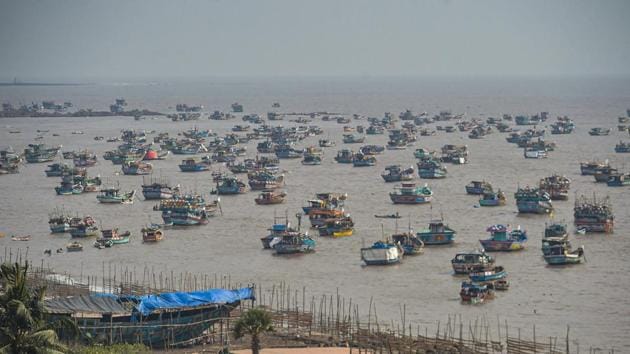
The weather department has advised fishermen to not venture into the southeast Arabian Sea, Lakshadweep area and along and off Kerala coast during next 48 hours.
{{/usCountry}}The weather department has advised fishermen to not venture into the southeast Arabian Sea, Lakshadweep area and along and off Kerala coast during next 48 hours.
{{/usCountry}}Alert has been sounded in Mumbai, its suburban districts, Thane, Palghar, Raigad, Ratnagiri and Sindhudurg districts in view of Nisarga. The IMD on Monday issued a red alert for these districts for June 3 and 4. A red alert - which indicates the possibility of extremely heavy rain of more than 204.5 mm - is a warning for residents to take action and keep safe from adverse impact.
Both Maharashtra and Gujarat governments have ordered people living in low-lying areas on the coastal regions to be evacuated and shifted to safer places.
With the formation of two cyclones - in the Bay of Bengal (Amphan) and Arabian Sea (Nisarga) - within two weeks of each other, scientists warn about the possibility of more pre-monsoon cyclonic storms in coming years due to warmer ocean temperatures.
ABOUT THE AUTHOR
Follow the latest breaking news, major developments and agenda-setting stories from India and around the world with the newsdesk at Hindustan Times. Operating round the clock, the desk brings together experienced editors, reporters and correspondents to deliver fast, accurate and contextual reporting across subjects that influence public policy, governance, business, society and international affairs. The HT News Desk covers politics, elections, government policies, the economy, business and markets, science and technology, the environment, law and order, infrastructure, education, climate issues and geopolitics, while closely tracking developments across states, institutions and global capitals. The team also leads coverage of major breaking news events, policy announcements, court proceedings, natural disasters, public emergencies and significant international developments. Reports published by the newsdesk are based on information gathered from reporters on the ground, official statements, government agencies, court records, regulatory filings, recognised institutions and other authoritative sources. Stories undergo editorial scrutiny and verification processes to ensure accuracy, fairness and relevance, and are updated as events evolve and additional information becomes available. Whether covering a key political decision in New Delhi, an economic policy shift affecting millions, a landmark court ruling or a major global event, the HT News Desk aims to provide readers with reliable, fact-based journalism that delivers not only the latest developments but also the context and analysis needed to understand their wider implications.