
 E-Paper



How welfare schemes and freebies are trumping development issues in Andhra Pradesh polls
Ruling YSRCP and opposition NDA partners are vying to attract voters with promises of freebies, which raises concerns about the financial burden on the state

 Prefer HTon Google


The lack of a defined capital city for Andhra Pradesh, even after 10 years of the bifurcation of the combined state, failure to complete the Polavaram irrigation project on the Godavari river, inadequate infrastructure and power supply, a lack of drinking water, hefty power bills and rising prices of essential commodities are some of the issues the people of the southern state have to deal with.
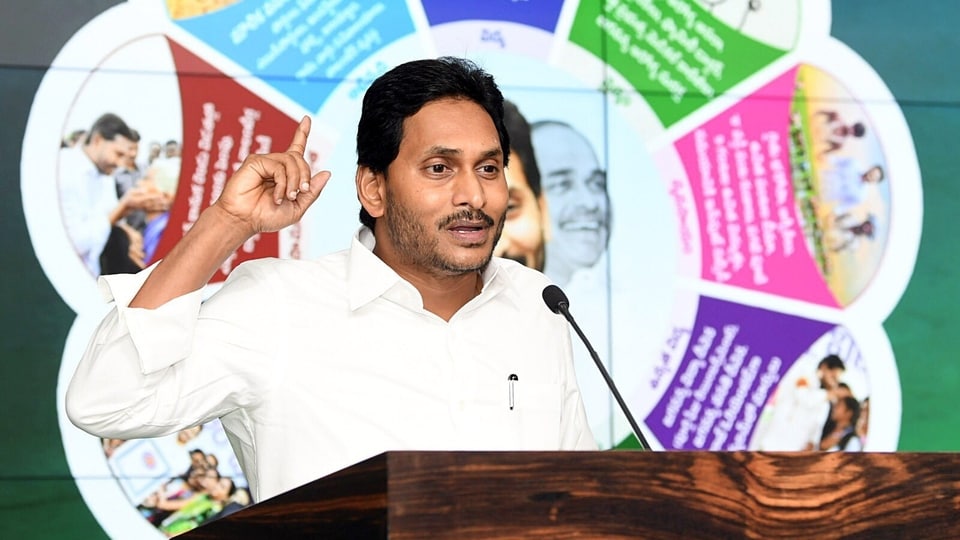
However, none of these seems to be a major issue in the state assembly and Lok Sabha elections in Andhra Pradesh, both scheduled to be held on May 13.
Major political parties – the ruling YSR Congress party headed by chief minister YS Jagan Mohan Reddy, the National Democratic Alliance (NDA) partners comprising the Telugu Desam Party (TDP), the Jana Sena Party and the Bharatiya Janata Party (BJP) – seem more focused on influencing voters with freebies under welfare schemes.
This is evident from the election manifestos recently released by the Yuvajana Sramika Rythu Congress Party (YSRCP) as well as the NDA. Both the YSRCP and the NDA vied with each other in attracting different sections of people with their welfare schemes, seemingly without assessing the impact on the state exchequer.
YS Jagan Mohan Reddy, a trendsetter in welfare schemes
During the 2019 general elections, Jagan Mohan Reddy came up with a manifesto with a nine-point welfare agenda, in the name of Nava Ratnalu (nine jewels) – a package of nine welfare schemes aimed at different sections of people.
They include YSR Rythu Bharosa, under which each small farmer would get financial assistance of ₹13,500 per annum in three instalments; Jagananna Vidya Deevena, which assured that school fees will be reimbursed to students from below-poverty-level (BPL) families; Jagananna Amma Vodi, under which an amount of ₹15,000 would be deposited in the bank account of mothers who send their children to schools; YSR Arogyasri, through which free healthcare would be provided to BPL families whose hospital bills crosses ₹1,000; YSR Jala Kala under which the government digs borewells for free benefiting over three lakh farmers hailing from BPL families.
Other assurances included the prohibition of liquor in a phased manner; YSR Aasara and YSR Cheyutha, under which zero-interest loans would be provided to women belonging to self-help groups and financial benefit of ₹75,000 over four years to women from weaker sections in the age group of 45-60 years; and YSR Pension Kanuka, under which senior citizens, differently-abled people and transgenders would be given pensions up to ₹3,000 per month.
The Nava Ratnalu agenda was a major attraction for the weaker sections, particularly women as the majority of these schemes were women-centric.
TDP president and former chief minister N Chandrababu Naidu could not match up to Reddy's welfare agenda. Though he tried to influence women voters with schemes like “Pasupu Kumkuma” by offering a sop of ₹10,000 to them, it did not work.
The Pasupu Kumkuma scheme did not work for Naidu because it was announced a few weeks before the 2019 elections and the TDP could not convince the beneficiaries that it was a genuine scheme and not just aimed at wooing them before the elections. By that time, Reddy's schemes have already gone into the people extensively; so, the womenfolk did not get attracted to Naidu's scheme.
Naidu lost the 2019 elections – the TDP could secure just 23 seats in the 175-member assembly and three out of the total 25 Lok Sabha seats in the state. Reddy came to power with a huge mandate, winning 151 assembly seats and 22 Lok Sabha seats.
Since then, Reddy has focussed mostly on implementing his Nava Ratnalu schemes with an eye on building a strong vote bank among weaker sections, farmers and women.
“Perhaps Reddy is the only chief minister who, right from day one of assuming power, began working out strategies of winning the next election five years down the line,” said political analyst and author Ramesh Kandula.
Reddy did not pay much attention to industrial and infrastructure development, employment generation programmes and the creation of assets that would generate wealth, Kandula said.
“The schemes that he had announced were not new – pensions, housing, loans to self-help group women, fee reimbursement and free health care to the poor, have been there for several years. Jagan only streamlined and systematised them, so that the financial benefits reached the beneficiaries through direct benefit transfer (DBT) methods without the involvement of middlemen. He ensured huge publicity for implementing the schemes by releasing the money with a click of a mouse every month. That fetched him huge mileage,” he added.
YSR Congress Party and NDA partners manifestos heat up poll contest
On April 26, Reddy released his manifesto for this year’s assembly and Lok Sabha elections. The new manifesto did not list new schemes but proposed enhanced financial assistance to beneficiaries under certain Nava Ratnalu schemes.
For example, under YSR Pension Kanuka, the social security pensions would be increased from ₹3,000 to ₹3,500 per month in two instalments over the next five years. Similarly, the financial assistance being given to mothers under the Jagananna Ammavadi scheme would be increased from ₹15,000 to ₹17,000 per year, the new manifesto said.
“We have successfully implemented 99% of the promises made in the 2019 manifesto. We've deposited ₹2.68 lakh crore directly into beneficiaries' accounts through DBT (direct benefit transfer) and ₹1.78 lakh crore through non-DBT methods. We've allocated ₹26,067 crore for the AmmaVodi scheme, ₹4275 crore to the Jagananna Vasati Devena, ₹12,609 crore to the Jagananna Vidya Deevena, and ₹34,378 crore to YSR Rythu Bharosa,” Reddy claimed.
However, Naidu dismissed Reddy’s manifesto. “His Nava Ratnalu schemes are merely Nava Mosalu (nine deceptions). He claims to have implemented 99% of his promises made in the manifesto, but has there been any tangible change in the lives of the people? Instead, people have been plunged into debt,” Naidu said.
On April 30, Naidu, along with Jana Sena Party president Pawan Kalyan and the BJP in-charge of elections in Andhra Pradesh, Siddharth Nath Singh, released the manifesto of NDA allies for the next week’s elections.
As claimed by Naidu, the manifesto was essentially an amalgamation of promises made by the TDP under the banner of “Super Six” and Jana Sena under "Shanmukha Vyuham” (six-pronged strategy).
The BJP said it had no role in the manifesto, as it was prepared by the TDP and Jana Sena much before the BJP joined the alliance. “The manifesto, however, has the support of the BJP,” Singh said.
While talking about the creation of two million jobs and the establishment of skill institutes to provide job-oriented training to the youth, Naidu also sought to attract voters with a large number of freebies. Expressing reservations over his welfare schemes, Kandula said, “Naidu appears to have gone overboard in announcing freebies in an attempt to outsmart Reddy."
Meanwhile, the NDA manifesto made a number of other promises including payment of an unemployment allowance of ₹3,000 per month to each jobless youth, ₹1,500 per month to each poor woman, free bus travel for women in state-run RTC buses, three free gas cylinders to every poor household, financial assistance of ₹15,000 to every mother sending their children to school under the Thalliki Vandhanam scheme,
Financial pressure due to welfare schemes
Whether it is Reddy's Nava Ratnalu scheme or Naidu’s Super Six schemes, freebies are going to be a huge burden on the state exchequer.
“In the last five years, Reddy had to borrow thousands of crores to implement his welfare schemes, at the cost of developmental works. Going by the enhancement of the financial assistance in the present manifesto, the debt burden would be much higher,” said political analyst Suresh Dharur.
According to BJP spokesperson Lanka Dinakar, the Reddy government made off-budget borrowings, to the extent of ₹13.50 lakh crore in the last five years. “The entire money was spent on freebies in the name of welfare, but not on development, asset creation and wealth generation,” Dinakar said.
Special secretary in the CMO, Krishna Duvvuri, however, said the total outstanding borrowings of the state government and the public sector undertakings stood at ₹6.38 lakh crore. “The borrowings are well within the limits of the state government,” he said.
Naidu, at a recent public meeting, also made a similar allegation. He said Reddy borrowed over ₹13 lakh crore. “He is saying that he distributed ₹2.75 lakh crores to people through DBT schemes. What happened to the remaining amount? Where did he spend? People have to repay these debts after Jagan loses power in the elections," he said.
At a recent public meeting, Reddy said the cost of the welfare schemes was ₹52,700 crore annually, including ₹24,000 crore towards pensions, ₹11,000 crore towards free electricity to farmers, ₹4,400 crore under Arogyasri, ₹6,500 crore under Amma Vodi, ₹5,000 crore towards fee reimbursement scheme under Vidya Deevena scheme and ₹2,200 crore towards total nutrition schemes.
“I asked my officials to find out how much Naidu’s latest schemes would cost the exchequer. They told me that it would be around ₹73,440 crore. Besides, Naidu also announced a pension for OBCs that would cost an additional ₹13,872 crores. That means the total cost of Naidu’s schemes would be ₹87,312 crores annually,” Reddy said. “Where would Naidu get this amount from? So, Naidu’s promises are not feasible. Don’t fall into his trap,” Reddy said at the rally.
Retired IAS officer IYR Krishna Rao, who served as chief secretary during the Naidu regime, said the latest manifestoes of Naidu and Pawan Kalyan are wholly impractical.
“If Naidu comes to power and seeks to implement his promises, the state’s economy will collapse completely within six months,” he warned. “Not just Naidu, even Jagan cannot implement some of his promises, as they would cause a huge drain on the state exchequer,” Rao said.
 ABOUT THE AUTHORSrinivasa Rao Apparasu
Srinivasa Rao is Senior Assistant Editor based out of Hyderabad covering developments in Andhra Pradesh and Telangana . He has over three decades of reporting experience.


